Wall Street Journal turns TikTok and podcasts into a new midterm-election listening tool
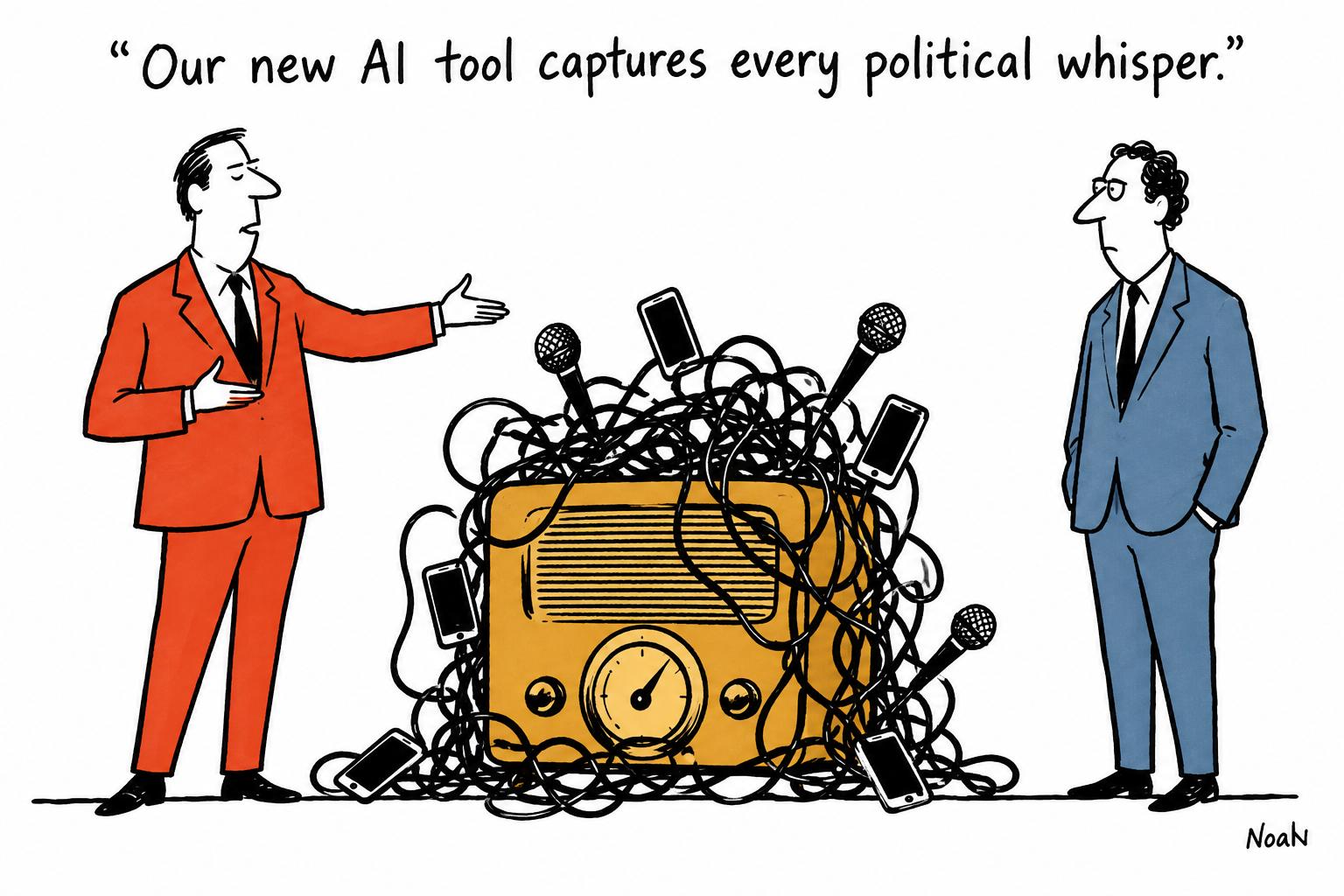
Cartoon · AI-generated
The Journal’s Doppler News AI analyses millions of videos, podcasts and news segments to identify political concerns that conventional polling may miss.
The Wall Street Journal is using a bespoke artificial intelligence system called Doppler News AI to widen its coverage of the 2026 US midterm elections, in a move that reflects both the pressures on traditional polling and the newsroom’s search for new ways to track public sentiment. More than 100 million people are expected to vote in the contest, and the paper says its aim is not to predict the result but to identify the issues, anxieties and arguments shaping political opinion beyond conventional survey data.
According to Nieman Lab, the Journal first used Doppler in a story published in late September and has since fed it an enormous volume of material, including more than 25 million TikTok videos, roughly 500,000 podcast episodes and thousands of Instagram clips and cable news segments. The system is designed to spot patterns across online conversation and to surface subjects that may be missed by polling alone, allowing reporters to map how voters encounter politics through culture, work, money, family and community rather than through campaign messaging alone.
Aja Whitaker-Moore, the Journal’s deputy editor-in-chief, told Nieman Lab that the newsroom wanted to listen more closely to those conversations and treat them as a statistical data set rather than as anecdote. She said the tool helps the paper show readers “here’s what people are talking about. Here are the questions they’re asking. Here are the places where those conversations are happening.” The project grew out of discussions with Washington bureau chief Damian Paletta and politics editor Christopher Matthews, who believed the 2024 election cycle left important undercurrents insufficiently captured by polling.
The Journal’s approach goes beyond the kind of AI-assisted transcription and summarisation that other newsrooms have used to monitor podcasts, school board meetings and local radio. Instead, Doppler is being used to run large-scale analysis quickly, with the findings then turned into publishable reporting. So far, Nieman Lab said, the tool has contributed to four major midterms stories, including an October 8 report on how right-leaning podcasters had begun talking about affordability as often as their left-leaning counterparts, despite President Trump dismissing the affordability crisis as a “hoax”.
Other Doppler-driven stories have examined opposition to AI and surveillance technologies, as well as the relative tone of online discussion about Democratic politicians. One October 1 piece looked at anti-Flock sentiment by analysing more than four million TikTok videos and thousands of hours of podcasts, finding that creators who opposed the cameras disagreed on other political positions at a far higher rate than average. Another story published on October 15 ranked the favourability of commentary around 67 Democratic politicians, placing Florida Senate nominee Angie Nixon highest and Senate Minority Leader Chuck Schumer lowest. The Journal says every Doppler story is accompanied by a short methodology note explaining how the analysis was produced and what its limitations are, while Barry stressed that human judgement remains essential because no model is free from error or ambiguity.
The initiative may eventually reach beyond election coverage. Whitaker-Moore said the newsroom sees potential for Doppler to support reporting across other desks, since the underlying data are not inherently political. For now, though, the Journal is using the system as part of a broader effort to understand the online mood of an election year, and to move past the narrow optics of the horse race.
Inspired by headline at: [1]
Sources by paragraph: - Paragraph 1: - Paragraph 2: - Paragraph 3: - Paragraph 4: - Paragraph 5:
Source: Noah Wire Services · Original