Caribbean newsrooms turn to AI without surrendering editorial control
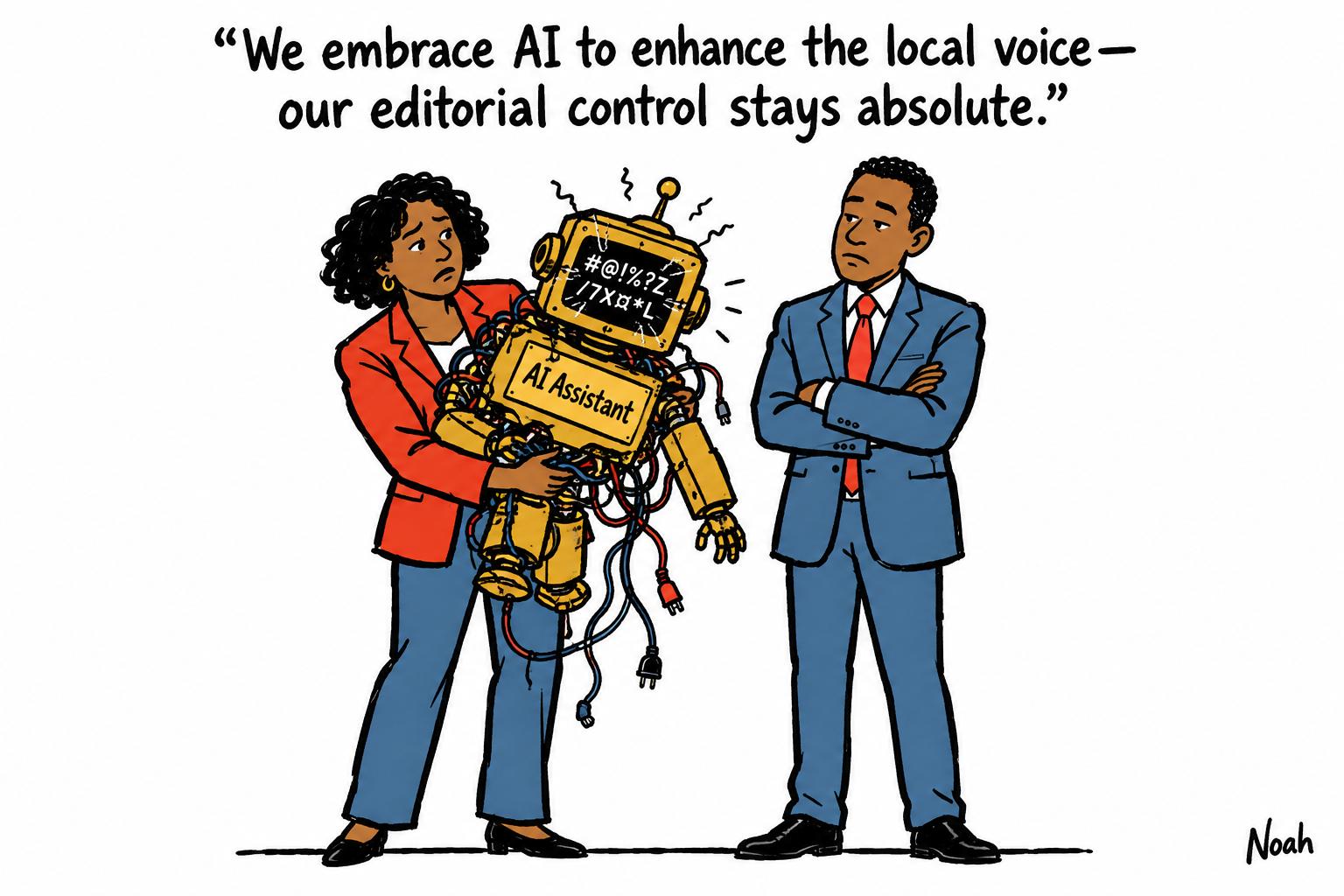
Cartoon · AI-generated
As AI reshapes news production, Caribbean broadcasters are building safeguards to protect local voice, factual accuracy and public trust.
Artificial intelligence is rapidly altering the media business, and for Caribbean newsrooms the shift is as much a cultural test as a technological one. As automated systems become more capable of drafting copy, generating audio and producing convincing imagery, publishers across the region are being pushed to decide how far they can adopt such tools without weakening the distinctive voice, factual discipline and public trust on which journalism depends. The concern is not simply efficiency, but whether a heavily automated media environment could flatten local storytelling and leave communities more vulnerable to manipulated information.
That warning reflects a broader human rights debate already being carried into international forums. At the World Summit on the Information Society in Geneva in July 2025, the UN High Commissioner for Human Rights, Volker Türk, urged governments and technology companies to anchor digital innovation in human rights, warning that rapid technological change can threaten free expression and privacy if it is not properly governed. His remarks underline a central anxiety for media organisations: that the same systems used to improve productivity can also be used to distort reality, amplify disinformation and place commercial logic above the public interest.
For Caribbean broadcasters and publishers, those risks are amplified by structural realities. Regional newsrooms often work in small markets, where trust is fragile, political tensions can be acute and a single false image or fabricated clip can travel quickly through closely connected communities. The problem is compounded by the fact that many major AI systems are trained on global datasets that do not reliably capture Caribbean dialects, histories or social context. In practice, that can produce generic output that misses nuance, or worse, reproduces inaccuracies that undermine the region’s own narrative.
That is why the Caribbean Community has been pressing for a more coordinated approach to digital governance. Its position, as reflected in regional discussions on artificial intelligence, is that digital transformation cannot be left to market forces alone. CARICOM has argued that rules on data, privacy and automated systems are evolving quickly at the global level, often without properly accounting for the realities of Small Island Developing States. The regional preference is for technology policy that strengthens democratic participation, protects cultural specificity and gives Caribbean institutions greater control over how AI is deployed.
The Caribbean Broadcasting Union has taken that argument into the practical realm. Under president Anthony Greene, the organisation devoted its 57th Annual General Assembly in Georgetown to the theme of Caribbean media and artificial intelligence, signalling that regional broadcasters should learn to use the technology rather than simply fear it. The CBU has also moved to build support structures, including an AI hub for member organisations, stricter disclosure expectations for AI-generated material in its awards framework, and partnerships aimed at improving fact-checking and digital literacy. Those measures are intended to help newsrooms adapt without surrendering editorial judgement.
Even so, regional media leaders continue to stress that automation cannot replace the human obligations of journalism. Machines may sort data and speed up production, but they do not possess conscience, local knowledge or a duty of care to audiences. The emerging consensus is that Caribbean newsrooms will need stronger verification standards, clearer rules on synthetic content and more investment in indigenous datasets if they are to train tools that reflect regional speech and experience. The deeper aim is not to resist technology, but to ensure that the public record remains grounded in human accountability.
Inspired by headline at: [1]
Sources by paragraph: - Paragraph 1: [1] - Paragraph 2: [2] - Paragraph 3: [1], [2] - Paragraph 4: [1] - Paragraph 5: [1] - Paragraph 6: [1], [2]
Source: Noah Wire Services · Original