AI can accelerate the newsroom — but only editors can stop a bad story
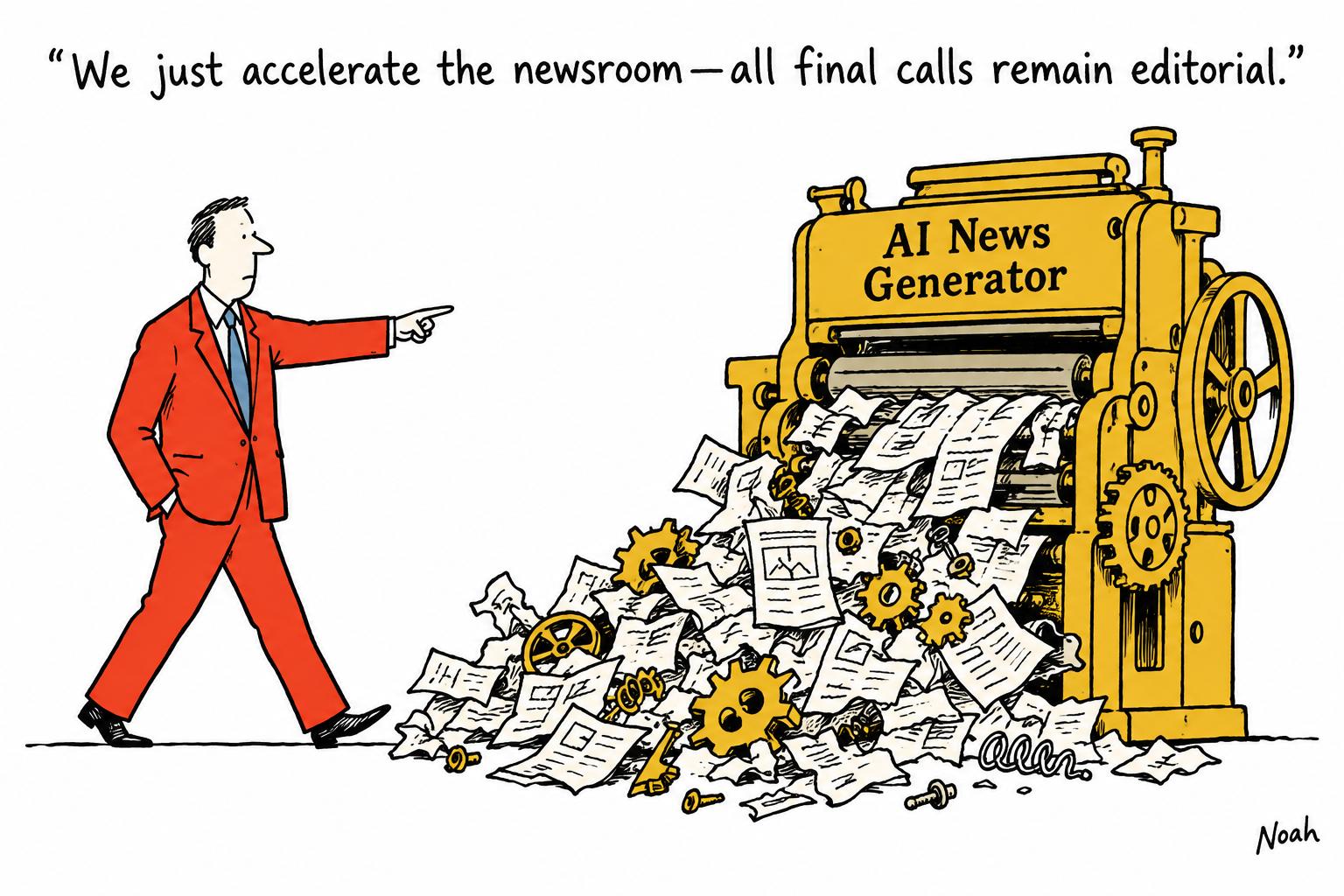
Cartoon · AI-generated
As news organisations automate drafting and source comparison, the decisive editorial skill is increasingly knowing when to pause, verify or reject machine-generated copy.
The speed of online publishing has turned verification into one of the most difficult jobs in modern newsrooms. A breaking story can be copied, paraphrased and embellished across dozens of sites before the first reporter has had time to confirm the basic facts, and corrections often arrive too late to undo the damage. That pressure has made artificial intelligence attractive to editors who need help sorting through fast-moving, incomplete information, yet the technology’s greatest promise also carries its sharpest risk: it can produce prose that sounds authoritative whether or not the underlying facts are sound.
In practice, AI is already doing part of the work many journalists once had to handle alone. It can compare reports, pull out recurring details, suggest a structure and produce a draft in seconds. For small newsrooms in particular, that can be a meaningful gain, especially when a limited staff is expected to monitor multiple sources, prepare copy and keep a constant stream of updates moving. But the same speed that makes the technology useful also makes it dangerous if editors begin treating fluent writing as proof of accuracy.
That tension is central to the experience described by FiNE NEWS, where the editorial team has been building its own automation system and where chief editor Arslan Dzhambulatov is also involved in the development process. The outlet presents the project as a practical attempt to manage routine newsroom tasks rather than a bid to remove journalists from the process altogether. The lesson, as the publication’s account suggests, is that the hardest part is not generating text, but deciding when a story should be paused, checked or rejected.
One of the clearest examples came in October 2026, when the publication’s editorial system stopped a particular item because of a prohibited word rule. On the face of it, that may sound like a minor technical event. Yet it underlines an important distinction between a text generator and an editorial instrument. A generator’s job is to produce output. An editorial tool must also know when not to do so, or when to hand the matter back to a human for review.
That, however, does not make keyword filters a solution to misinformation. A cautious but legitimate report may contain language that trips a rule, while a misleading or fabricated item may pass through without incident. As the FiNE NEWS account makes clear, such controls are meant to support editorial judgement, not replace it. They are a reminder that automation can assist with triage, but not with accountability.
This is also why the wider journalistic debate has moved beyond whether AI can write. According to a comparative study of editorial guidelines published in 2025-26, major media organisations in Russia and abroad are increasingly focusing on transparency, human oversight and limits on publishable AI output. The research points to a common concern across those editorial codes: newsrooms are willing to use automation for routine work, but they are wary of letting it shape published material without a journalist’s intervention.
That caution is echoed in industry behaviour. Muck Rack’s 2026 State of Journalism Report found that 82% of journalists are now using AI tools in their workflows, while 26% named unchecked AI use as a major concern. The same report suggests that journalists are relying less on social media as a reporting source, which implies that newsrooms are trying to become more deliberate about where information comes from even as they adopt more automated tools.
Professional bodies are also responding. The Union of Journalists of Russia is revising its ethics code to address the growing role of artificial intelligence and neural networks in media work, reflecting a broader push to define what should and should not be automated. Similar concerns appear in other studies of generative AI in journalism, which warn about authorship disputes, fabricated interviews and convincing but false visual material. Across those discussions, one theme recurs: the more convincing the output, the more important it becomes to know who checked it.
That concern matters because reader trust remains fragile. The Reuters Institute’s Digital News Report 2026 found that trust in news received through AI chatbots stood at 20%, compared with 37% for news overall. The gap suggests that audiences may be willing to use AI as a convenience, but are not yet ready to treat it as a fully reliable news source. For publishers, that creates a strategic dilemma: a newsroom can chase volume with machines, but it is trust, not throughput, that ultimately sustains a brand.
FiNE NEWS’s internal statistics, as reported by the publication itself, show the scale of experimentation now underway. By 20 October 2026, its central system had recorded more than 16,600 editorial task assignments during its period of use. Yet the figure does not mean that number of published stories. Some assignments were held for review, others ended in different statuses, and the outcome still has to be matched against the actual content that appeared on WordPress. That distinction is important, because volume alone tells us little about editorial quality.
The broader lesson is that AI is likely to make some parts of journalism faster while making the human parts more valuable. Routine drafting, source comparison, translation and document handling may increasingly be automated, but the essentials of the profession remain stubbornly human: checking claims, weighing reliability, deciding what matters and accepting responsibility when something goes wrong. As AI becomes more common in newsrooms, editors may write less, but they will be judged more sharply on the decisions they make about what reaches the public.
Inspired by headline at: [1]
Sources by paragraph: - Paragraph 1: [2], [7] - Paragraph 2: [3], [7] - Paragraph 3: [1] - Paragraph 4: [1] - Paragraph 5: [1] - Paragraph 6: [2], [5] - Paragraph 7: [3], [4] - Paragraph 8: [1], [2] - Paragraph 9: [1], [6]
Source: Noah Wire Services · Original