AI-native newsrooms move from experiment to publication
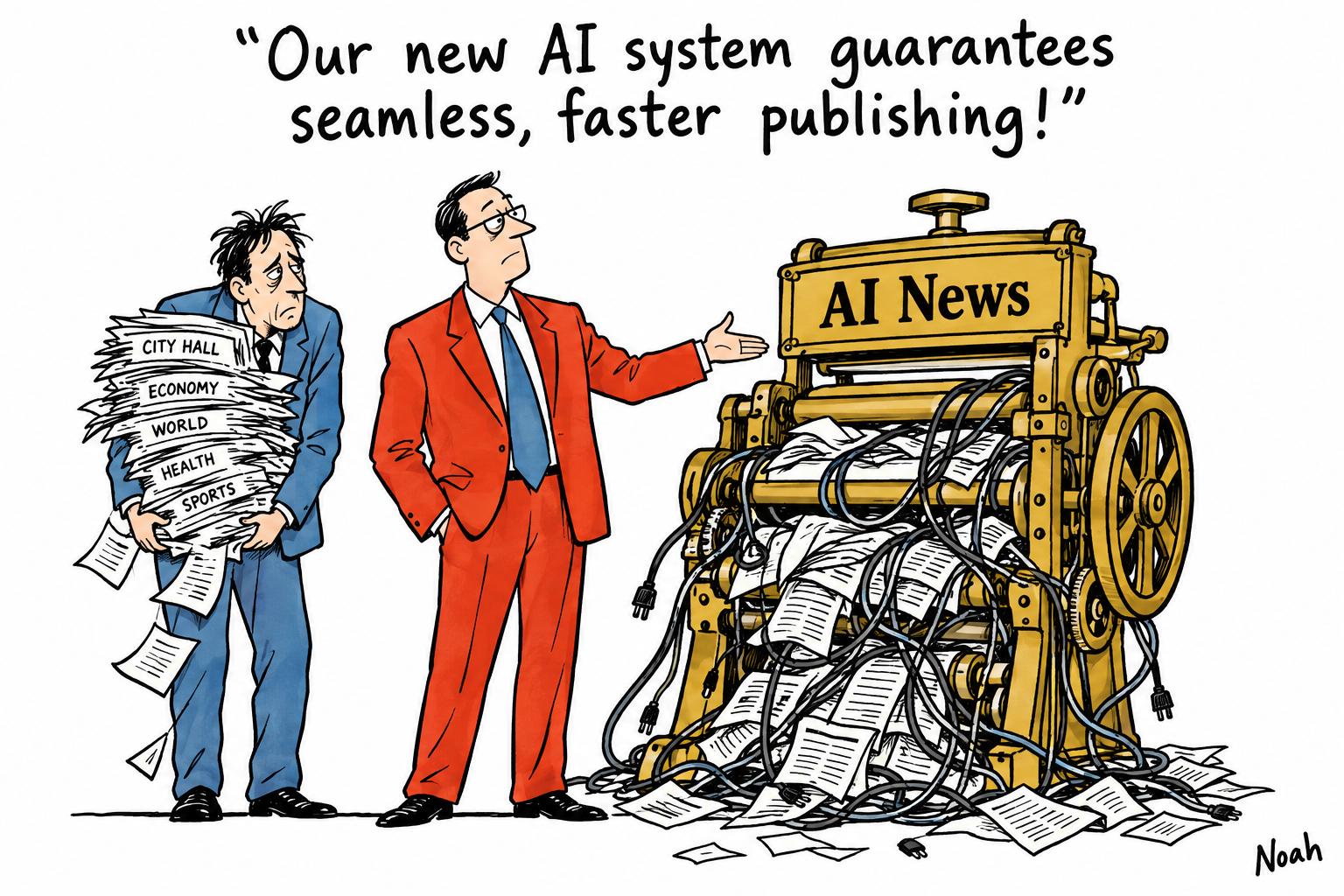
Cartoon · AI-generated
A growing group of outlets is using autonomous AI systems to find, verify and publish stories, promising cheaper coverage while raising fresh questions about accountability and jobs.
For many journalists, the idea of newsrooms run by autonomous software still sounds unsettling. Yet the concept is no longer theoretical. A small but growing number of so-called AI-native outlets are being built around artificial intelligence from the outset, rather than bolting it on to an existing editorial process. According to reporting by The Guardian, BBC News, The New York Times, CNN, Reuters and The Wall Street Journal, these operations are designed to monitor sources, research stories, cross-check information, draft copy and, in some cases, make editorial judgements with only limited human intervention.
The scale remains modest, but it is no longer negligible. Katya Gorchinskaya’s Jindex.ai database, which tracks AI projects in journalism, has logged about 30 such outlets worldwide. What links them is not a single business model but a shared ambition: to automate enough of the routine work of gathering and packaging information that small teams, or even a single person, can publish at speed. The degree of oversight varies sharply, from outlets where every item is reviewed by a human editor to others where machines handle most of the editorial chain.
One of the clearest examples is RuntimeWire, a US-based operation founded by technologist Ryan Merket, which has already demonstrated that an AI newsroom can move quickly enough to beat major competitors to a story. Merket said he spotted a revealing passage in a live transcript from the Black Hat security conference in Las Vegas, fed it into his system and saw a first version published within minutes. He later said the newsroom is built to verify evidence before publication, and that stories are held back if the sourcing is weak or a central fact cannot be established. In his view, the editor is not being removed but relocated into the design of the system itself.
That approach contrasts with Redazione Zero, an Italian general-news outlet built around autonomous multi-agent workflows and almost no human input once the rules are set. Its publisher, Emilio Salmeri, has said he defines the charter and safeguards, but does not pick or approve stories before they go live. The system uses separate AI agents to gather material, another layer to verify it, and a final AI editor to explain the day's coverage decisions. Redazione Zero also imposes hard limits on sensitive topics, including a ban on crime reporting and restrictions on health coverage, while allowing readers to challenge stories and seek a response within 48 hours.
Elsewhere, the motivation is often less ideological than practical. In Croatia, developer Tihomir Jauk created Moj Kraj, or "My area", to fill gaps in hyperlocal coverage by scanning more than 2,000 municipal and district sources alongside broader news feeds. In southern Arizona, veteran journalist Nicholas De Leon built Tucson Daily Brief to cover the everyday details that larger outlets often overlook, such as zoning notices, licence filings and local meetings. De Leon says his outlet uses automation for lower-stakes material, while anything more delicate is reviewed by a human before publication. He has also extended the project into podcasts, social video and search tools, turning what began as a reporting experiment into a broader local information service.
Canada offers perhaps the most conventional newsroom adaptation of the model. After Métro Media collapsed in 2023 and halted more than 30 hyperlocal titles, entrepreneur Pierre-Antoine Fradet acquired the intellectual property for Journal Métro and relaunched it with a single editor, Olivier Robichaud. According to Robichaud, AI is used to scan trusted sources for releases, reports and statistics, producing draft articles that he then checks, contextualises and, where needed, supplements with opposing views. He has described the arrangement as a way of letting technology do the routine work so that a human journalist can focus on the harder reporting that still demands judgement and judgement alone.
The appeal of these projects is clear enough: they promise more coverage, lower costs and a chance to restore local reporting in places where news provision has thinned out. But they also sharpen the uncomfortable questions around error, accountability and employment. Robichaud has acknowledged that AI will probably eliminate some jobs, although he argues that publishers will decide whether to use it as a replacement or as a tool to preserve journalism that would otherwise disappear. De Leon makes a similar point, saying his work is meant to add coverage in places where meetings and local decisions might otherwise pass unnoticed.
Even the most ambitious operators concede that the systems are fallible. Jauk says most of the items his outlet drafts are discarded by automated checks, while Redazione Zero has already issued corrections and tightened its safeguards after mistakes involving outdated information, misread fact-checks and editorial lapses. Salmeri has said the aim is to make each error visible and to ensure it leaves a mark on the machine. Merket, for his part, argues that the future is not a newsroom emptied of people but one in which software handles the repetitive labour and humans are held to a higher standard when it comes to publication, responsibility and trust.
Inspired by headline at: [1]
Sources by paragraph: - Paragraph 1: [2], [3], [4], [5], [6], [7] - Paragraph 2: [1], [2], [3], [4], [5], [6], [7] - Paragraph 3: [1] - Paragraph 4: [1] - Paragraph 5: [1] - Paragraph 6: [1] - Paragraph 7: [1]
Source: Noah Wire Services · Original