News Corp’s newspaper squeeze tests the subscription story
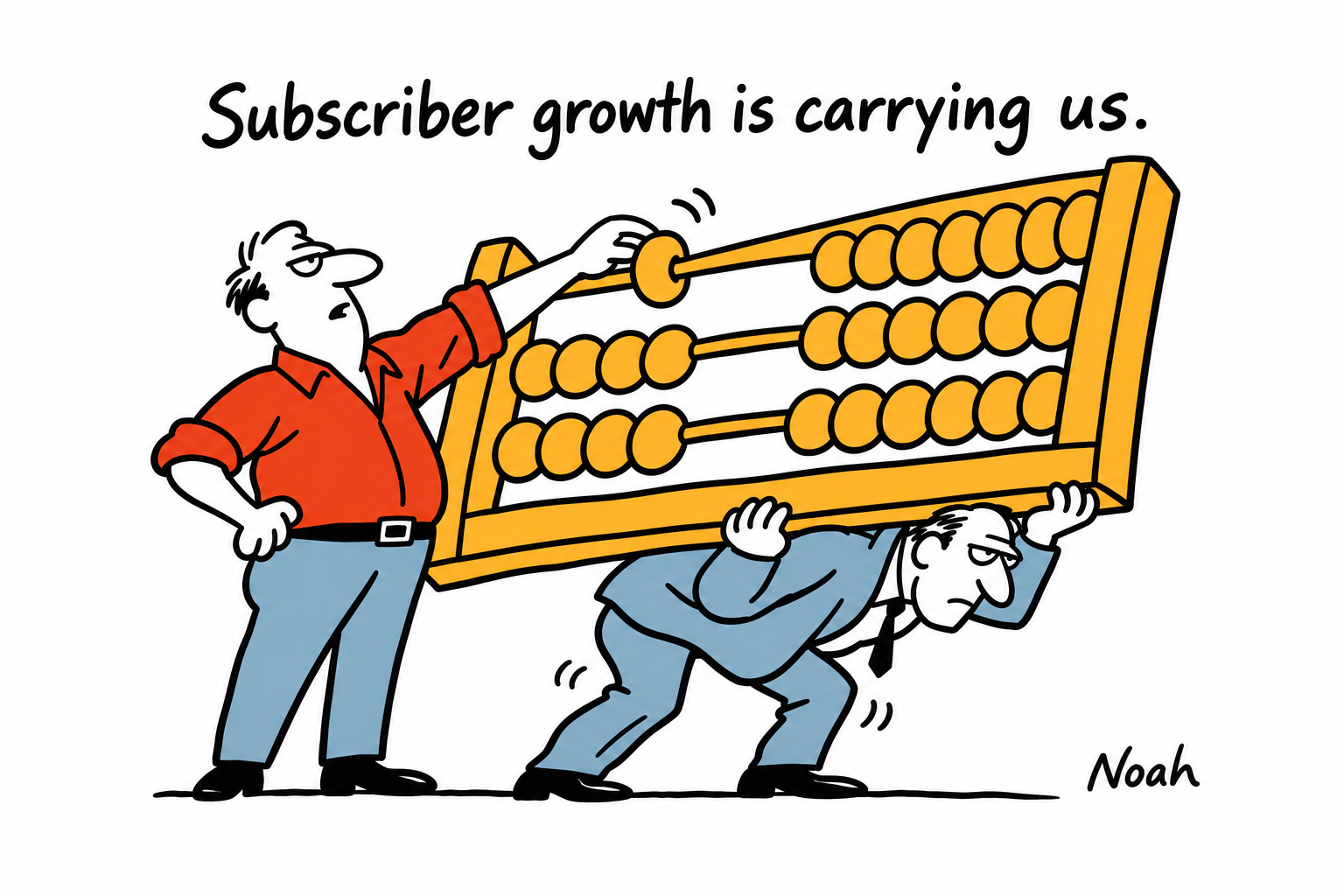
Cartoon · AI-generated
News Corp has added digital subscribers at The Times and The Sunday Times, yet earnings have fallen at their wider division. The contrast is a warning against treating subscription totals as proof of a healthy business. Useful paid products can fund journalism; businesses still carrying declining print income face a harder bill. The investment decision is which customers can be served profitably over time.
For the quarter to 30 September, News Media reported $18 million of segment EBITDA, News Corp’s adjusted operating earnings measure, down 40%. The Times titles, including the Times Literary Supplement, ended September with 686,000 digital subscribers, against 640,000 a year earlier. The division also contains Australian and US operations and broadcasting, so its results do not establish that Times profit fell.
That distinction matters to newsroom budgets. A growing paid audience can support investment without yet offsetting the cost of the wider business. Publishers need evidence of what customers pay, renew and use.
Robert Thomson, News Corp’s chief executive, told investors in the published results announcement that “high quality content is the very essence of AI”. That is an argument for the group’s intellectual property. It is not a disclosed return on each AI agreement, or an explanation of the economics of a newspaper subscriber.
A useful counterexample arrived on the same day. The New York Times Company reported digital-only subscription revenue up 14.6% and operating profit up 16.4%. Paid consumer journalism can grow both sales and earnings. News Corp’s figures are not a verdict against that model.
“Subscriber growth was powered by strong engagement and retention across our portfolio,” Meredith Kopit Levien, the New York Times Company’s president and chief executive, said in its published results statement. That is management’s explanation, not a separately quantified retention study. But the company also reports improving revenue per digital subscriber, giving readers more to assess than a customer count.
Counting the customer
Within News Corp, Dow Jones offers the stronger earnings story. Revenue rose 8% to $630 million and segment EBITDA increased 11% to $160 million. Calculated from those figures, its segment EBITDA margin was about 25%, compared with roughly 3% at News Media. These are broad businesses, not a clean comparison between two newsrooms, and neither margin is net profit.
The Wall Street Journal’s digital-only subscriptions grew 11% to nearly 4.7 million on average during the quarter, with enterprise subscriptions driving growth. Enterprise means an organisation buys access for its staff. That route can put journalism in front of readers through a corporate purchasing decision rather than thousands of separate retail transactions.
It also changes what the headline number means. News Corp reports a quarterly average for the Journal and a closing count for the Times titles. Neither should be read as a directly comparable number of full-price individual customers. Without contract prices, activation and renewal information, the enterprise total is an incomplete account of commercial progress.
Consider a hypothetical organisation paying £20,000 a year for access for 1,000 employees. The contract brings £20 per entitled employee before costs, however impressive the access count looks. It may still be a sound business for both parties. The publisher needs to know whether the organisation renews and what servicing the account costs, while the buyer needs to know whether employees get useful work done.
The same question applies to bundles. Reach launched organisation-wide access to 25 paid titles in October, including the Mirror, Express, Manchester Evening News and WalesOnline. That is a concrete distribution experiment, not yet public proof of attractive contract margins. Selling a broad package and establishing its value are different tasks.
A budget attached to a decision
Dow Jones is also selling products that do more than provide access to articles. Its Risk & Compliance business supplies screening information used to check transactions and counterparties. Its energy business sells pricing data and analysis. The group’s annual report describes professional information products combining reporting, data and tools for enterprise customers.
The commercial attraction is intelligible. A compliance team is buying help with a recurring responsibility. An energy customer may need information for a pricing or purchasing decision. That can give a publisher a clearer claim on a business budget than a promise that a general news subscription will keep employees informed.
Professional customers still have to choose this service over a cheaper alternative. The advantage rests on the quality, timeliness and usability of the information. Maintaining those qualities costs money. A specialist service needs corrections, reliable updating and support, not simply a more expensive login.
London-listed RELX provides another example. Its October update reported nine-month underlying revenue growth of 10% in Legal and 8% in Risk. The company attributes growth to analytics and decision tools, including AI-enabled services. Its figures support the commercial importance of these businesses; they do not isolate how much growth AI itself caused.
Thomson Reuters’ November results make the recurring element more visible: organic recurring revenue grew 8% in the quarter. Its Global Print business is treated as discontinued, with prior-year figures revised to match. That makes the comparison more useful than simply comparing a growth headline with last year’s unrevised business.
The attractive AI proposition here is practical. Better retrieval or screening could help a professional complete a task with less effort. The relevant test is whether it does so reliably enough to justify the price and its running costs. A demonstration that produces fluent answers is several steps short of that evidence.
The specialist label is no shelter
Informa’s latest update supplies a warning against treating professional audiences as an automatic refuge. Informa TechTarget’s nine-month underlying revenue fell 1.6%. The company said enterprise technology customers were prioritising AI investment over product marketing and sales support. A business can serve specialists and still depend on a budget that customers decide to cut.
Informa’s Academic Markets business reported 4% underlying growth, excluding non-recurring data contracts. That exclusion matters: a licensing payment and a renewable customer relationship need not have the same economic life. A publisher presenting a diversification success should make the distinction visible.
These figures cover different periods and use company-specific adjustments. RELX’s underlying measure excludes several effects, including print and print-related activities; Informa separately identifies non-recurring contracts. They cannot be lined up as a simple league table against News Corp’s reported quarterly numbers.
For a general news publisher, the choice is therefore more specific than moving into professional information. Which part of its reporting could help a defined customer make a recurring decision? Does it own or license the material needed? Can it maintain the service at the price customers will actually pay?
What would establish success
Reach illustrates the urgency of getting those answers. Its third-quarter digital revenue fell 20.3%, with indirect revenue falling faster than direct revenue. The company is diversifying while also restructuring. A new subscription product enters a business with existing obligations and costs; it does not arrive on an empty spreadsheet.
The New York Times’ quarter demonstrates what further investment costs. Its operating costs rose 8.5%, including higher journalism, content delivery and subscriber servicing expenses. Revenue growth still outpaced cost growth. That is a more informative account of a subscription business than growth in its audience alone.
For a new paid service, the evidence that would justify further spending is a cohort of customers who renew at an economic price, with a measured contribution after the costs attributable to acquiring and serving them. Early discounts and bundled access may be sensible ways to begin. They become a problem when the growth announcement substitutes for a view of what happens after the introductory offer.
News Corp’s next subscriber announcement will be worth reading. The more revealing disclosure would be what those readers earn the publisher after promotions, renewal and service costs. Until that is visible, a rising total deserves attention rather than a victory lap.
Sources
- News Corp: results for the quarter ended 30 September 2026, released 4 November
- News Corp fiscal 2026 annual report: segment scope and professional information products
- New York Times Company: third-quarter 2026 results and exact quotation
- Reach: corporate subscription bundle across 25 paid titles, 12 October
- Reach: third-quarter trading update, 13 October 2026
- RELX: nine-month trading update and underlying growth definition, 22 October
- Thomson Reuters: third-quarter 2026 results, 3 November
- Informa: nine-month trading update, 27 October 2026
- Research notes, source definitions and claim audit
Source: Tomorrow’s Publisher