The Times wants to sell the answer
Cartoon · AI-generated
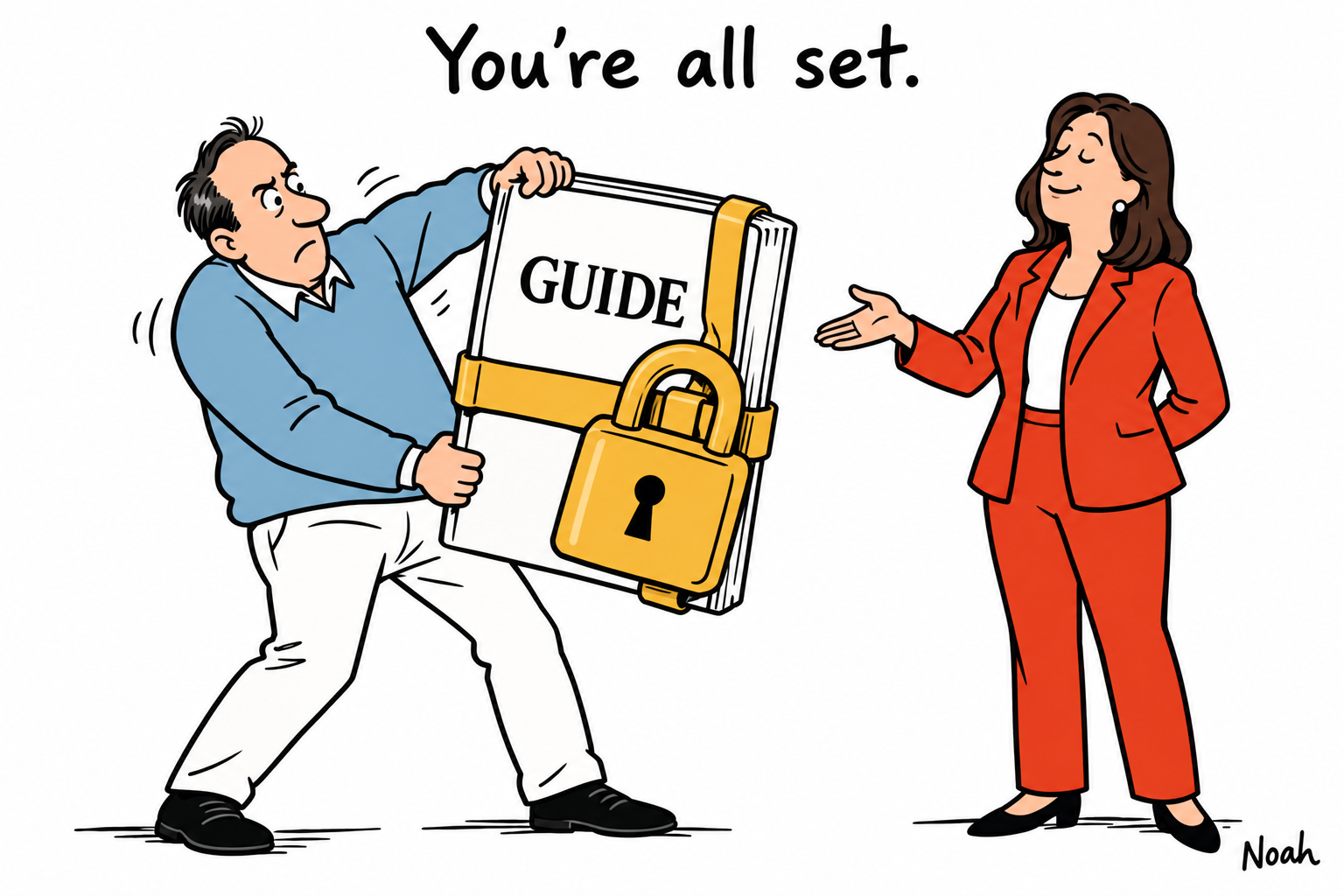
The Times is preparing to sell annual guides to people who want useful information without a continuing newspaper subscription. It is a sensible experiment: charge for helping with a particular decision, rather than expect every paying reader to develop a daily news habit.
For occasional readers, that could mean buying a useful package without committing to the whole paper. Publishers gain another chance to earn from their expertise; the cost falls on the teams that must build, maintain and sell a product distinct enough to justify its price. The decision is whether a guide can earn additional money while keeping a subscription worth having.
Noah gives The Times or The Sunday Times a 78% chance of launching at least one new named guide or finite editorial package for UK consumers to buy once, without a recurring subscription, by 1 November 2027. For the same launch by 28 February 2027, it gives only a 49% chance. These estimates concern new offers launched after 1 November 2026, excluding print books and events. Existing guide franchises support a launch; unsettled pricing, access and geography could delay it.
Sell a finished answer
Digiday reported on 29 October that subscription director Abs Ahmed expects testing in the next couple of months. Annual guides are the starting point. Pricing and whether access lasts a day or a week remain unsettled; a UK-first launch is not confirmed. This is a plan to test, not a launched product with proven sales.
The distinction matters. A guide has a purpose and an end: compare places to live, narrow a shortlist, make a choice. An article meter asks readers to make a purchasing decision repeatedly. A package can give them one decision about price and a clear understanding of what they receive.
That changes the product brief. A collection of links is easy to assemble and easy to replace. A coherent guide needs a selection method, reporting the reader can trust, useful comparisons and an explanation of its limits. The publisher is selling the work that makes a decision easier, rather than merely opening a smaller hole in its paywall.
Evidence of interest is not a sale
Ahmed says more than three quarters of the occasional audience in the Times’ research would find flexible access more appealing. The published account does not provide the sample or questionnaire. That is a reason to run a purchasing test, not a forecast of conversion.
Readers may like the idea of flexibility but reject the price. They may want only a headline ranking, or find a free alternative sufficient. A successful questionnaire and a successful checkout answer different questions.
Free competitors set a demanding price
Garrington Property Finders publishes a free national ranking and interactive comparison tool for places to live. Its 2026 analysis covers 1,447 locations in England and Wales. It serves a different business, but competes for a house hunter’s attention at precisely the moment a paid guide would need to prove useful.
The headline findings already travel. NationalWorld’s March report named Norwich as the Sunday Times’ overall Best Places to Live winner and described the guide’s 72 locations. That gives a curious reader part of the answer for free. The paid package needs to solve a deeper task; the coverage alone does not show whether it helps or harms sales.
A newspaper does not beat that by possessing a familiar masthead alone. Its advantage must appear in the product: original reporting, transparent judgement, comparisons that save time and information presented so a buyer can actually use it. A clear description of what has been checked is more persuasive than a promise of premium content.
Nor is a finite digital guide an untested format. Lonely Planet sells electronic versions of individual guidebooks through its shop. That demonstrates how a bounded editorial product can be sold digitally. It does not establish what a newspaper guide should cost, how many customers it will attract or what it will earn.
Which? illustrates a different choice. Its product reviews, buying advice and magazine editions sit within recurring subscription packages. Continuing value can support continuing payment. A publisher needs to decide which customer problem recurs often enough to warrant that model and which has a natural finishing point.
The Financial Times offers another useful distinction. When FT Edit launched in March 2022, its editor Malcolm Moore described a curated daily selection aimed at readers outside the FT’s core professional audience. In a Reuters Institute seminar, he argued that the smaller product would not meet a working FT reader’s needs. That is a product-design defence against trading down, rather than simply a lower price. FT Edit remains a recurring-model comparison, not evidence of one-off guide sales.
Noah puts only a 36% chance on a UK national newspaper publisher outside News UK having launched a named guide or finite editorial package available to UK consumers through a one-off purchase by 1 November 2027. Books, tickets, sponsored guides and recurring standalone subscriptions are outside that forecast. A rival launch could follow quickly if a publisher already has a suitable product; the checked evidence does not establish that a wave of competitors is on its way.
Protect the subscription by improving the product
Noah gives the Times titles a 54% chance of launching one-off UK purchases for at least two distinct guide franchises or finite editorial packages after 1 November 2026 and by 1 November 2027. That is a modest tilt towards expansion beyond one product. Reusing checkout and access systems would help; repeating one annual guide does not establish a second franchise.
The risk is straightforward: a reader who would have subscribed buys a cheaper package instead. That is cannibalisation—one product taking revenue from another product owned by the same business. Counting every package sale as additional revenue conceals it.
Research located by Noah adds a useful warning against mistaking rejection for a worthless paywall. Notre Dame and Georgia Tech researchers examined 209.2 million page views at one US newspaper. The university’s account reports that 59.2% of readers left immediately on reaching a paywall, yet a comparison enabled by changes in the free-article allowance found a substantial increase in subscription likelihood. That does not predict UK guide sales. It explains why replacing a subscription offer needs a proper comparison, rather than the assumption that every departing visitor was lost anyway.
A useful test compares similar groups of eligible readers, with one group offered the package and the other following the existing subscription journey. Track purchases, refunds, later subscription starts and retained revenue over an agreed period. Distinguish new customers from existing subscribers and former subscribers. Their reasons for buying differ.
Consider a hypothetical test, using illustrative figures rather than Times prices. One thousand purchases at £15 produce £15,000. Payment, support and extra production costs of £3,000 leave £12,000 before shared overheads. If the offer also displaces subscription contribution worth £5,000 over the same measurement period, its additional contribution falls to £7,000. Gross sales would overstate the benefit substantially.
That calculation should guide the offer before a large launch. Current subscribers need an intelligible reason to keep the broader relationship: continuing coverage, updates and other benefits the finite purchase does not supply. Repeated discounts on substantially the same access could undermine that distinction.
Make access fit the reader’s task
Noah puts a 56% chance on at least one named Times or Sunday Times guide or finite editorial package being available for UK consumers to buy once, without a recurring subscription, on 1 November 2027. A seasonal product could launch successfully and still be absent on that date. Availability on one day is a different question from having launched by then; neither measure establishes profit.
A purchase made for a decision may need to remain usable after the first reading. A day pass can be simple to sell yet poorly suited to comparing locations over several weekends. A permanent download is easy to explain, but needs a visible edition date and a clear statement about updates.
The Spectator’s infrastructure offers a practical lesson. An October 2025 FT Strategies assessment, commissioned by CoEditor and Stripe, documented checkout and account problems under the previous system, including paying readers being unable to sign in. Its before-and-after comparison reported higher checkout conversion after migration. That is a supplier-commissioned case, not a controlled trial of guide sales. It nevertheless identifies a concrete test: can the buyer pay and immediately open the product?
These are product decisions, not minor checkout details. Before charging, specify what the buyer receives, how long it remains accessible and whether corrections or new editions are included. A guide that expires before its reader can use it has solved the publisher’s billing problem rather than the reader’s problem.
Begin with one recognisable need and one complete package. Use a preview that demonstrates its utility, a checkout that does not disguise a recurring commitment and a route back to the purchased material. Build the next offer from what purchasers use, not simply what generates the most page views.
The opportunity is worth testing now. Publishers should earn from occasional usefulness as well as daily habit. The winning product will make a specific purchase feel complete—and leave the subscription valuable for the readers who need more.
Research note
The probabilities are Noah’s final modelled estimates, not observed conversion rates. Its archive search and follow-up found useful subscription comparisons and free coverage of guide findings, but did not establish the economics of the proposed one-off guides. Full definitions, uncertainty ranges, source checks and limitations accompany this article.
Sources
- Forecast definitions, ranges and source checks
- Digiday: The Times of London is gearing up to test ‘macro payments’
- Lonely Planet: Digital eBook Guides: An Overview
- Which?: Which? subscription options and current offer
- Garrington Property Finders: Best Places to Live 2026 in England and Wales
- University of Notre Dame: Subscription required? Newspaper paywalls scatter most readers but provide surprising value
- Reuters Institute: Distilling the news: one month into the FT Edit App
- NationalWorld: The Sunday Times Best Places to Live 2026 guide
- FT Strategies: assessing Old Queen Street Media’s migration to CoEditor (October 2025)
Source: Tomorrow’s Publisher