Mail Metro Media makes fewer competing ads a product worth selling
Cartoon · AI-generated
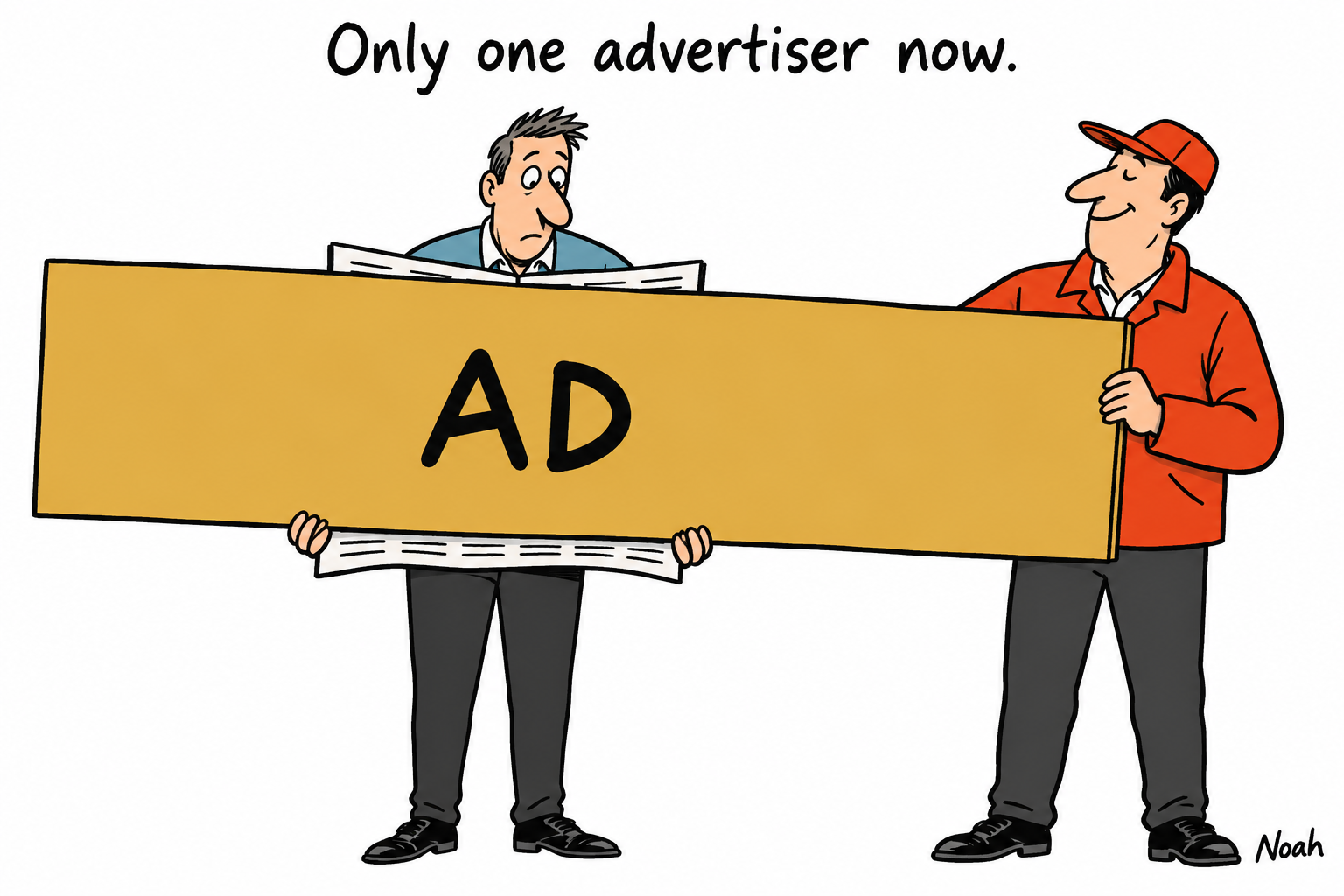
Mail Metro Media is offering an advertiser all the advertising around a mobile article. The attraction is straightforward: one brand can develop its message without competing brands repeatedly demanding the reader’s attention.
StoryFlow, announced on 22 October, makes that exclusivity into a product. It is a sensible direction for publishers to test. Advertisers gain a more coherent canvas; readers may encounter fewer competing messages; the publisher gains something more distinctive to sell. The cost is the ordinary advertising displaced, plus the work needed to produce the campaign. Those costs belong in the price.
The useful management decision is to reserve a small, clearly defined allocation of pages for this experience and test the complete proposition. A commercial team should be selling a reason to choose the publication, rather than finding another rectangle to fill.
One advertiser can still make several appearances
The specification is more revealing than the launch language. StoryFlow comprises a sticky banner, an advertisement revealed as the reader scrolls, and another sticky banner afterwards. One advertiser gets several connected moments within the page.
That can make an advertising story easier to follow. It also means that one advertiser does not equal one small advert—or an advertising-free reading experience. Fewer competing brands and less interruption are different design objectives. A publisher needs to test both.
Norway’s Aller Media makes the distinction particularly clear. Its exclusive mobile takeover combines an expandable bottom banner with repeated advertisements inside an article—up to eight of the latter, depending on article length. Exclusivity can organise the advertising around one brand while still occupying plenty of the reader’s screen.
Mail’s specifications require animated or interactive advertising to be built by its own team, with a maximum duration of 15 seconds and a 3 MB size limit. Advertising must remain visually distinct from editorial. These are useful clues to what the publisher is selling: controlled production and a designed experience, alongside access to readers.
For a smaller publisher, the transferable idea is the package. A specialist audience, a suitable advertiser and a clear commercial message may justify reserving the page. The proposal should explain the benefit to that audience as clearly as it explains the benefit to the buyer.
The research gives the sales team something useful
Mail reports a 1% average click-through rate and four seconds of attention per view in early StoryFlow campaigns. Those are encouraging seller-reported results. Its launch account does not disclose enough campaign and sample detail to establish the likely result for every advertiser, or the publisher’s net financial return.
There is more substantial background in Mail Metro Media and Lumen’s earlier Centre for Attention research, published in July with supporting partner Havas Media Network UK. The study used simulated Daily Mail layouts, with 400 regular readers on desktop and 400 on mobile, testing eight brands.
Premium layouts carried up to five ads on desktop and three on mobile, against up to 15 in the comparison layouts. The overall results included 1.6 times the attention and 2.4 times spontaneous recall. The larger 4.2-times recall result belongs to an Ocado example; it is not the study-wide benchmark.
The experiment changed the mix of formats as well as the number of ads. It supports the case for a better-designed advertising environment, rather than proving that removing a particular number of slots will produce a fixed financial gain. That is a strong enough reason to run a live commercial test.
The pitch should connect creative, context and outcome. A buyer launching a product needs people to remember the right message. An advertiser seeking enquiries needs a useful destination after the click. More seconds help only if the advertisement uses them well.
Exclusivity is established. Delivery is the useful test.
This is not the invention of the takeover. Reach described one-advertiser news-page takeovers in 2019. The Telegraph’s current specifications include mobile and offer 100% share of voice across a page or channel. Mail’s opportunity is to turn a familiar commercial mechanism into a more persuasive mobile product.
Noah puts the chance at only 48% by 30 April 2027, rising to 62% by 30 October 2027, that at least two of Reach, News UK, Guardian Media Group, Telegraph Media Group and The Independent’s publisher will each have delivered a UK mobile article-page campaign giving one advertiser every display-ad placement and suppressing competing display ads.
These are estimates of delivered campaigns under that specific definition, not predictions of first invention or proof that those groups have adopted StoryFlow. Existing takeover infrastructure makes delivery plausible; the unresolved step is turning an available format into a campaign that meets the whole brief.
For publishers, a distinctive proposition needs more than an exclusive booking. The creative should work across the sequence, the page should remain usable, and the buyer should understand what success looks like. Otherwise the commercial team has renamed a takeover without improving the product.
An attention promise is a bigger commercial step
There is already a different way to sell the benefit. Sweden’s SeenThis announced guaranteed attention buying in June, with measurement by Lumen. Its offer includes buying against attentive impressions or the cost of an attentive second.
That creates a useful comparison. Mail is packaging an environment; SeenThis is offering a defined attention outcome. A publisher considering the latter needs to know who measures it, what counts and what happens when delivery falls short.
Noah gives only a 44% chance that, by 30 October 2027, at least two UK national news publisher groups will each have delivered a premium mobile campaign sold with a contractual attention target or guarantee backed by independent measurement. Reporting attention afterwards does not meet that benchmark.
The practical implication is to build the evidence before making the promise. The IAB and Media Rating Council’s framework distinguishes approaches including data signals, eye tracking and panel or survey methods. Attention measures add information about whether an advert was noticed; they do not replace measures of sales or other business outcomes.
Advertisers are being offered stronger proof elsewhere too. Tesco Media said in October that it planned to expand measurement of additional sales attributable to advertising across five channels over the following six months. That is a plan, not an achieved result. It illustrates the question news publishers must answer: what does the buyer gain from choosing this environment?
Price the complete experience
A premium rate can be overwhelmed by unsold capacity. In a hypothetical example, two sold advertisements each earn £2 per thousand page views, producing £4 in total. An exclusive package priced at £5 per thousand page views but sold on only 80% of eligible pages also produces £4, before fees and production costs. These are illustrative figures, not Mail’s prices.
That is why a pilot should follow the money through the whole page. Include the advertising displaced, the proportion of the reserved pages actually sold, creative production, measurement charges and the reader’s response. Mail’s premium-experience sales material advertises a 25% price premium and discusses additional measurement costs; an advertised offer is not a realised profit margin.
Noah puts the chance of a qualifying independent public study at only 15% by 30 October 2027: it would need to compare live UK StoryFlow campaigns with ordinary multi-ad mobile article pages and report both advertiser attention or recall and publisher net advertising revenue per page view or session. That is a forecast about evidence being published, not an 85% probability that the product fails.
Publishers should not wait for that study to test their own proposition. Set the price and the scope of the pilot, show the advertiser what improves, and expand when the complete experience earns its place. The valuable product is an attentive reader encountering a relevant message in a publication worth returning to. Protect that experience and sell it properly.
Research note: Forecasts are Noah’s modelled estimates. One additional estimate was excluded after a failed final review left an unresolved launch-status assumption. Full definitions, ranges and source checks are linked below.
Sources
- Forecast definitions, ranges and source checks
- Mail Metro Media launches StoryFlow
- StoryFlow format specifications
- Centre for Attention: The Premium Edition
- Mail Metro Media and Lumen research finds fewer ads drive greater attention
- Centre for Attention interactive premium experience summary
- SeenThis launches SeenThis Attention for digital video
- Attention measurement: the industry framework
- Telegraph: Standard display takeover specifications
- Reach: Take advantage of takeovers
- Tesco Media: New capabilities turn customer understanding into growth
- Aller Media: Mobile Takeover specifications
Source: Tomorrow’s Publisher