Black Ballad turns a beauty panel into repeat business
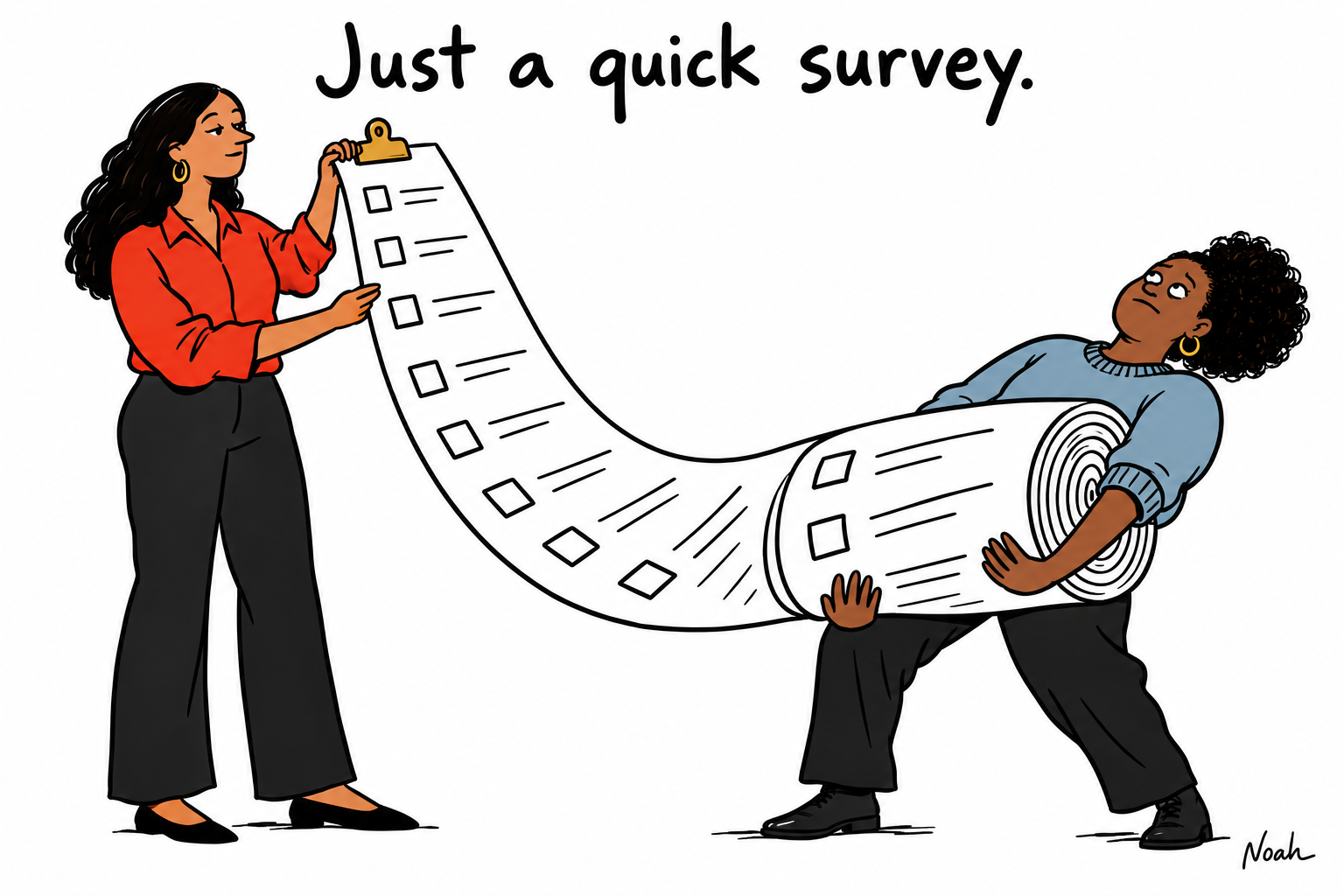
Cartoon · AI-generated
Black Ballad is turning beauty-product testing and reader feedback into paid research, brand partnerships and events. Its commercial progress gives publishers a concrete way to build a business around knowing a particular community well.
Through its Beauty Council, brands can hear Black women’s experiences directly. Readers get products, experiences and a chance to influence businesses that serve them. Brands get more useful evidence; the publisher gets paid work. The demanding part is organising that exchange repeatedly, without treating the community as a free research department.
The opportunity deserves a focused commercial test. A publisher should identify a recurring customer decision, recruit willing participants and price the work of answering it. A database is a starting resource. It becomes a business when the answer is useful enough for someone to buy again.
A new commission is a credible next step
Noah gives the Beauty Council a 70% chance of completing at least one new research commission for an external organisation between 1 November 2026 and 30 April 2027. The estimate rises to 80% by 31 October 2027, using the same starting date.
The existing panel, research offer and partner experience support further delivery. A proposal or event-only sponsorship does not meet that benchmark. The client could be new or returning; a completed commission would not, by itself, establish profitable recurring revenue.
Co-founder Bola Awoniyi’s December 2025 account for the News Product Alliance describes broad surveys that produced editorial opportunities but disappointing commercial results. Buyers wanted deeper category knowledge and evidence that could be refreshed. The subsequent Beauty Council had more than 400 participants and generated monthly revenue.
He reported 14 deals across insights, media and events in 2025, with beauty revenue up 150% on the previous year. Those are company-reported commercial results; the account does not establish the margin on those deals. They nevertheless describe actual work bought, a more useful starting point than the size of a dataset.
The current founder site lists more than 500 Beauty Council panellists—people recruited to take part in research. That is a later snapshot of the community, rather than a comparable measure of active responses to every project.
The council’s public offer includes product testing, surveys, focus groups and events. In ordinary terms, a brand can learn why a product disappoints, what a customer needs and which changes deserve testing. The publisher supplies access, organisation and interpretation.
A buyer’s problem gives the research a shape
The wider publishing industry already uses reader panels. Bauer describes an opt-in community drawn from its brands and uses research to inform campaigns. Immediate’s July Joy Advantage study combined its own Insiders panel with a nationally representative sample, surveying 2,095 people in April.
This is an established publisher capability. In 2014, InPublishing quoted Immediate and its client Silver Spoon describing a delivered, multi-stage research project that included a bespoke audience panel and product testing. Black Ballad’s significance is the focused community it serves and the way it organises the exchange, rather than inventing publisher research.
These are different ways to use audience knowledge. Research may help a publisher sell advertising, improve its own products or deliver a separate service to a client. A valuable panel does not establish that all three are profitable businesses.
A specialist publisher considering the last option should ask a prospective buyer which decision is difficult today. A gardening audience might help a supplier understand why instructions fail beginners. A professional title might investigate an obstacle to adopting a tool. These are hypothetical examples: the product needs a defined user, a decision and an answer that can change what the buyer does.
Awoniyi gives a pointed example: dating was Black Ballad’s most-read topic in 2025, but falling spending by dating apps on reaching Black audiences meant it failed the commercial test. Reader interest and a buyer’s research budget can point in different directions.
Start with the commercial question before commissioning a questionnaire. An interesting editorial topic can deserve coverage even when nobody wants to sponsor research about it. Preserve that distinction when allocating time.
Keep the reader’s reason to return
Black Ballad’s model extends beyond research. In her October interview with Media Voices, founder Tobi Oredein described audience listening as a guide to events and brand partnerships. The Weekender’s official 2026 offer linked membership to ticket savings and promoted sessions, shopping and activities.
The connection is practical: an event can make the benefits of belonging visible. It also brings its own bills, including venue, production and staffing. Ticket demand should be assessed separately from the hope that attendees will renew a membership or buy a partner’s products.
Oredein’s current website reports that Garnier usage within the Black Ballad community rose from 4% to 20% over its partnership. The published account does not provide the sample or a control group. Treat it as a company-reported community result, not a fivefold increase in national market share or a proven advertising effect.
The useful editorial question is what the participant gains. Product feedback should have a route back to the people supplying it: what was learned, what changed, and which request is worth their time next.
Sell the limits as clearly as the insight
A self-selected community is particularly useful for hearing experiences a general survey may miss. It does not automatically represent every member of a population. A strong commercial report says who took part, how they were recruited, when they answered and what the findings can support.
That distinction is good product design. Understanding why some customers dislike a product is a different task from estimating the proportion of all customers who dislike it. The first may inform a redesign; the second needs a sampling approach suitable for that population.
Trust also depends on explaining the relationship with the buyer. Participants should understand the purpose of the exercise and what will be shared. Research clients should receive findings with their limitations. Paid research and brand-funded content should remain distinguishable from the newsroom’s independent judgements.
Build the offer around the work required: recruitment, participant rewards, research design, analysis, account handling and the next round of questions. A repeat invoice is useful only if the publisher can deliver it without exhausting its staff or the community.
Consider a hypothetical £6,000 project. Eight staff days costed at £350 total £2,800; £1,000 of participant rewards and £500 of other delivery costs leave £1,700 before shared overheads. Those are illustrative figures, not Black Ballad’s prices. More recruitment or client revisions could quickly consume that remainder. The next sale needs a repeatable process as well as a willing buyer.
Black Ballad’s example supports a direct recommendation: test a small, specific research service with a real buyer and a willing community. Expand when the buyer returns, the participants see value and the work earns its cost. Knowing readers properly is an editorial strength. Turning that knowledge into repeat business takes a product of its own.
Research note
The two probabilities above are Noah’s final modelled estimates. A separate Weekender forecast returned no number after a validation failure. Two other estimates were excluded because of unresolved scope issues. Full definitions, ranges, exclusions and source checks accompany this article.
Sources
- Forecast definitions, ranges and source checks
- Media Voices: How data drives membership, events and brand partnerships at Black Ballad
- Bola Awoniyi: Black Ballad’s three-step test for turning audience data into commercial opportunities
- Black Ballad Beauty Council
- Tobi Oredein: Black Ballad, Weekender and Garnier case study
- Black Ballad Weekender 2026
- About Black Ballad
- Bauer Media: Research & Insight
- Immediate research links a joyful mindset to advocacy and spend
- Immediate Insiders: historical client research with Silver Spoon
Source: Tomorrow’s Publisher