AI-native newsrooms draw the line between automation and accountability
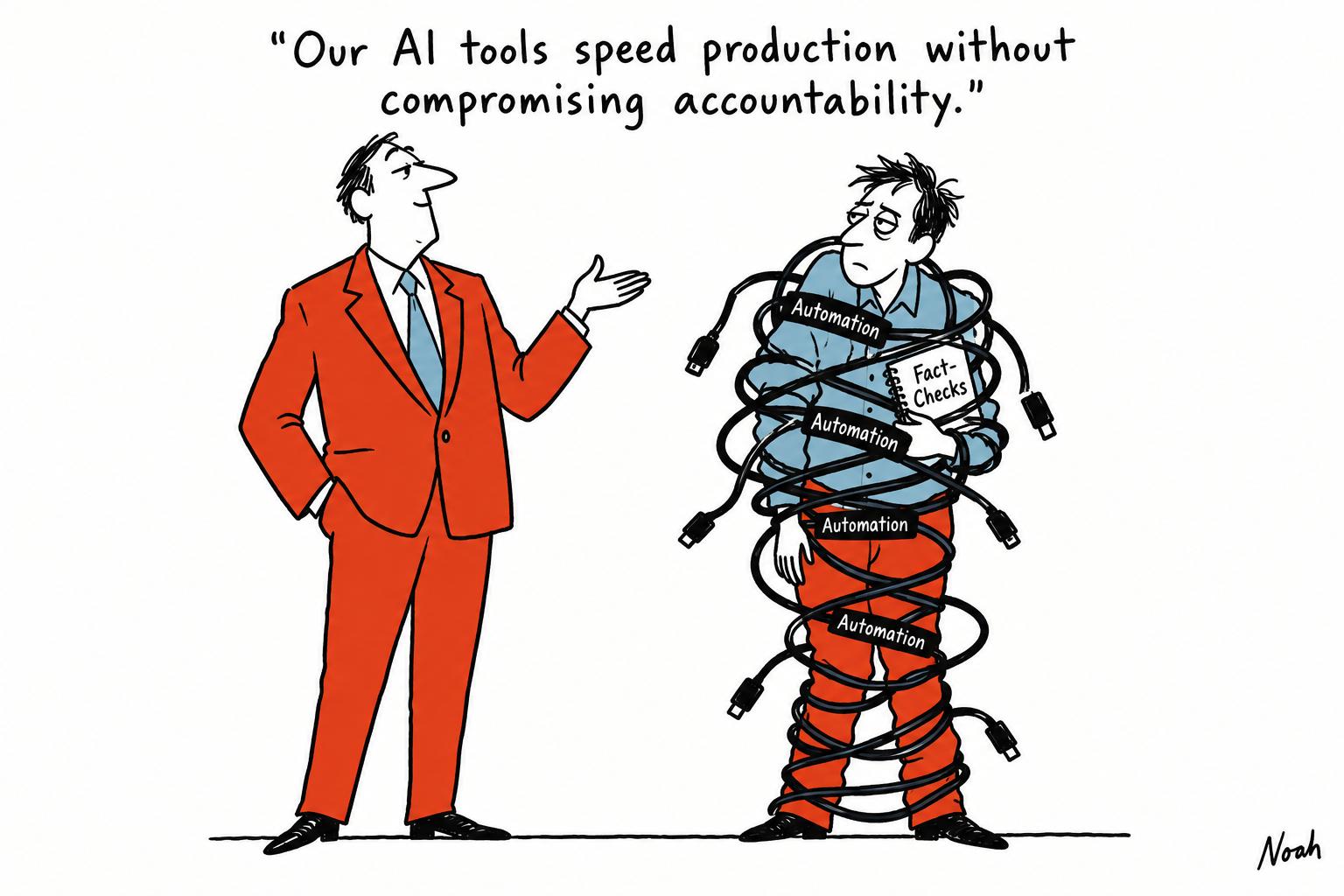
Cartoon · AI-generated
AI-native outlets are adopting sharply different rules for human review, source checking and corrections, exposing the unresolved risks of publishing machine-generated news.
Newsrooms designed around artificial intelligence are pushing the industry into a new question: not whether software can draft and distribute stories, but how much human judgement should remain in the loop. A Reuters Institute feature published on 16 October 2026 profiles five AI-native outlets in the United States, Canada, Croatia and Italy, and shows that the answers vary sharply depending on the newsroom’s ambitions, beat selection and appetite for risk.
Among the examples, Italy’s Redazione Zero appears to have embraced the most automated model. According to the Reuters Institute profile, the site says AI generates its content without human review before publication, yet its editorial charter still insists on linked sources for factual claims, usually demands two independent sources, and allows exceptions only when confirmation is not available and that limitation is disclosed. The charter also bars crime and court reporting, prohibits naming minors and limits health coverage, while requiring visible corrections, a sign that even highly automated outlets are still trying to impose guardrails on what software may handle.
At the other end of the spectrum, Tucson Daily Brief in Arizona separates material that can be published automatically from items that need an editor’s sign-off. The Reuters Institute says Nicholas De Leon allows routine summaries and previews of public meetings to appear without prior review, but requires his approval for reports on what actually happened. De Leon checks machine-transcribed meetings against the transcript before editing and publishing, and the outlet discloses the model used, the source material and whether a person has reviewed the output. The profile also points to other variants, including Croatia’s Moj Kraj and Canada’s Journal Metro, where editor-in-chief Olivier Robichaud reviews AI drafts, adds context and looks for additional perspectives where necessary.
What emerges from the feature is less a single model of AI journalism than a set of different accountability arrangements. RuntimeWire, another outlet highlighted by the Reuters Institute, says in its editorial policy that stories are checked against primary documents and cross-referenced before publication, and that unverified claims should be held back or clearly labelled as unconfirmed. That approach mirrors wider concerns raised this year by Thomson Reuters Institute commentary, which argues that as agentic AI becomes more capable of taking action, organisations need clearer governance, stronger observability and a better understanding of which tasks can safely be automated and which require stricter oversight.
The Reuters Institute also reports that all five outlets acknowledged errors in their AI-driven operations, underlining a point that extends well beyond journalism: post-publication correction systems are not the same as pre-publication safeguards. Thomson Reuters has warned in separate commentary that accountability gaps grow as AI systems act more independently, while other analysis from the same institution says many companies still lack robust policies on data quality, worker impacts and ethical assessment. For news organisations considering similar systems, the lesson is not simply whether to use AI, but where to draw the line between automation, review and responsibility.
Inspired by headline at: [1]
Sources by paragraph: - Paragraph 1: [2], [7] - Paragraph 2: [2] - Paragraph 3: [2], [6] - Paragraph 4: [3], [4], [5], [6]
Source: Noah Wire Services · Original