AI could help local newsrooms survive the coverage crisis
Cartoon · AI-generated
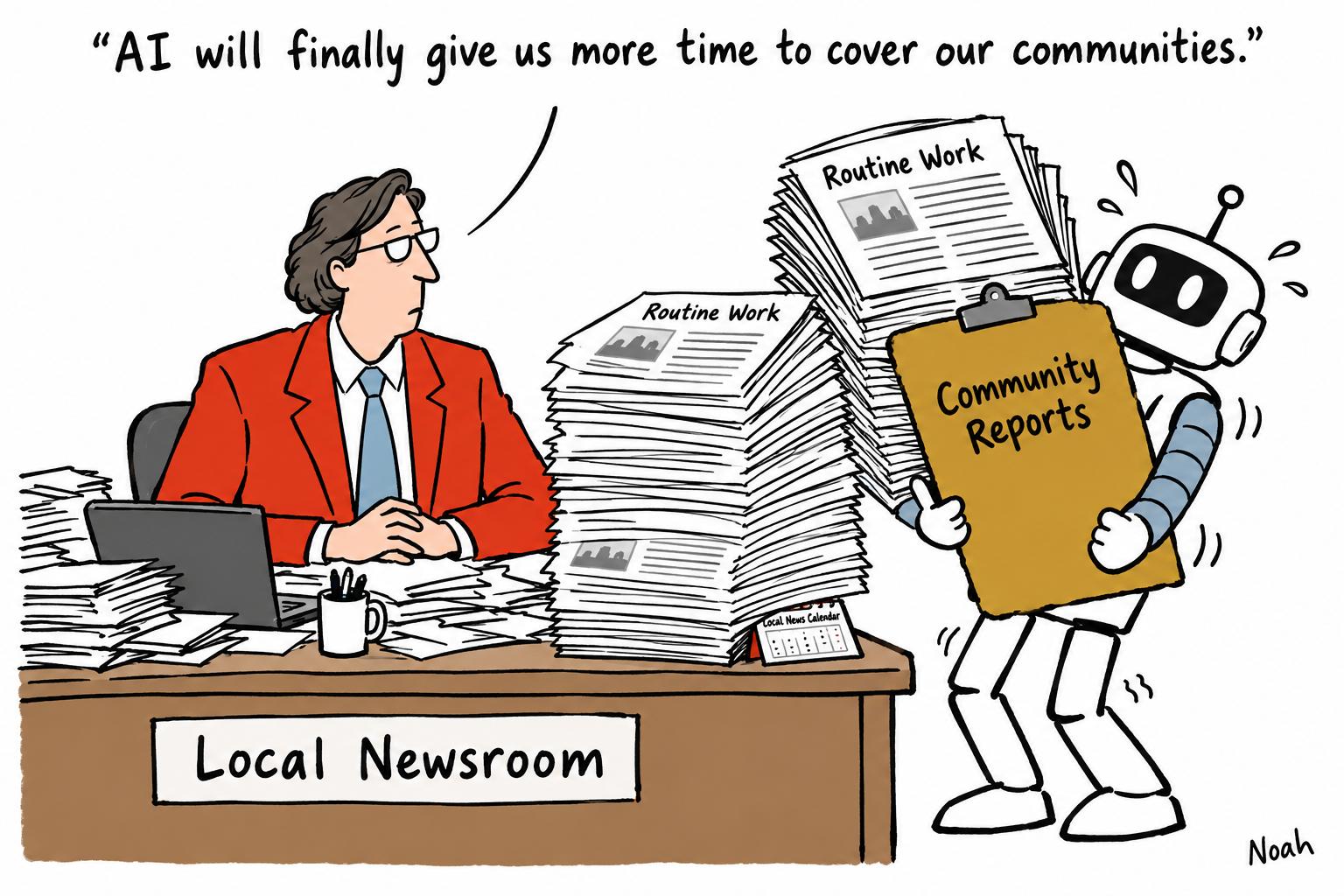
As local news coverage contracts and newspapers continue to close, AI could handle routine work and give journalists more time to report in their communities.
AI has become a convenient villain in discussions about jobs, but in local media it may prove less a destroyer than a stopgap. That is the thrust of William Pollack’s argument in Radio Ink: the real crisis is not automation but the long erosion of local news coverage, especially in smaller communities where newspapers have closed, television has narrowed its reach and residents are left with little sustained reporting on councils, schools and other civic affairs. Northwestern University’s Medill School of Journalism has documented how severe that erosion has become, with its 2025 report finding 213 counties without a local news source and roughly 50 million Americans living with limited access to local reporting.
By the following year, Medill said the situation had worsened further. Its 2026 study found 238 counties lacking local news coverage, with newspapers continuing to shut at a rate of about three a week and digital traffic to local newspaper websites down by half. Yet the same research also pointed to a modest countertrend: 75 digital-only and print startups had launched in the past year, suggesting that while the traditional local-news model remains under intense strain, new forms of coverage are trying to fill the gap.
Pollack’s point is that AI may help these smaller outlets survive by taking over work that does not require local judgement or human presence. Accounting, scheduling, routine alerts, call handling and internal messaging are all tasks that software can manage more cheaply and quickly, freeing staff to spend more time in the community, speaking with businesses, attending meetings and reporting on issues that affect residents directly. In his view, that human contact remains irreplaceable: trust is built face to face, and local broadcasters or journalists still need to show up at council chambers, storefronts and live events if they want to matter to the places they serve.
The more ambitious claim is that AI could even support hiring rather than reduce it, if the time it saves is reinvested in reporting and sales rather than headcount cuts. That is a hopeful reading of a battered sector, but it aligns with the broader evidence from Medill: local news is shrinking, audiences are fragmenting and the old economics no longer work as they once did. Against that backdrop, AI looks less like a substitute for journalists than a tool that might help small stations and publishers concentrate on the work that algorithms cannot do: building relationships, covering public institutions and reminding communities that someone is still paying attention.
Inspired by headline at: [1]
Sources by paragraph: - Paragraph 1: [2], [3] - Paragraph 2: [4], [6] - Paragraph 3: [2], [4] - Paragraph 4: [3], [5], [6]
Source: Noah Wire Services · Original