EBRA’s AI drive puts the future of local journalism under scrutiny
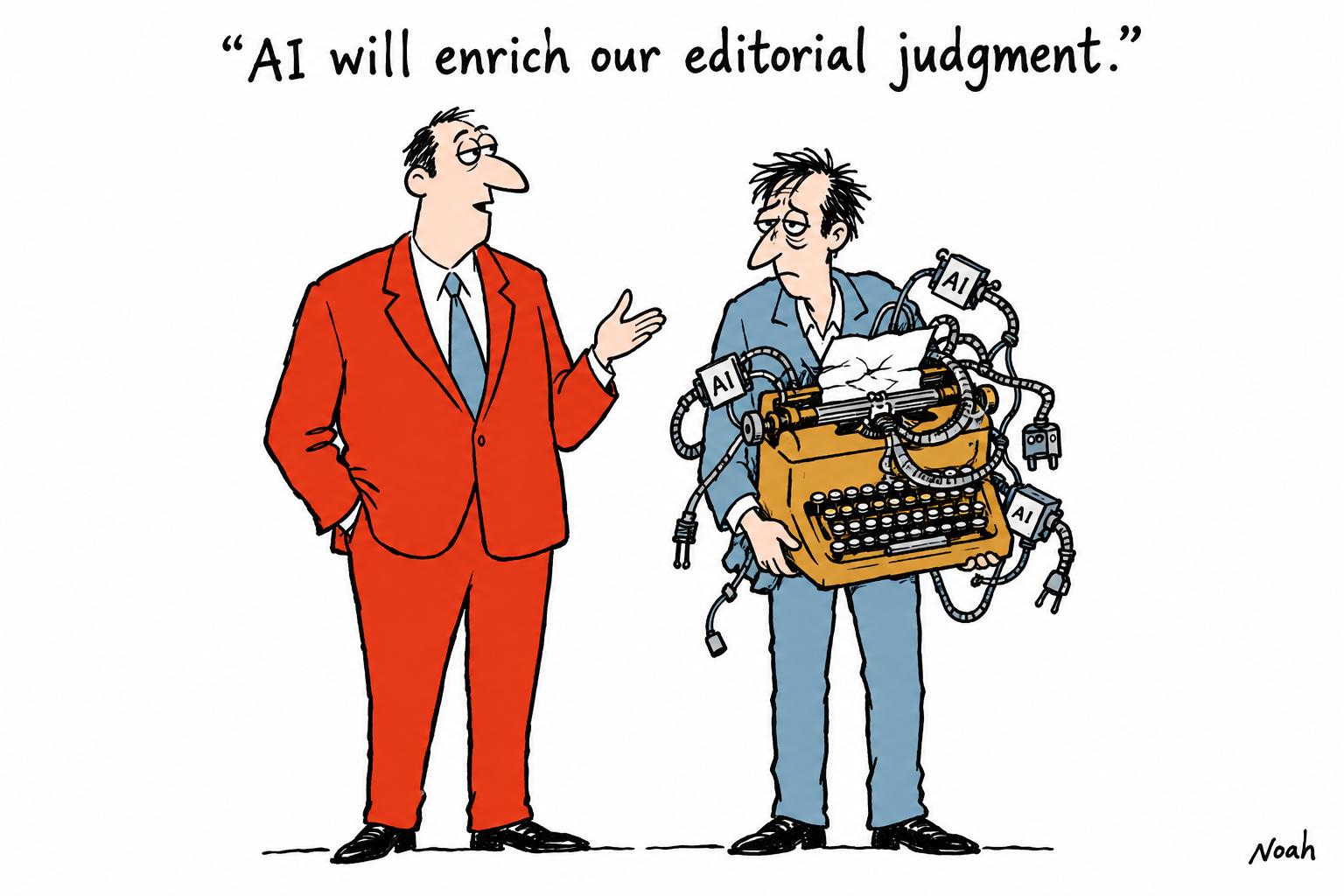
Cartoon · AI-generated
France’s EBRA newspaper group is facing criticism over plans to make AI central to newsroom operations, raising questions about editorial judgement, training and the future of human-led reporting.
EBRA Group, one of France’s largest regional newspaper owners, is drawing criticism after signalling that it wants to place artificial intelligence at the centre of newsroom operations, a strategy that observers say risks recasting editorial work as an exercise in automation rather than reporting. According to Le Monde, the company’s push goes well beyond ordinary experimentation with software tools and instead points to a broader rethink of what a newspaper is for, and who should do the work that has traditionally defined it.
The concern, as framed by Le Monde, is not simply that AI is being introduced into routine tasks, but that EBRA appears to be leaning on it as a substitute for parts of the journalistic process itself. That has prompted unease in France’s media sector, where publishers are already under pressure from weak advertising markets, falling print readership and years of digital disruption. The newspaper group’s direction fits a wider pattern in the industry, but one that many editors and reporters view with caution when it begins to affect the substance of local news coverage.
That anxiety is echoed in reporting from the Columbia Journalism Review, which recently examined the growing willingness of AI firms to treat journalists’ notebooks, reporting scraps and unpublished material as commercial assets. The article raised ethical questions about whether such material can be bought, repackaged or trained into systems that then compete with the original reporting. In that context, EBRA’s approach looks to critics like part of the same shift: journalism increasingly treated as raw material for machine-driven production rather than as a human-led public service.
At the same time, the issue is not as simple as rejecting AI outright. WAN-IFRA has documented how publishers across the world are using the technology for transcription, summarisation, translation, audience engagement and workflow support, while noting that measuring its real value remains difficult. The Journalism AI Index similarly shows that adoption is spreading across newsrooms, but unevenly, with many organisations still unsure how to assess the effect on quality, speed and trust. In other words, AI is already embedded in the sector; the dispute is over whether it should remain a tool or become a governing philosophy.
Le Monde has previously argued that AI is intensifying the pressures on journalism after two decades of digital upheaval, and that many workers are being pushed towards new systems without adequate preparation. A separate report from Le Monde last year found that employees were moving towards AI use faster than employers were providing training. That gap matters in a newsroom setting, where the risks are not limited to efficiency or labour relations but extend to accuracy, accountability and the editorial judgement that distinguishes journalism from automated content production.
Inspired by headline at: [1]
Sources by paragraph: - Paragraph 1: [2] - Paragraph 2: [2], [6] - Paragraph 3: [4] - Paragraph 4: [3], [5] - Paragraph 5: [6], [7]
Source: Noah Wire Services · Original