The Independent says AI-enabled editors are six times more productive
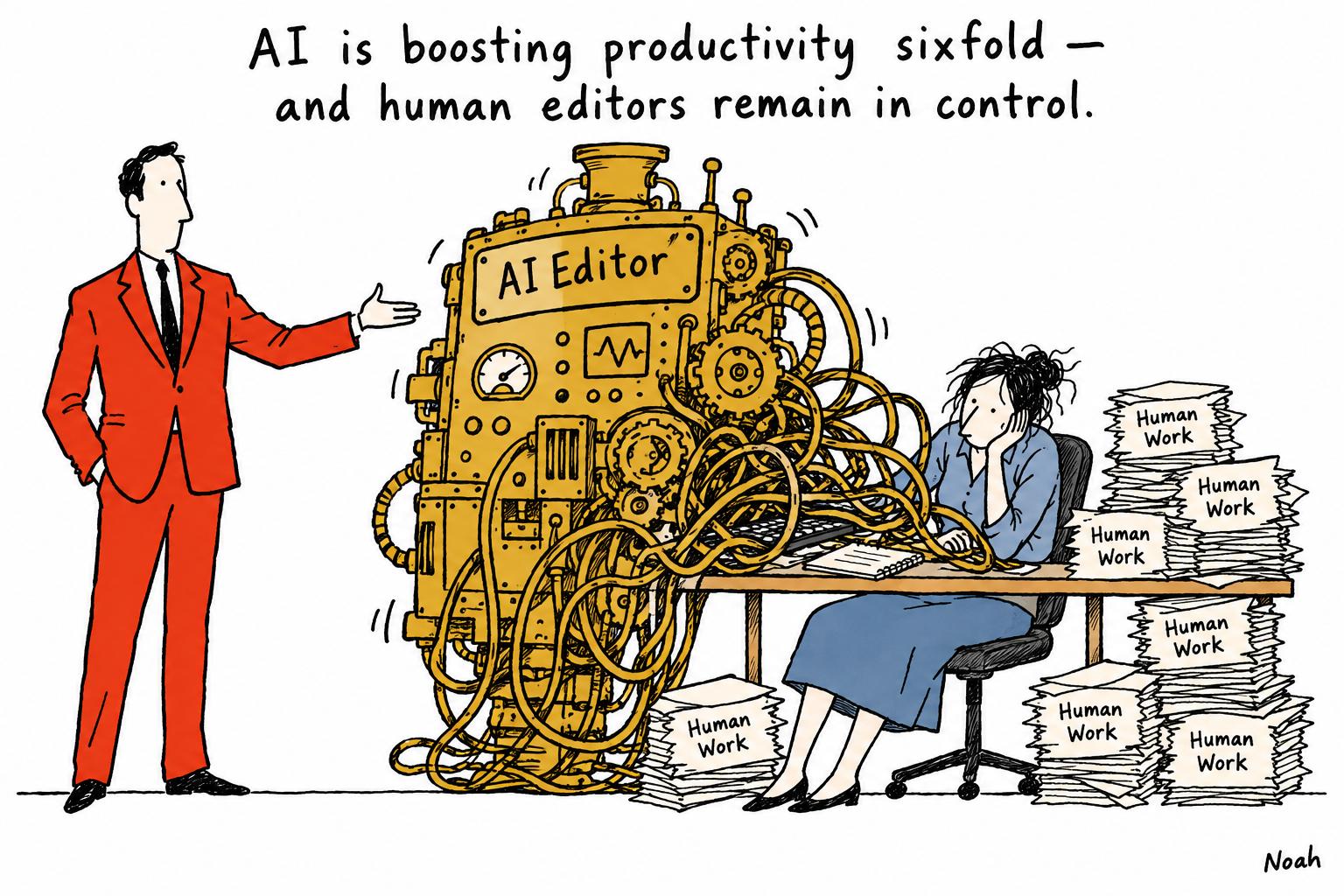
Cartoon · AI-generated
News executives say AI is accelerating routine newsroom work and audience engagement, but insist human editors must retain control over journalistic decisions.
At a London media conference, senior newsroom executives painted artificial intelligence as a force that is already changing how journalism is made, but not one that should be allowed to displace editorial judgement. Christian Broughton, chief executive of The Independent, told the event that editors making full use of the publisher’s in-house AI tools were now "six times more economically productive" than colleagues who did not use them, a claim that sits at the centre of a broader industry debate about whether the technology is genuinely transforming output or simply shifting work elsewhere.
According to The Independent’s account, the publisher began building its AI operation in earnest at the start of 2025 with Bulletin, a product that publishes AI-summarised versions of articles under human supervision. Broughton said much of the system has been developed internally, with controls governing where the software can source information and with final editorial responsibility still resting with journalists. He also pointed to the company’s four-decade archive as a key advantage, saying articles and images were turned into searchable data last year so the system can retrieve past coverage by meaning rather than by keyword. That, he argued, helps reporters find previous framing, related material and additional context without handing over editorial decisions to the machine.
Broughton also said automating routine work such as tagging and search-engine metadata had created room for more substantial journalism, including recent long-form work such as the podcast investigation SAS: The Shadow War. Yet the wider industry picture is more complicated. Commentary cited in connection with the event suggests that while AI can make individuals faster, the gains may be less obvious at company level once the time spent checking, correcting and approving machine-generated output is taken into account. The point has become especially important as publishers look for ways to prove that AI delivers measurable value rather than simply adding another layer of editorial administration.
Reach offered a similar picture of cautious adoption. Chief content officer David Higgerson described tools such as Mantis Scribe, which can adapt the same story for different local titles, and Launchpad, an editorial dashboard that combines AI functions, analytics and image access. He said the aim is to give journalists more time for work that adds the greatest value while keeping the process transparent and under human control. He offered the example of an AI system reviewing a 35-page planning document and flagging, almost incidentally, a line about a local café that was due to be demolished, illustrating how technology can help reporters spot a story rather than write it themselves.
Reuters executive editor Nick Tattersall said the agency has taken a similarly restrained approach. He described tools that suggest alternative headlines and extract potentially newsworthy facts from source material, while leaving final decisions to editors and reporters. Reuters is also using AI in more limited, foundational ways, including automated translation that allows earnings stories to appear in several languages almost instantly and synthetic voice narration on consumer platforms, where audiences are told the audio is AI-generated. Tattersall also said Reuters has built a Model Context Protocol server so customer AI systems can search and retrieve verified Reuters material using natural language, a move he said is intended to prepare newsrooms for a future in which agentic systems do much more of the background searching.
The event also turned to questions of disclosure and audience reach. Marie Bering, vice-president of product management at Stibo DX, said best practice on labelling AI-assisted written content is still evolving, but argued that fabricated images and video should be disclosed more plainly, with content credentials able to travel through the distribution chain. Elsewhere, Metropolis chief executive Robert Marr said his company has responded to falling website traffic by launching ten new apps and seven journalist-led newsletters, while also using AI to tailor recommendations and streamline event production. He said the group’s in-house Miso chatbot has handled 1.5 million reader questions over the past two years, underlining how quickly AI is becoming part of both newsroom operations and audience engagement.
Inspired by headline at: [1]
Sources by paragraph: - Paragraph 1: [2], [4] - Paragraph 2: [1], [2] - Paragraph 3: [1], [4], [5] - Paragraph 4: [1] - Paragraph 5: [1], [2], [6], [7]
Source: Noah Wire Services · Original