Svenska Dagbladet pulls essay, exposing the new fault line over AI and trust
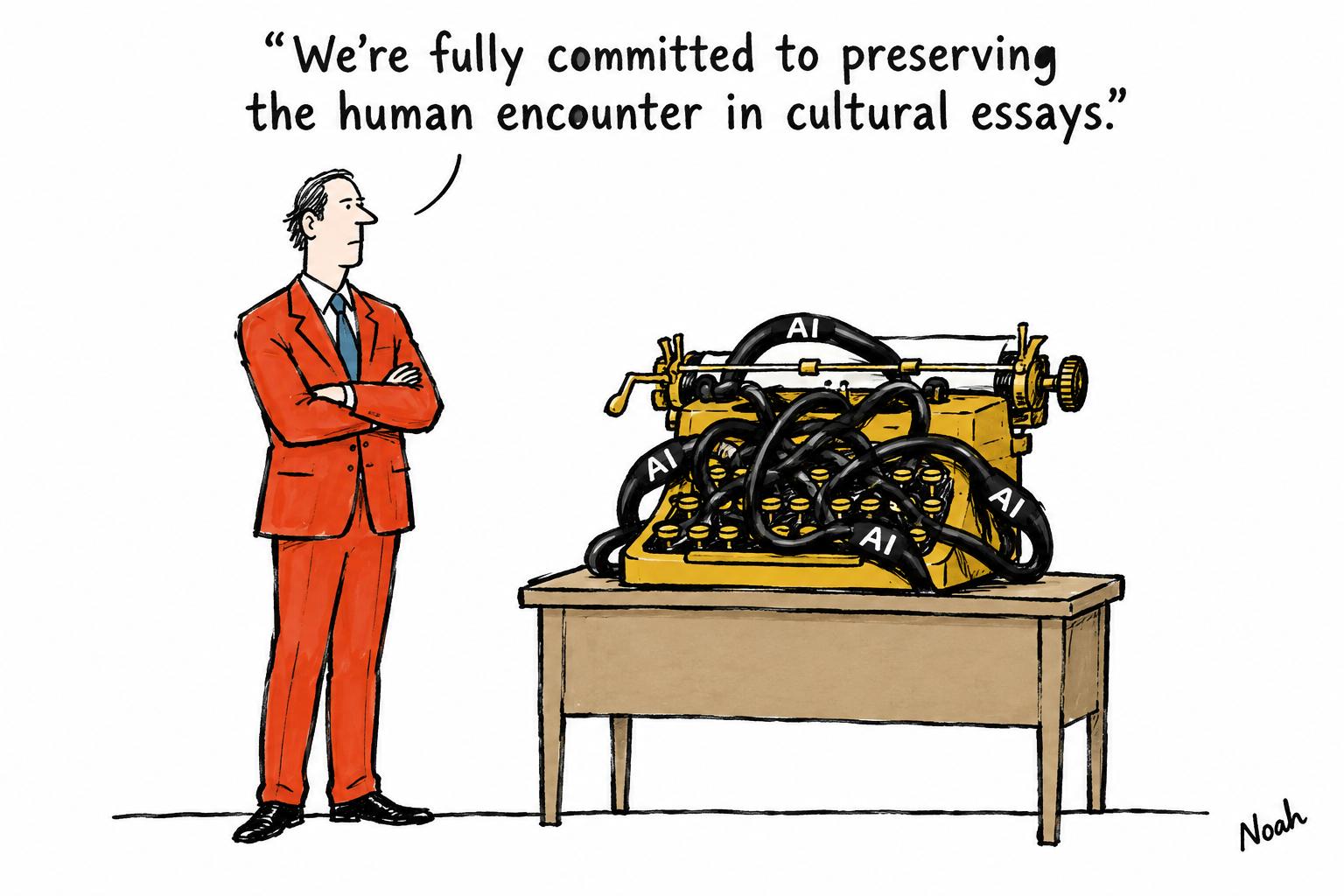
Cartoon · AI-generated
The removal of an Under strecket essay has intensified a wider debate over whether AI-assisted writing can preserve the human encounter readers expect from cultural essays.
At Svenska Dagbladet, the removal of a recent Under strecket essay has become more than an internal editorial decision; it has turned into a public argument about what readers are entitled to assume when they open a cultural essay. Ida Ölmedal, SvD’s culture editor, wrote that the paper had reason to believe the piece was to a substantial extent produced with the help of AI, and she framed the issue as one of trust between writer and reader. In her view, an essay in that setting is not merely a vessel for information but an encounter with another mind, and that expectation is central to the genre. The controversy comes at a moment when publishers and cultural institutions across Europe and the United States are grappling with how to police machine-written prose without sliding into blanket suspicion. The Guardian reported in July that the Commonwealth Short Story Prize winner Jamir Nazir faced allegations of AI use, prompting a review by the Commonwealth Foundation, while earlier this year Sports Illustrated’s AI-related publishing scandal continued to loom over debates about editorial authenticity.
Ölmedal’s position is that AI can be used in the writing process, but only under conditions the newsroom can oversee and explain openly to readers. She said SvD intends to strengthen its ability to detect and define the limits of AI-generated copy, an acknowledgement that the challenge is now operational as well as philosophical. That stance echoes anxieties elsewhere in the media business, where confidence in bylines has already been damaged by cases of synthetic or misattributed content. In 2023, Sports Illustrated was accused of running articles attributed to fabricated writers, a case that sharpened concerns about whether audiences can still tell who is speaking to them, and in 2025 reports emerged that some academics were hiding AI prompts in papers in an effort to manipulate peer review. Together, those episodes have helped turn a niche editorial question into a broader test of institutional credibility.
Yet there is also a counter-argument, and Ölmedal is careful not to dismiss it. As Martin Schori, the former AI and innovation chief at Aftonbladet, argued in Dagens Media, an overzealous hunt for “AI cheats” risks becoming a purity campaign, and SvD’s culture editor said she shares that concern. The problem, however, is that essays occupy a special place in public life. A recipe, as she put it, is judged by whether it works; if AI can produce a decent soup recipe, the reader may care little about the provenance. An essay, by contrast, is expected to carry the imprint of study, reflection and experience. Its value lies partly in the sense that a particular person has thought through a subject and is inviting the reader into that process.
That distinction helps explain why different institutions are settling on different rules. Sveriges Radio’s culture programme Obs has kept online an essay by the same writer despite accusations of generous AI use, according to an episode of Medierna. In France, by contrast, the literary world has shown a growing willingness to act against suspected machine assistance. The Guardian reported in September that the Académie Goncourt removed Thélyson Orélien’s novel from its longlist after anonymous claims that it had been largely written with AI, and in July the Commonwealth Short Story Prize drew similar scrutiny when judges had to examine drafts and notes after online allegations about Jamir Nazir’s story. At the same time, the landscape is not moving in only one direction: The Guardian also reported in October that a new French prize has been launched specifically for fiction co-written with AI, complete with rules requiring entrants to disclose the model and prompts used. The emerging picture is one of parallel norms, with some institutions drawing harder lines and others building frameworks for collaboration.
What remains unresolved is not whether AI will be part of writing, but what kind of writing can tolerate that fact without losing its point. Ölmedal argues that readers of Under strecket expect something more than polished sentences or reliable facts; they expect to meet a thinking human being whose prose reflects lived knowledge and intellectual labour. That does not mean AI has no place in drafting, experimenting or refining language. But it does mean that, in the case of the essay, the source of the thought matters almost as much as the quality of the argument. As the debate widens, the issue is becoming less about a single newspaper’s internal standards than about how culture, journalism and literature preserve trust in a period when the boundary between human and machine authorship is harder than ever to see.
Inspired by headline at: [1]
Sources by paragraph: - Paragraph 1: [2], [5], [6] - Paragraph 2: [1], [6], [7] - Paragraph 3: [1], [3] - Paragraph 4: [2], [4], [5] - Paragraph 5: [1], [3], [4], [7]
Source: Noah Wire Services · Original