Meta’s delay gives publishers time to put limits in writing
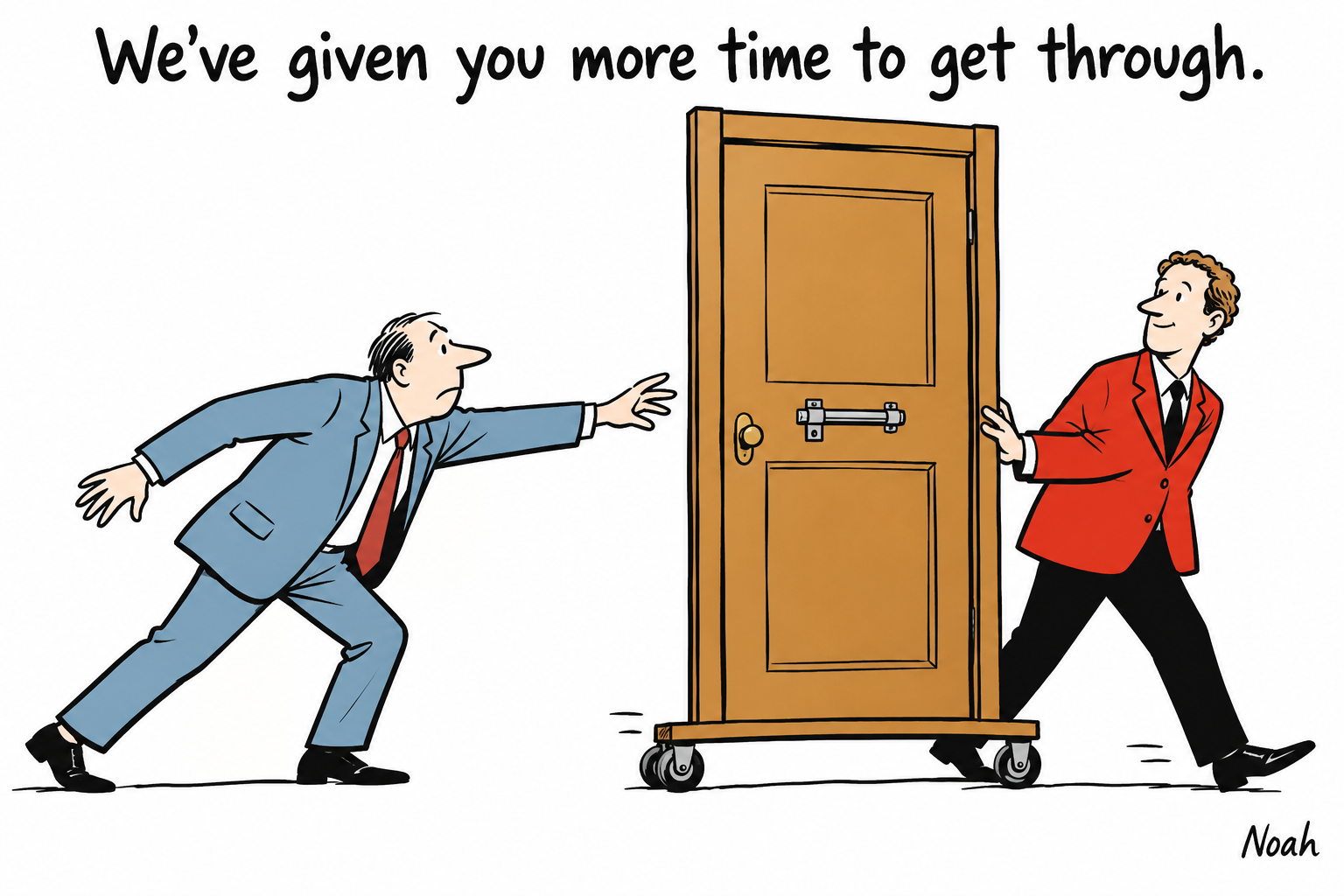
Cartoon · AI-generated
Meta has moved the start date of its new business terms from 30 October to 20 November, giving news publishers three more weeks to challenge permissions they fear would reach into their own websites. That is a useful concession. It gives publishers time to demand a clearer choice about how their journalism may be used.
The immediate benefit is greatest for publishers that would find it costly to abandon Facebook audiences. Meta gains time to explain its position. Publishers should use the same window to establish the limits they need in writing, and what continued platform access is worth to their businesses. Waiting for the controversy to disappear is a poor strategy.
The service and the permission should be separate
At issue is the relationship between a publisher’s presence on a social platform and automated collection of material from its website. Crawling means software visiting pages and retrieving their contents. The dispute concerns what Meta’s terms would authorise and for which purposes, rather than simply whether a crawler exists.
Imagine a local title advertising a subscription on Facebook. It wants people to see the offer and become readers. Whether additional uses of its wider reporting archive should follow from that business relationship is a separate commercial question. This is an illustrative example, not a finding that Meta has taken a particular publisher’s archive.
The European Publishers Council made that distinction explicit on Friday: publishers should be able to refuse additional permissions while retaining the business services they requested. The UK News Media Association (NMA) welcomed the delay but described it as “a pause, not a solution”. Both are interested industry bodies; their demands have not become a regulatory remedy.
A usable control is still uncertain
Noah gives only a 32% chance that at least one UK or European Economic Area news publisher can use an account-level AI control by 31 January 2027. The control must expressly keep content associated with its business accounts out of training or improving Meta’s generative-AI models, while leaving those accounts active. By 24 October 2027, the estimate is still only 46%.
Those dates describe a specific practical safeguard, not the odds that publishers win every part of this dispute. Narrower contractual wording or withdrawal of a disputed permission could improve their position without producing that control. Equally, a general reassurance or a crawler instruction would not establish that the defined account-level choice exists.
The delay creates room for negotiation, but it does not make a new control the expected outcome within either tested window. Publishers should therefore press for usable protections now and plan how to operate if no convenient switch arrives. The longer forecast does not establish that one is inevitable later.
A crawler preference does a different job
Meta says the update consolidates terms for advertising and business products and does not change how it uses web crawlers. In statements reported by Reuters and Nieman Lab, the company says content owners can continue to signal preferences through robots.txt. That assurance matters: the company disputes the interpretation that this is a new entitlement to scrape news sites.
Robots.txt is a text file giving instructions to automated visitors. The internet standard, RFC 9309, expressly distinguishes those instructions from access authorisation and from security measures. A sign telling a visitor where to go is useful; a locked door performs a different function.
Contractual limits address another question again: what uses are agreed after material has been obtained? The European Publishers Council argues that crawler preferences do not settle those limits. Publishers should seek clarity about both collection and subsequent use, including the products and purposes covered.
That is why changing a file on the website cannot be treated as the entire commercial response. The technical team needs to understand legitimate service functions and access controls. The commercial and legal owners need to understand the applicable agreement. Each should know what the others are relying on.
Scrutiny is real; a remedy takes another step
Noah puts the probability of the UK’s Competition and Markets Authority (CMA) or European Commission publicly opening a formal investigation specifically into these commercial terms or the associated use of publisher content at 52% by 24 October 2027. That is a narrow lean towards a formal opening. It offers no assurance of a remedy before the new November start date.
The CMA’s position is more nuanced than a claim that it is powerless. In parliamentary evidence on 20 October, chief executive Sarah Cardell said Meta did not have a Strategic Market Status designation—the gateway to firm-specific rules under the UK’s digital markets regime—while identifying possible action under other competition powers. The authority was already seeking information and engaging with Meta.
Nieman Lab reported on Friday that the CMA would continue scrutinising the terms following the delay. Meetings and information requests can matter, but a formal investigation would still be a further step; its opening would not establish that Meta had broken the law.
The near-term test is concrete: does Meta turn its public explanation into sufficiently specific commitments? A later investigation might increase pressure, but publishers cannot base next month’s operating decisions on a remedy that has not been secured.
The cost of leaving belongs in the calculation
Noah gives only a 19% probability that, by 24 October 2027, at least one UK news-publishing NMA member deletes or deactivates a principal corporate Facebook or Instagram account and publicly identifies Meta’s content-use terms as a reason. Advice to delete an account, a threat or reduced posting is a different outcome.
The forecast captures a costly action rather than the volume of opposition. It does not require all of a publisher’s brands to leave the platforms. Continued account activity would not demonstrate approval of the terms either: a business can object strongly while remaining dependent on distribution.
The NMA says some local titles derive up to a third of their traffic from Facebook. That is an attributed upper example, with no representative industry denominator supplied. It is not a forecast of the revenue those titles would lose by leaving.
For an individual publisher, the useful question is what those visits produce: repeat readers, newsletter relationships, subscriptions and advertising contribution. The cost of leaving also depends on how much of that value could be retained elsewhere. A large referral total can justify serious attention without answering the commercial decision on its own.
Small publishers have a role beyond waiting
The original scrutiny did not begin with a giant newsroom. Stephen Beale’s account on The Steampunk Explorer records seeing a Meta Business Suite notice, comparing the terms and alerting Nieman Lab. His dated updates also preserve Meta’s clarification and the subsequent postponement.
That is a useful example of operational vigilance by a specialist publisher. It does not establish that Beale alone caused the delay or that his business has quit Facebook. It shows how someone close to a small publishing operation can spot a change that deserves wider examination.
The extra weeks should produce more than another round of objections. Publishers need a named owner for the decision, a record of the terms applicable to their accounts, an understanding of connected websites and crawler settings, and an honest account of the audience value at stake.
The good news is that the timetable has moved. The business objective remains a meaningful ability to choose additional uses of journalism while obtaining a clearly defined distribution service. That is the standard against which the next version of the terms should be judged.
Research note
Noah’s automatic forecasts were reviewed alongside current reporting, publisher statements, parliamentary evidence and the robots protocol. Meta’s live terms preview was inaccessible in this review, so version-specific wording is attributed to dated reporting. The four estimates used here concern three distinct outcomes; the complete five-estimate register, including one broad permissions question omitted from the argument, is linked below.
Sources
- NMA: response to Meta’s delay, 23 October 2026
- Reuters: Meta’s explanation of the postponement
- European Publishers Council: request for separate permissions
- UK Parliament: CMA evidence, 20 October 2026
- Nieman Lab: the delay and continuing regulatory scrutiny
- NMA: Facebook traffic and local publishers
- RFC 9309: robots instructions and security
- The Steampunk Explorer: original reporting and updates
- Forecast definitions, ranges and claim audit
Source: Tomorrow’s Publisher