Spokane newsrooms draw different lines on AI as questions of trust and authorship grow
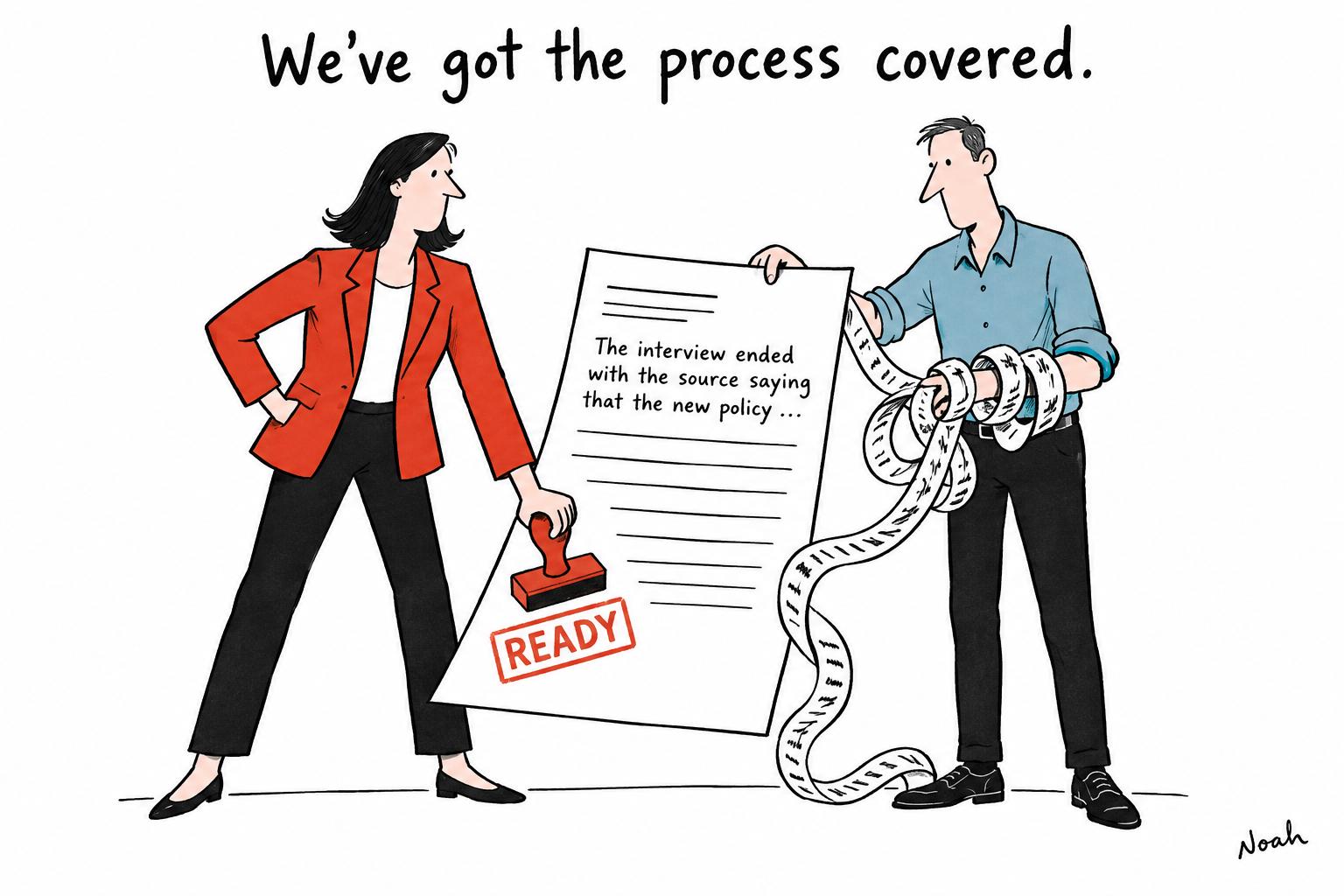
Cartoon · AI-generated
From editing and transcription to repackaging stories, local outlets are adopting AI in different ways , raising questions about disclosure, accuracy and who remains responsible for the reporting.
In Spokane, the debate over artificial intelligence in journalism is no longer abstract. It is playing out in decisions about how stories are edited, how newsroom staff manage limited time and what readers should be told about the tools involved. RANGE’s investigation found a wide range of approaches among local outlets, from tight restrictions on AI-assisted editing to using it for routine tasks and repackaging material already gathered by reporters.
Religion journalist Tracy Simmons described using Claude as a sounding board after writing her own draft, asking for help with wording, structure and possible angles. She said the tool can partly fill the gap left when reporters no longer have colleagues nearby to discuss a difficult paragraph with. Yet the practice sits uneasily alongside her teaching: Simmons has prohibited students from using ChatGPT in writing assignments, and said she does not rely on AI to produce her columns. Pangram, an AI-detection service used by RANGE, nevertheless flagged several of her published pieces as containing substantial AI-generated text. Such results are signals, not conclusive proof of how a story was written; Simmons told RANGE she used Claude to edit her work and offer suggestions. [2]
That distinction, between assistance and authorship, is central to the local dispute. The Spokesman-Review’s managing editor, Lindsey Treffry, described the paper’s internal rules as allowing limited support such as transcription, basic copy-editing and analysis of large data sets, but not AI involvement in reporting or writing. Spokane FAVS and InvestigateWest permit a broader range of workflow assistance, including organising information and tightening language, while saying readers will be informed when AI has a meaningful role. The policies themselves raise a further question: disclosure promises matter only if newsroom practice makes clear when the threshold has been crossed. [2]
The Associated Press offers a useful comparison. Its standards allow AI to help with tasks including transcription, translation, grammar and summarising documents, but require journalists to review generated material and retain responsibility for verification and editorial decisions. The AP also bars generative AI from creating or altering news photographs and calls for disclosure when AI materially contributes to published work. The approach does not settle the local arguments, but it illustrates how a newsroom can define permitted support without handing over the core duties of journalism. [3]
Broadcast outlets in Spokane described using AI chiefly to turn material into different formats. KHQ’s tool, Collaborator, can convert a reporter’s work between web and television formats; RANGE also reported that digital producers could use it to turn press releases into web content without additional reporting being mandatory. KXLY said its internal system can reformat existing journalism but cannot be used to generate a story from a press release. Those distinctions are consequential: converting a reported story is not the same as creating one, and human review alone cannot supply the reporting that was never done. [2]
The pressures behind adoption are not confined to Spokane. TheWrap reported that McClatchy introduced a Claude-powered Content Scaling Agent to adapt existing reporting for other audiences and formats, prompting employee and union concerns about attribution and the effect on journalists’ work. At Washington State University, a partnership with Nebraska-based FanWord brought AI-assisted tools into athletics communications, including support for recaps and feature material. Critics cited by GovTech worried that automation could reduce opportunities for students to learn interviewing and writing. Both examples show why a tool promoted as an efficiency measure can also become a question about jobs, training and who gets credit. [5], [6]
Audience attitudes add another dimension. The Reuters Institute’s 2026 research found that use of dedicated AI services is increasing, while using AI specifically to obtain news remains less common. Public views of AI in news are mixed, and the report cautions that willingness to use the technology does not necessarily amount to confidence in its journalistic role. A separate Associated Press report describes wider disputes over disclosure, employment and human oversight, suggesting that concerns voiced by Spokane journalists are part of a broader struggle over accountability and trust. [4], [7]
The risks are not only about who writes a sentence. RANGE’s investigation described local examples in which AI-related errors could have misled readers about public officials or the timing of a council meeting. Editors and reporters interviewed by the publication also pointed to the value of first-hand observation, context and judgement, qualities that cannot be supplied simply by reshaping existing text. The local accounts underline a basic limit: software may help organise or reformat information, but it cannot independently establish that the information is true or decide why it matters. [2]
For journalists, the question is therefore not simply whether to use AI, but where to draw boundaries that can be explained and enforced. Some see automation as a way to reclaim time for original reporting; others fear that workload pressures will make nominally optional tools difficult to refuse. In a profession whose credibility depends on readers knowing who gathered and shaped the information, transparency and human responsibility remain essential, whatever tasks machines are asked to perform. [2], [7]
Inspired by headline at: [1]
Sources by paragraph: - Paragraph 1: [2] - Paragraph 2: [2] - Paragraph 3: [3] - Paragraph 4: [2] - Paragraph 5: [5], [6] - Paragraph 6: [4], [7] - Paragraph 7: [2] - Paragraph 8: [2], [7]
Source: Noah Wire Services · Original