Scholarly publishers race to govern AI as use outpaces readiness
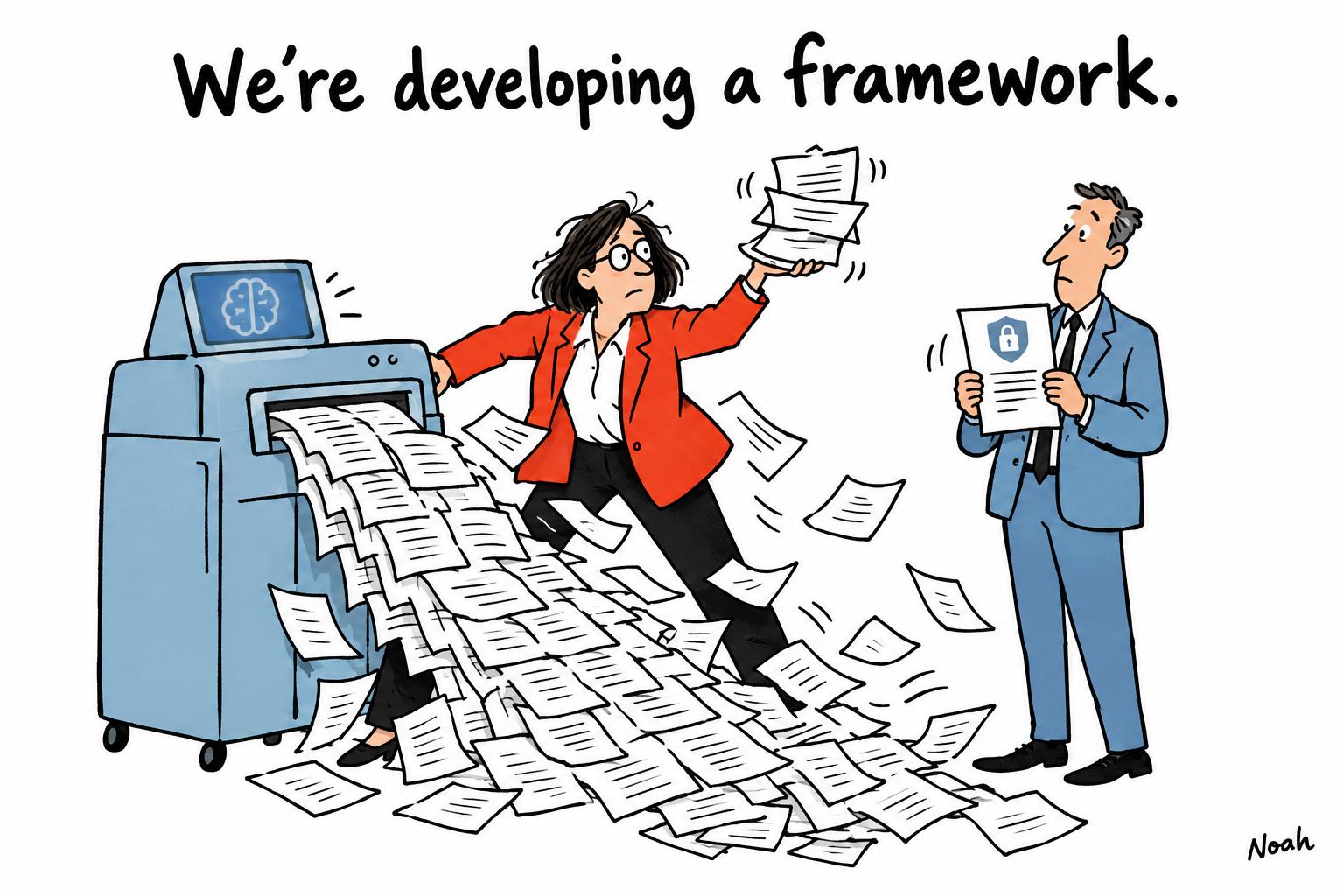
Cartoon · AI-generated
A survey of 563 people in scholarly communication found AI use is widespread, but publishers still face gaps in expertise, privacy safeguards and governance.
Artificial intelligence is now embedded in parts of scholarly publishing, but many organisations have yet to establish the controls needed to use it with confidence. The Society for Scholarly Publishing’s 2026 AI Pulse Check, based on responses from 563 people across scholarly communication, found that use was widespread while preparedness remained limited. Respondents identified ethical and legal questions, data privacy and security, and shortages of expertise and staff capacity as leading obstacles, according to the report.
That gap matters in an industry handling unpublished research, confidential reviewer feedback and editorial communications. In an interview published by The Scholarly Kitchen, Gregory Simmons argued that publishers face a dual challenge: finding ways for AI to ease pressure on staff while ensuring sensitive information and consequential decisions remain protected. The practical task, he said, is not simply to set limits, but to give people approved ways to do their work within them.
Guidance from the International Committee of Medical Journal Editors makes confidentiality a particular concern in peer review. Its recommendations warn against placing submitted manuscripts into AI systems unless confidentiality can be assured or authors have given permission. The Committee also says human authors remain responsible for their work and should disclose AI assistance. The Committee on Publication Ethics similarly states that AI cannot take authorship or accountability, while the STM Association proposes a classification to help publishers distinguish and describe different kinds of AI support.
For publishers, those principles need to shape day-to-day processes. Simmons’s approach, as described by The Scholarly Kitchen, separates tasks AI may assist with from outputs requiring human checking and decisions that must remain with an accountable person. A tool might flag unusual citation patterns, for example, but an editor must assess their significance and decide what action is justified. This distinction is especially important where judgements concern research quality, ethics or publication.
The risks are not limited to inappropriate handling of confidential material. Publishers are also contending with paper mills, fabricated references and manipulated images, among other threats to research integrity. Technology can contribute to such problems, but it can also help identify warning signs. STM’s Integrity Hub, for instance, offers shared screening infrastructure designed to detect patterns associated with paper mills and other potential breaches. Such systems can support scrutiny, but they do not replace human investigation or decision-making.
Simmons recommends that organisations begin by identifying a genuine problem, then assess whether AI is suitable before choosing a tool. Governance should be built into the resulting workflow through permissions, information safeguards, privacy and security measures, monitoring and audit trails. The aim is to give staff useful options within a managed environment, rather than leaving individuals to select tools without organisational oversight.
Readiness, in this view, is about more than acquiring technology. The Society for Scholarly Publishing’s survey found that organisations see potential in routine-task automation, integrity checks and improved access to content, while also worrying about unreliable submissions, undisclosed AI use and diminished trust. Publishers can build experience through lower-risk work, such as event preparation or internal knowledge searches, then assess what has worked before moving towards more sensitive applications.
A durable approach also requires staff to learn from experiments and revise controls as tools change. Simmons’s advice is to identify useful work, judge the sensitivity of the information involved, provide approved systems, define when human review is required and measure outcomes. The survey’s findings suggest why that discipline matters: AI use is advancing, but organisational confidence and capability have not kept pace.
Inspired by headline at: [1]
Sources by paragraph: - Paragraph 1: [3] - Paragraph 2: [2] - Paragraph 3: [4], [5], [6] - Paragraph 4: [2] - Paragraph 5: [2], [7] - Paragraph 6: [2] - Paragraph 7: [3] - Paragraph 8: [2], [3]
Source: Noah Wire Services · Original