Academic publishers face the harder task of making legacy archives accessible
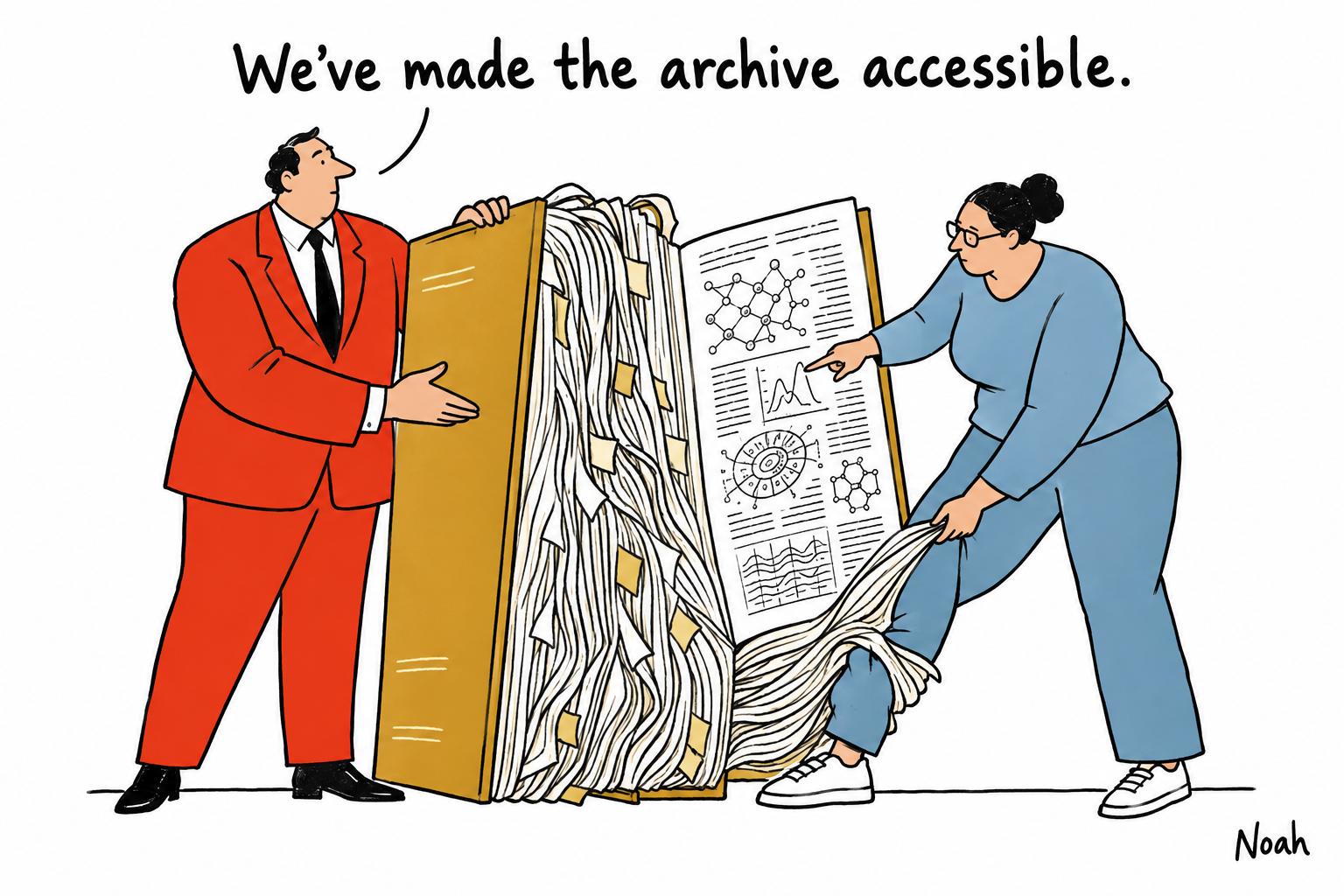
Cartoon · AI-generated
With accessibility deadlines taking effect, publishers must tackle decades of complex backlist content. AI can help assess and process archives, but expert review remains vital for scientific material.
Accessibility in academic publishing is no longer a theoretical concern deferred to some future compliance project. It has become an operational test of whether publishers can actually maintain usable backlists, not just publish new material that passes a checklist. Balamuraly Kanthavelou, writing for The Scholarly Kitchen, argues that the real problem is not awareness of regulation but the difficulty of remediating decades of accumulated content at scale. That challenge comes into sharper focus against a backdrop in which the Council of the European Union says the European Accessibility Act became applicable on 28 June 2025, while the US Department of Justice has set phased compliance dates for state and local government web content under Title II of the Americans with Disabilities Act. The deadlines are real, but the harder question is what it takes to meet them across large scholarly catalogues.
One reason publishers struggle is that they often cannot say with confidence how much of their archive is actually accessible. Kanthavelou points out that traditional audits tend to rely on manual review and sampling, which can expose isolated defects without revealing the scale of the broader problem. Research cited by Michigan State University suggests that the issue begins even earlier in the workflow: in a study of 541 ecology and evolution journals, nearly three-quarters did not explicitly ask authors to consider accessibility at submission. Where guidance did exist, it often focused narrowly on colour-blind-friendly figures, rather than the wider range of access needs faced by disabled readers. In other words, the sector is still trying to solve a back-end remediation problem that was never fully addressed at the front end.
Legacy content is where the difficulty becomes most acute. Academic publishers have inherited archives built across multiple systems, file types and production eras, from PDF and XML to ePub, images and application files such as InDesign and Word. A research chapter examining 8,000 scholarly articles from major publishers, including Springer, Elsevier, ACM and Wiley, found that automated checks can identify many widespread accessibility problems, but that detailed assessment still requires human review. That finding aligns with the practical reality described by Kanthavelou: backfile remediation is expensive, particularly for journal content full of complex figures, multi-panel charts, equations and dense tables. For simple image descriptions, automation can help; for scientific material, it can easily produce output that exists technically but fails to communicate meaningfully to screen-reader users.
That is where artificial intelligence enters the discussion, though not as a substitute for editorial judgment. Kanthavelou describes AI as useful for auditing archives, estimating the likely scope of remediation, normalising metadata and generating first-pass captions, transcripts and descriptions. The World Wide Web Consortium’s accessibility guidance supports that distinction by noting that different kinds of images call for different kinds of alternative text, and that complex diagrams or charts may require fuller explanations than a simple automated description can provide. The practical limit is especially clear with scientific and technical content, where accuracy matters as much as completeness. For that reason, the most credible remediation models use AI to move volume, then route uncertain or high-risk material to subject-matter experts. Industry groups such as the International Association of Scientific, Technical & Medical Publishers have also assembled accessibility resources for scholarly publishers, reflecting a broader shift towards embedding accessibility into production rather than treating it as a one-off clean-up exercise.
The same distinction between short-term compliance and long-term capability runs through the article’s conclusion. A publisher can clear a backlog for an audit and still leave the underlying workflow unchanged, which means the same gaps will reappear in future content. Kanthavelou argues that sustainable accessibility programmes track risk, progress and cost continuously, rather than only when a deadline looms or an audit forces the issue. That approach prioritises the highest-risk material first, builds in human review for technical content and treats metadata and structural consistency as essential rather than optional. The message is plain: accessibility at scale is not won by producing a compliant-looking archive once, but by building an operating model that can keep content usable over time.
Inspired by headline at: [1]
Sources by paragraph: - Paragraph 1: [2], [4], [5] - Paragraph 2: [2], [3] - Paragraph 3: [2], [6] - Paragraph 4: [6], [7] - Paragraph 5: [1], [7]
Source: Noah Wire Services · Original