Argentine newsrooms draw a line between AI support and editorial judgement
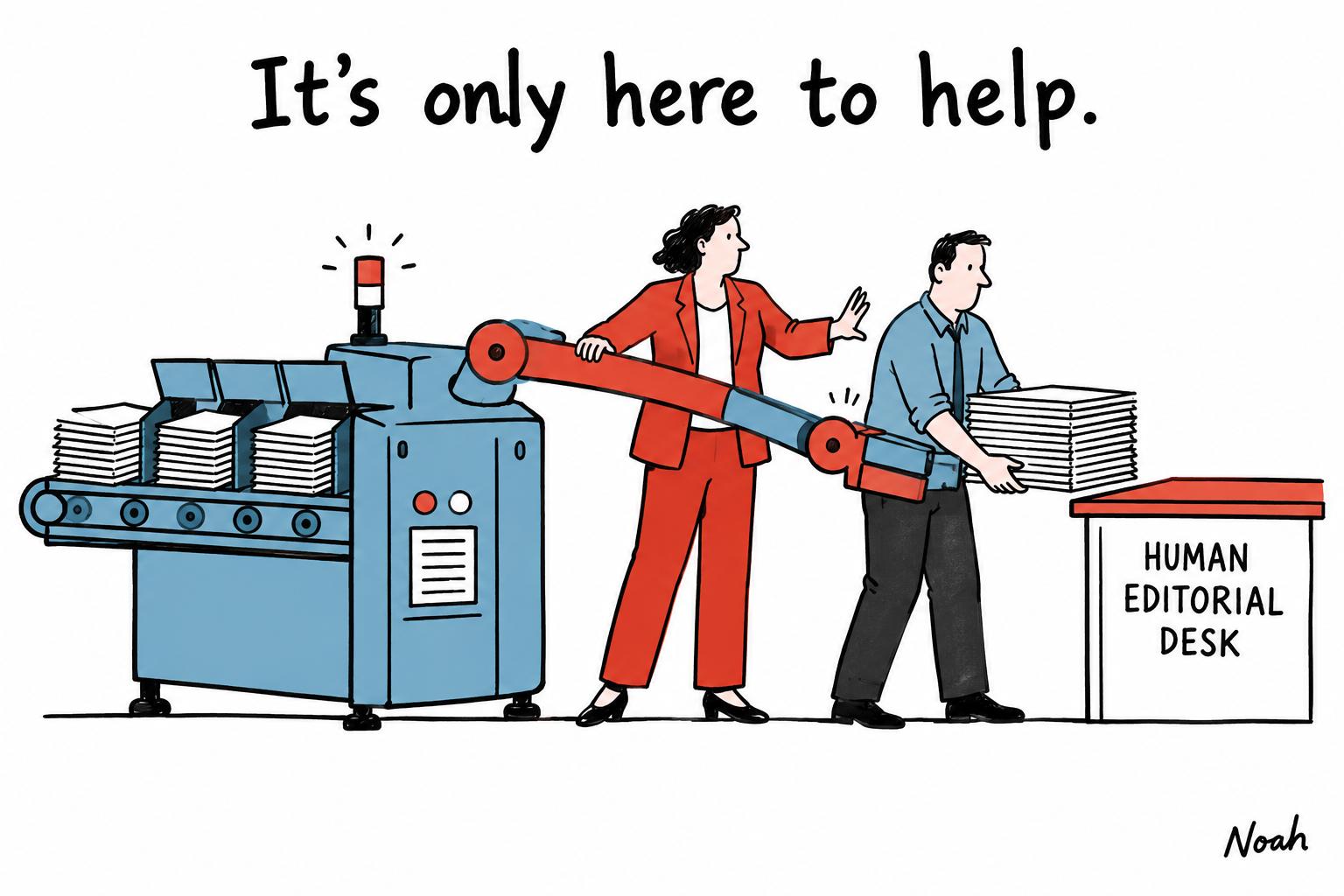
Cartoon · AI-generated
Editors at LA NACION, Clarín and Infobae say AI can assist reporting and newsroom workflows, but decisions must remain in human hands as publishers confront questions of quality, control and revenue.
Artificial intelligence is already embedded in the daily work of Argentina’s leading newsrooms, but the industry appears to have drawn a clear line: machines can support editorial work, yet they should not be allowed to make editorial decisions. That was the central message from a panel featuring LA NACION, Clarín and Infobae at the opening day of Media Party Buenos Aires 2026, the international journalism innovation gathering held at Ciudad Cultural Konex in Buenos Aires. According to the report from LA NACION, the debate set out not just the opportunities created by AI, but the limits many editors still want to preserve.
The session, titled "Fear of change versus reinvention: AI in Argentine newsrooms", brought together Gastón Roitberg of LA NACION, Javier Kraviez of Clarín and Opy Morales of Infobae, with Guadalupe López of Chequeado moderating. Their exchanges underlined how differently each organisation has approached the same technological shift. Clarín has leaned heavily on staff training to ease anxiety about job security and build confidence in the tools. LA NACION has opted for a cross-functional model rather than a standalone AI department. Infobae, meanwhile, has developed its own editorial platform, ScribNews, to embed AI across several of its newsrooms.
Even with those different strategies, the discussion repeatedly returned to a shared concern: the real challenge is no longer simply adoption. News organisations now have to think about training, supervision, workflow redesign and the editorial value that distinguishes journalism from mass-produced content. Roitberg’s warning that "volume and speed do not mean quality" captured that unease. The LA NACION account said the remark reflected a broader fear that automation could increase output without improving accuracy, relevance or usefulness for readers.
In Clarín’s case, Kraviez said one of the first reactions among journalists was apprehension that AI would replace them. The company responded with a months-long training programme involving an external consultancy and the group’s big data team, an effort designed to make the technology less threatening and more understandable. LA NACION’s approach, by contrast, has centred on an interdisciplinary team working across editorial departments, as well as an internal AI guide that the paper has made available for others to adapt. Roitberg also argued that the industry has moved beyond the first phase of experimentation and must now build systems to audit automated processes and spot errors before they reach readers.
Infobae’s contribution focused on what can happen when a publisher builds its own tools rather than depending entirely on third-party systems. Morales said ScribNews has been used across the company’s five newsrooms for three years. He also explained that Infobae abandoned traditional PDF training manuals after finding that they went out of date too quickly. Instead, the platform now includes an AI assistant that answers questions about its functions and draws on recorded training sessions to improve its knowledge base. For Morales, the key distinction is not simply the quantity of information a model can access, but whether it can draw on sources in the journalistic sense.
That theme of control extended well beyond Argentina. In a keynote covered by Media Party, Caspar Llewellyn Smith of The Guardian warned that journalism faces a structural challenge as technology platforms increasingly use news content to generate automated answers, potentially weakening direct traffic to publishers. He argued that the issue is about more than tools: it touches intellectual property, distribution power and the economic model of news. Media Party’s coverage of his talk also stressed that publishers may need collective action on standards, rights and fair payment if they are to preserve editorial independence while still engaging with AI.
The economic pressure on journalism was also central to Andrew Fishman’s presentation on The Intercept Brasil. According to Media Party and the outlet’s own account, the organisation faced a severe drop in audience reach and member revenue before reworking its strategy around stronger audience relationships and a clearer sense of impact. Fishman described that pivot as a move away from chasing scale for its own sake and towards producing work that readers regard as worth supporting. The result, according to figures shared at the event, was a sharp increase in recurring income and a much larger audience footprint.
The innovation track also highlighted how AI can be used to strengthen verification rather than replace it. Franco Piccato of Chequeado presented Datilia, a tool that allows journalists to query World Bank data in natural language, identify claims that merit checking and build visualisations. He also introduced Nunchi, which organises audience comments so newsroom teams can spot unanswered questions and possible fact-checking leads. A separate Media Party profile of Piccato said both tools are designed to support editorial judgement, not substitute for it. Marco Túlio Pires of Google DeepMind made a similar point in relation to research workflows, arguing that newsrooms need systems that make claims traceable.
The first day of Media Party also broadened the conversation beyond newsroom mechanics to the power structures behind the technology itself. Marina Walker Guevara of the Pulitzer Center urged journalists to investigate the companies building AI systems, not just use their products, arguing that the history of AI is bound up with money, ideology and power. The event also looked at audience habits, with MediaWise presenting Creator News Studio, a project pairing newsrooms with independent creators to reach people who increasingly consume information through social platforms. That wider picture suggested a profession trying to adapt to AI’s speed and scale without surrendering the editorial standards, source discipline and public accountability that still define journalism.
Inspired by headline at: [1]
Sources by paragraph: - Paragraph 1: [2] - Paragraph 2: [2] - Paragraph 3: [2] - Paragraph 4: [2], [6] - Paragraph 5: [3], [4] - Paragraph 6: [3], [5] - Paragraph 7: [2], [6] - Paragraph 8: [2], [3]
Source: Noah Wire Services · Original