Meta’s hold on publishers runs deeper than clicks
Cartoon · AI-generated
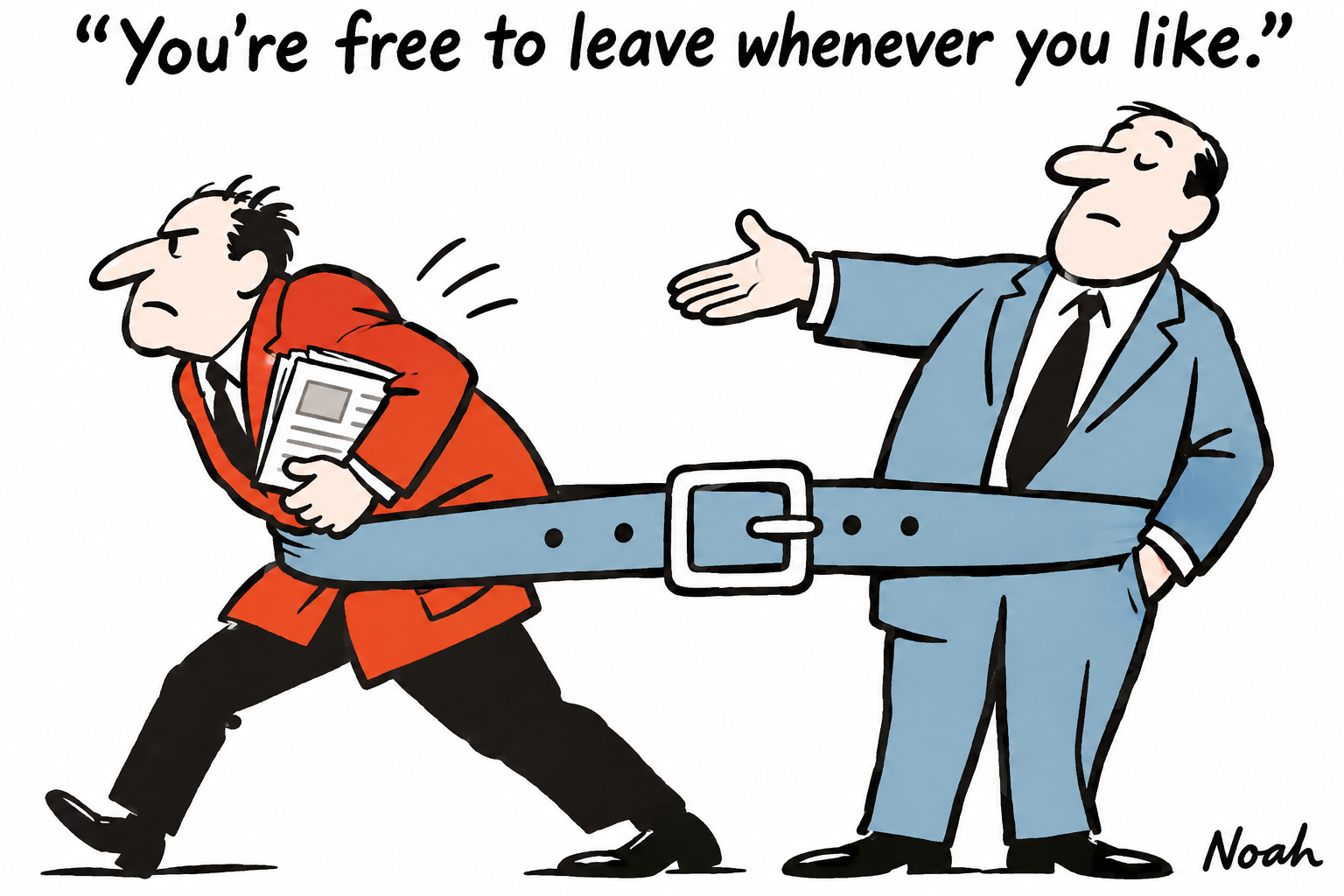
British publishers have gained a competition inquiry into Meta’s business terms and a pause in their introduction. The harder question is what it would cost to leave Facebook or Instagram. Publishers challenging the proposed use of their journalism need to show the value of the services they still use, even when those services send fewer readers to their websites.
“Access to audiences should not come at the price of publishers’ content,” Sajeeda Merali, chief executive of the Professional Publishers Association (PPA), said in its 30 October statement. Her members’ objection is commercially precise: winning subscribers and serving advertisers should not require accepting broader uses of their journalism.
The UK Competition and Markets Authority (CMA) opened its investigation on 30 October. It is examining whether Meta holds a dominant position in relevant UK markets and whether its commercial terms abuse that position. No infringement has been established. For publishers, the useful change is a formal route to test the conditions of access, rather than another exchange of public assurances.
Meta disputes the premise that its update creates new crawling rights. It says the changes consolidate advertising and business terms, do not change how its web crawlers operate, and leave publishers able to signal preferences through robots.txt. That response, reported by Digiday, deserves to be taken seriously. The dispute is over whether the contract gives publishers an enforceable choice.
“But where a company holds a dominant position, it must not use that position to impose unfair terms,” CMA chief executive Sarah Cardell said in the regulator’s announcement. The conditional matters. The investigation must establish the market position and the conduct; the industry’s strength of feeling settles neither.
A smaller traffic source can still be hard to replace
Fresh reporting by Digiday on 3 November describes the awkwardness behind publishers’ threats to leave. Three unnamed audience executives still saw value in Meta’s services for activities including paid promotion, branded content and audience engagement. Their accounts are evidence of particular businesses’ calculations, not a representative survey of the industry.
The traffic figure in the same report is striking: Meta’s platforms supplied an average 3.47% of global publisher traffic in July 2026 across more than 2,500 domains measured by Chatbeat. That is a network traffic measure, not a measure of UK publishing revenue or the share of subscriptions sold through Meta. It answers a narrower question than the one now facing the regulator.
Consider a hypothetical publisher receiving only 2% of its website visits from Meta, but acquiring one in five new subscribers through campaigns there. Neither figure is an industry estimate. They simply describe different functions. Losing a small stream of editorial clicks could be manageable; replacing a productive subscription-sales channel could be expensive. The publisher needs to know whether those customers can be acquired elsewhere at a comparable cost and quality.
That calculation also needs discipline. A subscription credited to a Meta campaign is not automatically a subscription that would disappear without it. Some readers might have subscribed anyway or encountered the offer through another channel. Publishers make a stronger commercial case when they can distinguish genuinely additional customers from those merely counted by an advertising dashboard.
The PPA’s account supports this distinction: it says members’ traffic from Meta has declined without a corresponding withdrawal from its services. Their continued presence is not proof that the proposed terms are fair. Equally, it does not prove every publisher is trapped. Different titles will have different alternatives, customer economics and reasons to stay.
The deadline has changed again
The timetable is easy to misreport. The original 30 October start was first postponed to 20 November. The CMA’s announcement records a subsequent pause pending consultation with industry groups, and the PPA says the existing terms remain in place. Publishers should not treat 20 November as an unconditional live deadline, or mistake the pause for withdrawal of the disputed provision.
Noah, a research and forecasting service, gives only a 10% chance that the disputed crawling provisions become legally and operationally effective for UK publisher accounts by 20 November 2026, without a continuing general suspension or injunction. The estimate rises to only 31% by 28 February 2027. The pause and UK scrutiny weigh against rollout; a drafted package that has not been withdrawn leaves a route back. These estimates concern the disputed provisions, not materially rewritten terms. They favour planning for a continuing dispute, without assuming it will end in a usable opt-out.
The trade body’s requested remedy is more substantial than clearer communication: separate access to Meta’s services from consent to website crawling, preserve existing rights and make publishers’ control enforceable. Crawling means automated software retrieving pages. The concern reaches material on publishers’ own websites, rather than just the posts they choose to place on a social platform.
A robots.txt file does a useful technical job by stating instructions for automated visitors. The internet standard expressly says those instructions are not access authorisation; they are not a security system either. A contractual restriction on subsequent use addresses another question. Good crawler settings and a clear agreement should reinforce each other. One should not be offered as a complete substitute for the other.
Norway shows what collective action can buy
Norwegian publishers have already pursued a different lever. Schibsted says it joined NRK, TV 2, Amedia, Polaris, Aller and other media businesses in seeking interim relief from Oslo District Court on 26 October. The court blocked the disputed provision two days later. Some 180 companies backed the action, supported by the Norwegian Media Businesses’ Association.
This is an interim result, not a final determination that settles the dispute across Europe. Schibsted says the urgent decision was made without Meta being heard and that the company can request a new hearing. Those qualifications do not erase the practical value of an injunction. They define what the publishers have secured and what remains contested.
The Norwegian route and the UK inquiry have a common commercial logic. Publishers can challenge conditions collectively while demonstrating why access matters to their individual businesses. The force of that case does not depend on pretending that every newspaper could replace Facebook’s audience tomorrow. It depends on showing which functions are difficult to substitute and which permissions exceed the service being supplied.
Opposing these terms need not mean opposing AI
Schibsted’s position makes that distinction concrete. In February 2025, it announced a partnership with OpenAI covering content from titles including VG, Aftenposten, Aftonbladet and Svenska Dagbladet. The announcement described attributed news summaries in OpenAI’s products. It established an agreed route for using journalism, not proof that every such deal will deliver attractive returns.
A publisher can support a negotiated AI partnership and object to broader permissions being attached to a service it already relies on. That is a coherent commercial position. It leaves room for AI products that readers value and for licences that fund reporting. It also leaves publishers free to reject a poor deal rather than treating technical innovation as sufficient justification for its terms.
Nor is every new complaint about Meta part of this case. The CMA says its separate information gathering about the Meta One business subscription service and external-link concerns sits outside the commercial-terms investigation. Combining distinct disputes may produce a louder argument, but it obscures the evidence and the remedy each requires.
The strongest negotiating brief is a commercial one
The Guardian’s public-policy director Tami Hoffman has warned that some publishers may decide to leave Meta’s platforms, according to Digiday’s account of her LinkedIn video. That is a warning about possible decisions, not evidence that The Guardian or a group of publishers has already withdrawn. Threats have value only when the alternative is understood.
The sources checked here do not establish a comparable replacement cost for a named UK publisher. The revealing evidence would be the contribution from subscribers acquired through Meta, their renewal behaviour and the performance of other routes to market. For an advertising business, it would include campaigns and client commitments tied to the platform. A total of social followers supplies none of those answers.
The pause should be used to assemble that evidence, while testing alternatives in ways that do not casually sacrifice valuable customers. There is no need to abandon a productive channel to demonstrate independence. There is a need to know what would happen if access changed, and to make that cost visible in the debate over the terms.
Fewer referrals have not made this a simple choice between accepting Meta’s terms and switching off an account. The platform can matter as a place to find customers even when it matters less as a source of visits. Publishers will argue more convincingly for a real choice over content use if they can explain that dependence in pounds and customers, rather than clicks alone.
Research note
Reporting checked on 4 November 2026 combines regulator records, publisher and trade-body statements, original reporting and Noah’s completed research programme. The two estimates are judgement-based quick forecasts, not measured frequencies. Full definitions, ranges and selection reasons are linked below. Meta’s live terms page was inaccessible in this review, so disputed wording is attributed to the dated sources.
Sources
- CMA: investigation and subsequent pause, 30 October 2026
- CMA: statutory case scope and current procedural status
- PPA: Sajeeda Merali’s statement and requested safeguards, 30 October 2026
- Digiday: publisher dependence beyond referrals, 3 November 2026
- Digiday: Meta’s response and the earlier postponement, 26 October 2026
- Schibsted: scope and limits of the Norwegian interim decision
- MBL: Norwegian publishers’ collective legal action, 28 October 2026
- OpenAI: agreed Schibsted content partnership, 10 February 2025
- RFC 9309: robots instructions and access authorisation
- Research notes, forecast definitions and claim audit
Source: Tomorrow’s Publisher