Publishers turn to image provenance to show how AI handles newsroom pictures
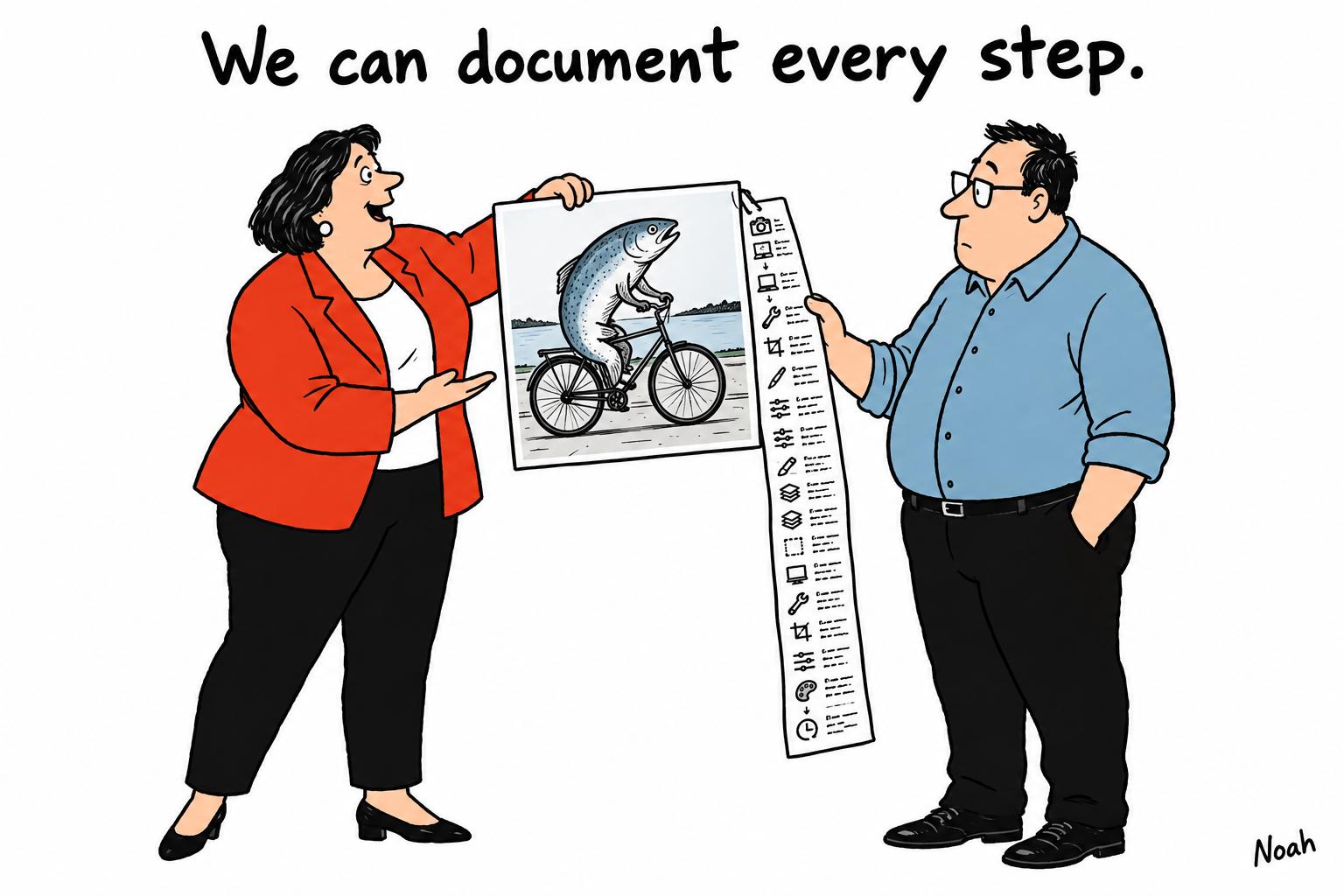
Cartoon · AI-generated
As newsrooms use AI to classify and route images, publishers are focusing on records that document an image’s origin, edits and tools used , while recognising that provenance cannot by itself prove a picture is authentic.
Publishers are increasingly using artificial intelligence in the quieter parts of the image chain rather than at the point of creation. In a recent piece for InPublishing's AI special on image workflows, Fotoware chief product officer Janniche Moe argued that newsrooms are most comfortable using AI to recognise faces, places, objects and events so that images can be tagged, described and filed more efficiently. That reflects a broader newsroom pattern: the Reuters Institute’s 2026 media trends report found that back-end automation, including automated metadata, remains one of the most commonly valued AI uses in news organisations.
The emphasis, however, is shifting from convenience to credibility. Many publishers remain wary of using AI to generate or materially alter editorial images, preferring instead to apply it to classification, routing and archive management. Reuters' own standards underline why: the agency says it does not use generative AI to create or enhance editorial imagery, while allowing approved tools to assist with tasks that do not change the underlying photograph. For visual journalists, the key issue is not merely whether AI can speed up the workflow, but whether its use leaves the image's editorial integrity intact.
That is why image provenance has become central to the discussion. In practical terms, provenance is the recorded history of a digital image from capture through to publication, including who created it, what edits were made, which tools were used and whether AI played any role. The C2PA standard, which underpins Content Credentials, is designed to make that record tamper-evident through cryptographic hashes and digital signatures. But C2PA's own explainer also stresses its limits: provenance can be incomplete or removed, and a credential alone does not prove that an image is truthful or that it depicts reality as it happened.
The distinction between provenance and AI detection matters here. Detection systems make probability-based judgements about whether an image may have been generated or manipulated, whereas provenance offers an evidential record of how a file was handled. That makes provenance a more useful tool for publishers that need to explain not just whether an image might be synthetic, but where it came from and what happened to it along the way. The US Office of Research Integrity has made a similar point, noting that credentials can record creation, modification, software and time stamps, while still requiring human judgement because missing or stripped metadata does not prove an image is false.
Digital asset management systems are becoming the place where those records must live if they are to be useful. According to Moe's article, a DAM should preserve provenance credentials, track edits and workflow actions, document AI involvement and make that information easy for editors to inspect. Microsoft's documentation on provenance disclosure takes a similar line, describing credentials and watermarks as practical signals that can record origin, generation history and whether AI was involved, although support varies by model and scenario. The result is a more transparent workflow in which automation can help newsrooms move faster without obscuring how visual assets were handled.
That transparency is now doing double duty. It is an operational requirement, because publishers need reliable systems that can route, enrich and audit content at scale, and it is also a trust requirement, because audiences are increasingly sensitive to manipulated imagery and deepfakes. Editors can still make normal adjustments such as cropping, colour correction or resizing, but the record should show what changed, when it changed and which tools were involved. As publishers fold AI more deeply into image management, the prize is not simply efficiency; it is a documented chain of custody that allows them to defend the authenticity of what they publish.
Inspired by headline at: [1]
Sources by paragraph: - Paragraph 1: [2], [4] - Paragraph 2: [2], [5] - Paragraph 3: [2], [3], [6] - Paragraph 4: [3], [6] - Paragraph 5: [2], [7] - Paragraph 6: [2], [3], [5], [6]
Source: Noah Wire Services · Original