Local news has a grant. Now it needs an income
Cartoon · AI-generated
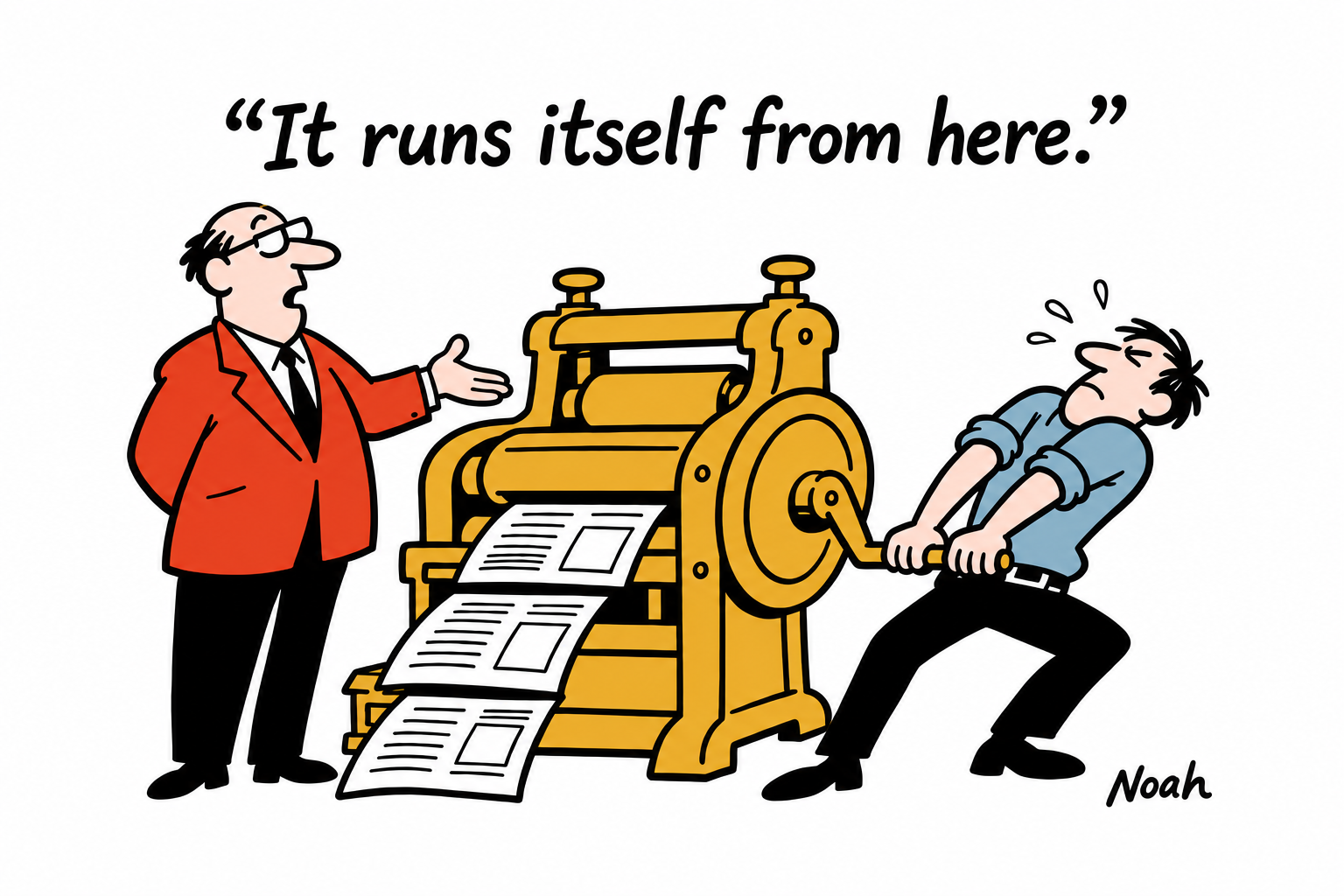
The Meon Valley Times has won £98,450 from the government’s Local News Fund. Its explanation to readers is unusually useful: the money will help build the business, but it will not pay for the everyday work of reporting the news. The distinction matters more than any promise of a new app. England and Wales are getting a publicly funded experiment in making local journalism pay. Publishers gain room to invest; taxpayers carry the initial risk. The decision now is whether that money buys continuing reporting capacity or a collection of projects whose bills outlive their grants.
In a 5 November question-and-answer article under Steve Clark’s byline, the newspaper says: “These are temporary project-funded roles, not permanent newsroom posts.” A Community Engagement Editor and a Partnerships Manager are funded until March 2027. Further recruitment depends on income the business can generate.
The paper says it currently has one journalist. That is a revealing starting point for a development programme. Someone must keep producing the journalism while new systems, commercial relationships and community contributions are organised. A grant can fund the attempt to escape that constraint. It cannot establish that enough readers or businesses will pay afterwards.
The Stray Ferret is making a related bet in Harrogate. Its £59,247 award will fund subscription improvements and self-service advertising. Founder Tamsin O’Brien puts the commercial reality plainly in the publisher’s 5 November announcement: “We have always needed both subscriptions and advertising to survive.”
The government announced a £6 million funding package on 5 November, covering local outlets and shared infrastructure. Its project register includes Mill Media, Newsquest and Media Concierge alongside much smaller publishers. This is an opportunity to compare competing answers to a common problem, rather than declare one winning model before the work has been done.
The less glamorous investment
The Stray Ferret plans easier movement from monthly to annual subscriptions, £1 entry offers and an automated system through which advertisers can load their own material. It says the changes will let it reduce advertising prices in 2027, with features due over the next five months.
Noah, a research and forecasting service, puts the chance of at least one Stray Ferret campaign being booked, paid for and delivered through self-service, without a staff-negotiated order, between 10 November 2026 and 9 May 2027 at 53%. The funded rollout supports that possibility; the uncertainty is whether self-loading extends to independent checkout. This is a first-transaction milestone, not a forecast of profitable advertising.
Those proposals expose both sides of the calculation. A simpler purchase may attract a business that would never telephone a sales representative. It may also persuade an existing customer to pay less. An introductory subscription can recruit a reader cheaply and still lose money if that reader leaves before paying the normal price.
Consider a hypothetical local publisher that cuts the staff time needed to book an advert from half an hour to five minutes. It has freed 25 minutes, not necessarily earned more money. If the advertiser also pays a lower price, the saving must cover the discount and the system’s ongoing cost. The useful measure is the contribution left after serving the customer, alongside whether that customer returns.
That is why a working payment page is an intermediate result. The stronger evidence would show what proportion of trial subscribers remain after their introductory offer, how annual renewals perform and whether advertising produces more cash after administration. The denominator matters: an impressive number of sign-ups can conceal a much larger group that never pays again.
Mill Media’s £125,000 reader engagement project covers seven titles. Better reader data can improve an invitation to subscribe, but it cannot create a reason to pay. Its value depends on whether editors can use it without losing reporting time.
A wider European comparison strengthens the case for patient evaluation. Capital Stacks of Journalism, from the Center for Sustainable Media and partners, examines 21 viable ventures, including Mill Media. It describes grants financing audience infrastructure before reader revenue grew, and a median three years to first break-even. This is a deliberately selected group of viable businesses, not a success rate for news startups. It shows a possible route, not the odds of this grant round working. The missing resource may be the cash and management time to reach that point.
The Meon Valley Times, meanwhile, describes progress reports and financial records required under its grant agreement, as well as intended public updates. That separates accountability for spending the award from evidence of a durable business. Completing the contracted development work is necessary. Continuing to fund journalism afterwards is the harder result.
Shared tools, continuing bills
The Public Interest News Foundation made the distinction explicit in its July guidance to applicants: the scheme was designed to support innovation towards sustainability, rather than ordinary core costs. Its account set a completion date of 22 March 2027. That was the application timetable, not confirmation that every recipient now has identical delivery terms.
The practical window matters. JournalismUK’s Jacob Granger reported on 5 November that the scheme attracted more than 200 applications. His public report also describes missing questions in application forms and payment delays of up to three weeks, based on documents the publication says it saw. Those are reported problems, not documents inspected by Tomorrow’s Publisher.
For a small newsroom, late payment can mean carrying costs before the promised cash arrives. It can also compress the period in which an audience experiment has time to produce useful renewal evidence. Fixing the administration is therefore part of making the innovation work, rather than a separate bureaucratic concern.
Shared infrastructure could spread the benefit beyond the original recipients. Open Council Network has £183,836 to expand council-document tooling already used by 35 Local Democracy Reporters at Reach titles. Media Concierge has £239,960 to extend its Minerva revenue analytics to smaller independent publishers.
There are already different prices for different kinds of access. Open Council Network’s public plans offer recent summaries free and a Professional subscription at £50 a month or £500 a year. Separately, its API, the connection for feeding data into another product, starts at £249 a month. These are current advertised services, not the published terms of the grant-funded expansion. Shared infrastructure need not mean free infrastructure. A small publisher needs to know which service it requires, what continued access costs and whether its own data remains portable.
Article-level revenue information also needs editorial judgement. A report about a council decision may attract little immediate advertising income and still be the reason a subscriber trusts the publication. Measuring revenue more precisely is useful. Treating the easiest revenue to attribute as the entire value of a story would be a poor reason to stop covering it.
The AI test is additional reporting
Newsquest’s £125,000 London Local News Lab plans an app for gathering interview material and producing AI-assisted transcripts and draft formats for editorial review. It will support a new Hammersmith & Fulham service. These are funded plans, not demonstrated savings or evidence that the service is already sustainable.
The attractive possibility is straightforward: less time copying material between systems could leave more time to ask questions outside the newsroom. That is a credible use of AI. It still has to survive the full production process, including checking names, quotations, context and what the software leaves out.
An editor’s approval is a safeguard, not a free resource. If checking a draft takes longer than the task it replaces, the apparent saving disappears. If the tool helps a reporter identify an important decision that would otherwise have gone unread, the benefit may be substantial even when the final article takes the same time to write.
The evaluation should follow a story from source material to publication. How much staff time did it require? What errors needed correction? Did the tool enable original questions and follow-up reporting, or merely more versions of the same account? Output volume by itself cannot settle whether the public received better scrutiny.
The public return
The risk is not that every project must become wholly commercial immediately. Some reporting has a public value that the local market will not fully finance. The government’s March action plan explicitly recognises market failure in public-interest journalism. Innovation funding should not be asked to prove that this wider problem has vanished.
But the awards can establish which investments make a newsroom less fragile. Recurring income after acquisition costs, a manageable technology bill and more reporting time would be meaningful gains. So would evidence that a shared service helps a publisher that could not have built it alone.
The Meon Valley Times has started with the right disclosure: this award develops the organisation, while the news still needs a business to support it. The fund’s success should be judged by what remains when the temporary roles and development budgets end. A new system is worth celebrating when it leaves someone able to report the next council meeting.
Sources
- Meon Valley Times: Local News Fund questions answered, Steve Clark, 5 November 2026
- Stray Ferret: grant award and planned subscription and advertising changes, 5 November 2026
- DCMS: Local News Fund awards and full project register, 5 November 2026
- Public Interest News Foundation: Making sense of the fund, 9 July 2026
- JournalismUK: Jacob Granger on delays, forms and payments, 5 November 2026 (secondary reporting; public preview)
- Government: Amplify, Local Media Action Plan, updated 26 March 2026
- Open Council Network: public free and Professional access plans, checked 9 November 2026
- Open Council Network: separate API pricing, checked 9 November 2026
- Center for Sustainable Media and partners: Capital Stacks of Journalism, executive summary
- Research and forecast notes: definitions, uncertainty ranges and complete returned register
Source: Tomorrow’s Publisher