IT/OT Insider draws a line between AI assistance and human authorship
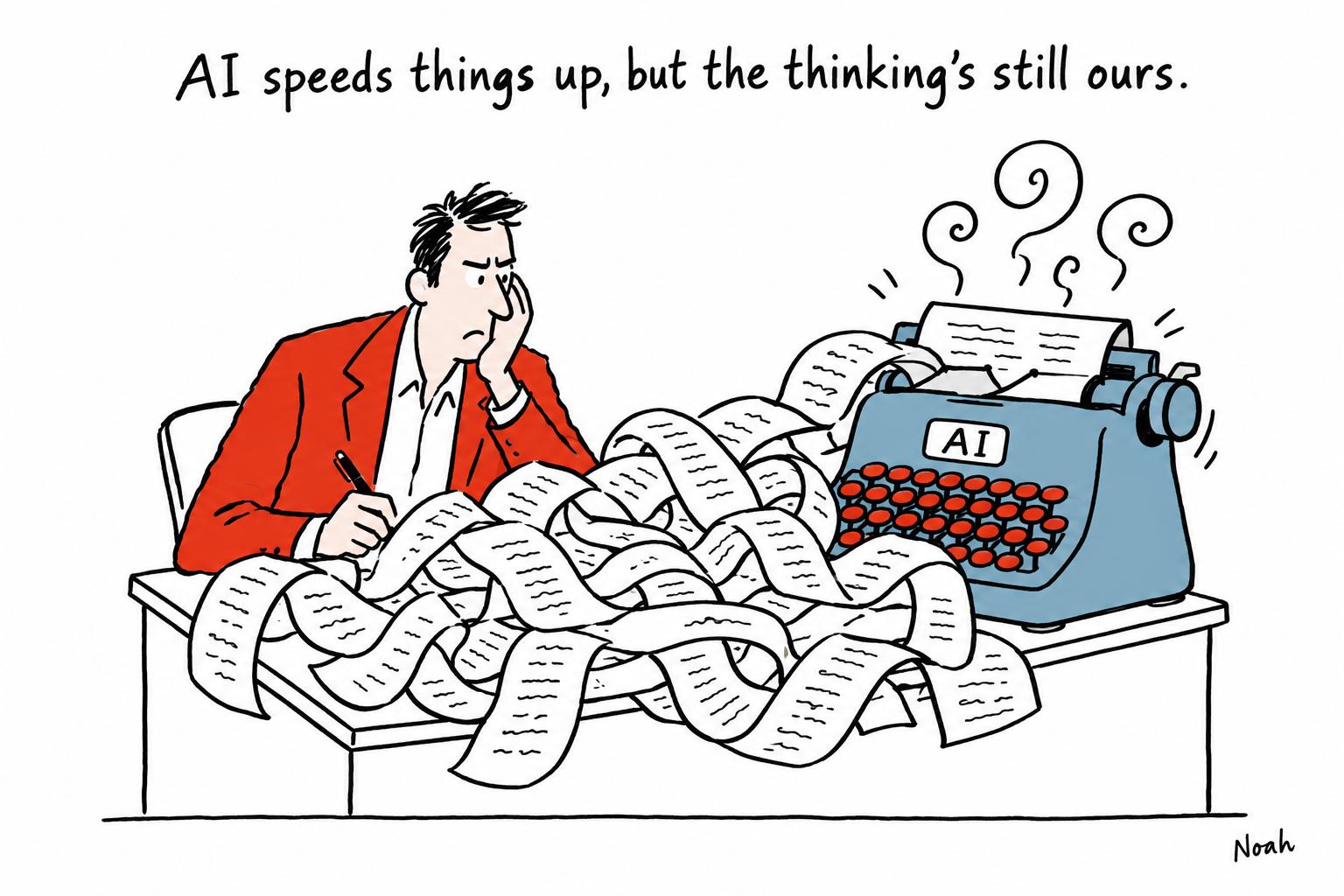
Cartoon · AI-generated
The publication says AI can speed up research, coding and editing, but insists that writers must retain responsibility for the thinking, voice and final copy.
The IT/OT Insider has chosen to spell out, in unusually plain terms, where artificial intelligence helps its work and where it does not. In a publishing landscape increasingly crowded with machine-produced copy, the site’s central message is that AI may assist with research, coding and editing, but it will not be allowed to replace human authorship. That distinction matters more as AI moves deeper into professional workflows and as, according to Axios, the pace of model development continues to outstrip the academic and editorial systems built to assess it.
The publication says AI is most useful at the start of a project, particularly when it needs to get up to speed on a new technical subject. In practice, that means using it to generate long discussion papers packed with references, which then serve as a launch pad for independent reading rather than a finished product. That approach reflects a wider shift across engineering and research communities. TechRadar has reported that AI can accelerate both software production and scientific work, but it also introduces obvious risks: one recent analysis found that while AI-generated code was highly fluent, a substantial share of it still failed security checks. The lesson is not that AI should be avoided, but that it has to be supervised carefully.
That caution is especially relevant in coding, where the IT/OT Insider says it already relies on AI for websites and demos. Other companies have been taking a similarly aggressive approach. Tom’s Hardware reported that Nvidia now uses a specialised version of Cursor across its engineering teams, with more than 30,000 developers drawing on AI tools for writing, testing and debugging code. Nvidia says the result has been a large increase in output, though human review remains in place and bug rates have not risen. The IT/OT Insider’s stance is more modest, but the principle is similar: AI can take over repetitive work, provided a human still decides what belongs in the final product.
The same pattern runs through the rest of the site’s workflow. It uses AI to help manage its website, generate transcripts and summaries for podcasts and videos, and support internal editing by checking structure, consistency and grammar. Yet the publication makes clear that these tools are advisory, not decisive. The aim is to preserve the writers’ own voice while reducing the time spent on mechanical tasks. In that respect, the approach is close to what industry guides describe as AI-assisted development: the machine can suggest, but the person remains responsible for judgement, accuracy and the finished result.
That distinction also extends to the organisation’s longer-form work. The IT/OT Handbook, it says, is written by humans and edited by its publisher, even if AI is useful during the revision process. The publisher, IT Revolution, has its own formal policy stressing that original human insight, expertise and authorship remain essential. The site’s articles follow the same logic. They are deliberately kept tight, with the writers preferring a concise, highly edited form that aims to leave readers able to explain the subject to someone else after one reading.
Ultimately, the disclosure is not a defence of AI so much as a boundary-setting exercise. The publication argues that readers are entitled to know when a tool has helped shape a piece and when it has not, especially as online publishing becomes harder to trust. That concern is echoed by broader industry data: Axios has reported that AI-assisted content has become common across the web, while studies cited by TechRadar suggest that speed and scale do not automatically produce safety or reliability. Against that backdrop, the IT/OT Insider’s promise is straightforward enough: use AI where it saves time, but keep the thinking, the writing and the accountability human.
Inspired by headline at: [1]
Sources by paragraph: - Paragraph 1: [2], [3] - Paragraph 2: [1], [5] - Paragraph 3: [2], [4] - Paragraph 4: [1], [7] - Paragraph 5: [1] - Paragraph 6: [3], [6], [2]
Source: Noah Wire Services · Original