HubSpot found AI made writers faster — but publishing slower
Cartoon · AI-generated
A year after adopting an AI-first workflow, HubSpot found that quicker drafting brought longer articles, deeper checks and a renewed focus on human judgement.
When HubSpot’s blog team moved to an AI-first writing model in June 2025, the shift was not greeted with simple enthusiasm. There was relief at the prospect of trimming obvious inefficiencies, but also a more personal anxiety: what happens to a team whose work has always depended on judgement, voice and individual craft when the process changes so quickly? The answer, after a year of experimentation, was more complicated than a straightforward productivity gain. The company found that AI could accelerate certain parts of editorial production, but it also introduced new layers of checking, refinement and management that preserved the central role of human writers rather than replacing it.
Before the transition, the team’s approach was relatively loose. Writers were trusted to shape their own workflow within editorial guardrails, and that freedom helped produce posts with personality as well as substance. Research, drafting and final polish were all time-consuming, but the main labour sat in the writing itself. Once AI tools such as Claude, ChatGPT and NotebookLM entered the process, the team deliberately avoided imposing a rigid new method at the outset. Instead, writers were asked to experiment first and let the workflow evolve around what proved genuinely useful. That decision reflected a wider view among content leaders that AI should support editorial judgement, not dictate it.
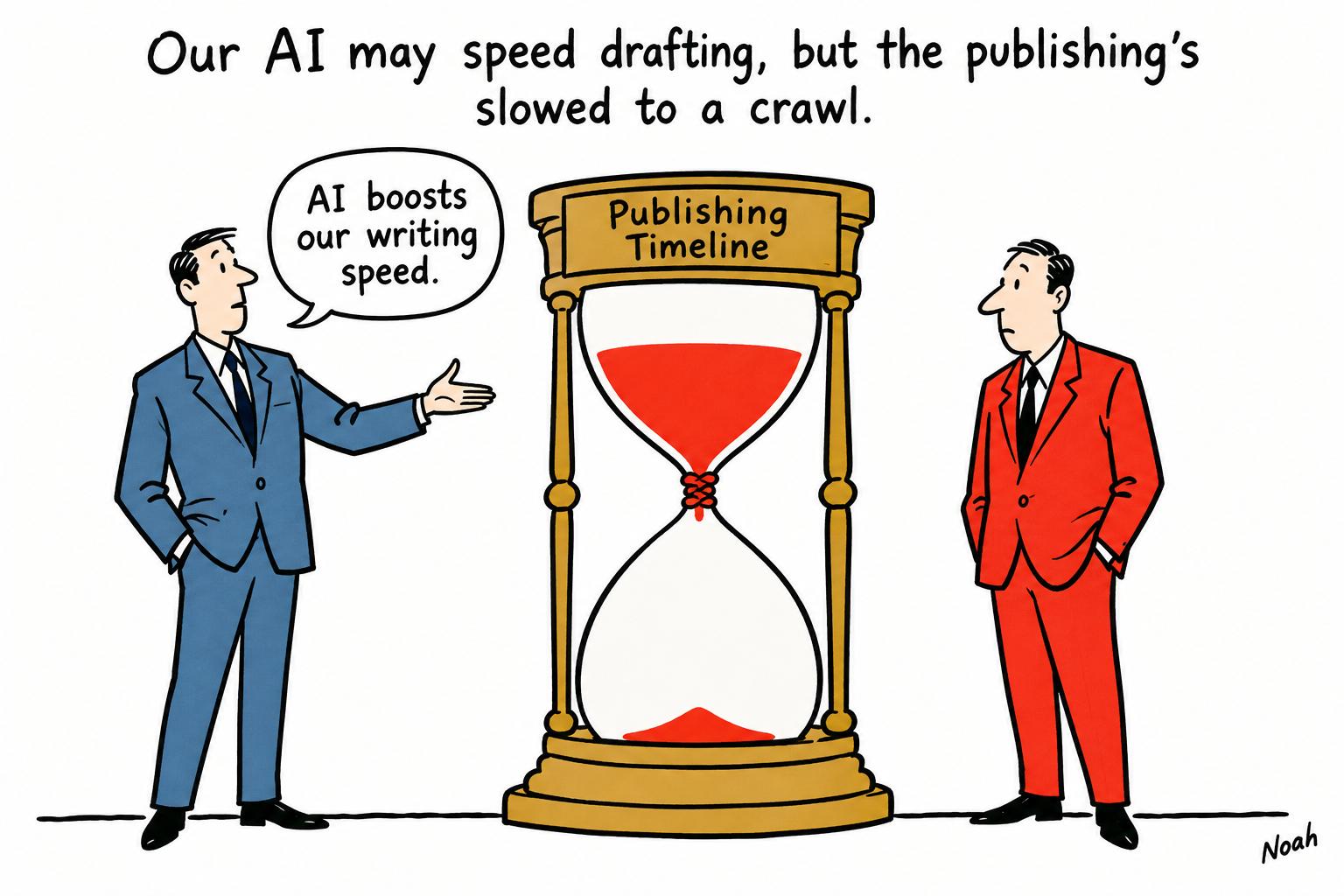
The most immediate surprise was that faster drafting did not translate into faster publishing. HubSpot’s internal tracking suggested that although writers could generate text more quickly, the overall workload did not shrink. Posts became longer, more detailed and more demanding to produce, because the time saved at the blank-page stage was absorbed by deeper research, more extensive source gathering and greater scrutiny of the final product. That experience fits a broader industry pattern: AI is increasingly common in online publishing, yet high-volume output can only work if review standards keep pace. 5W Public Relations has argued that scaling content without scaling editorial review leads to quality erosion, even though well-edited AI-assisted work can perform better in AI search citations than unreviewed material.
Research proved to be the sharpest fault-line. For broad explanatory topics, AI could speed up orientation and help writers get up to speed quickly. But once the work depended on current product information, competitor pricing or recent feature changes, the limitations became obvious. HubSpot’s writers found outdated information being presented with confidence, and the problem was not confined to pricing. AI also produced fabricated statistics, misattributed quotes and incorrect terminology, all in a tone that sounded authoritative. Scribendi has warned that human editors remain essential precisely because fluent AI text can conceal errors, including invented references and other inaccuracies that automated systems do not reliably catch.
That led HubSpot to formalise a separate fact-checking stage, something that had not previously existed as a distinct step. What had once been folded into a final editorial pass became a dedicated part of the workflow, particularly for posts involving statistics, quotations or product claims. The company also expanded quality assurance beyond factual accuracy to cover the tell-tale weaknesses of machine-assisted prose: overused AI phrases, repetition, poor link handling, missing image alt text, awkward heading structures and content that was not easily parsed by search systems. This is consistent with broader guidance from Studio24 and Brightspot, both of which stress that successful AI adoption depends on clear boundaries, explicit quality standards and careful integration into existing editorial processes.
Even so, the company’s leadership came away convinced that the most important elements of good editorial work never moved to the machine. Original reporting, first-hand perspective, strategic judgement and careful source selection remained human responsibilities. That is not merely a matter of taste; it is increasingly a structural issue in digital publishing. Axios reported in May 2026 that Graphite’s analysis suggested AI-generated content had levelled off at roughly half of online material for more than a year, indicating that human writing still occupies a substantial share of the web. At the same time, experts quoted in that report warned of the risk of future AI systems training on low-quality synthetic content, potentially creating a feedback loop of derivative output.
For managers, the lesson was as much about people as process. A team of writers does not react to AI in one uniform way. Some are energised by a tool that speeds up routine work and gets them to the finish line sooner. Others feel that an AI-led workflow threatens the craft that brought them into journalism or content work in the first place. HubSpot’s experience suggests that the most effective response is not to prescribe a single method, but to create room for honest feedback, set clear standards and let writers help shape how the tools are used. In an environment where quality, trust and originality matter more than ever, the value of a writer is not diminished by AI. If anything, it becomes easier to see.
Inspired by headline at: [1]
Sources by paragraph: - Paragraph 1: [2], [4] - Paragraph 2: [1], [4], [5] - Paragraph 3: [1], [3] - Paragraph 4: [1], [7] - Paragraph 5: [1], [4], [5] - Paragraph 6: [1], [2] - Paragraph 7: [1], [4], [5], [6]
Source: Noah Wire Services · Original