AI can flood publishing with pitches, but it still cannot do the reporting
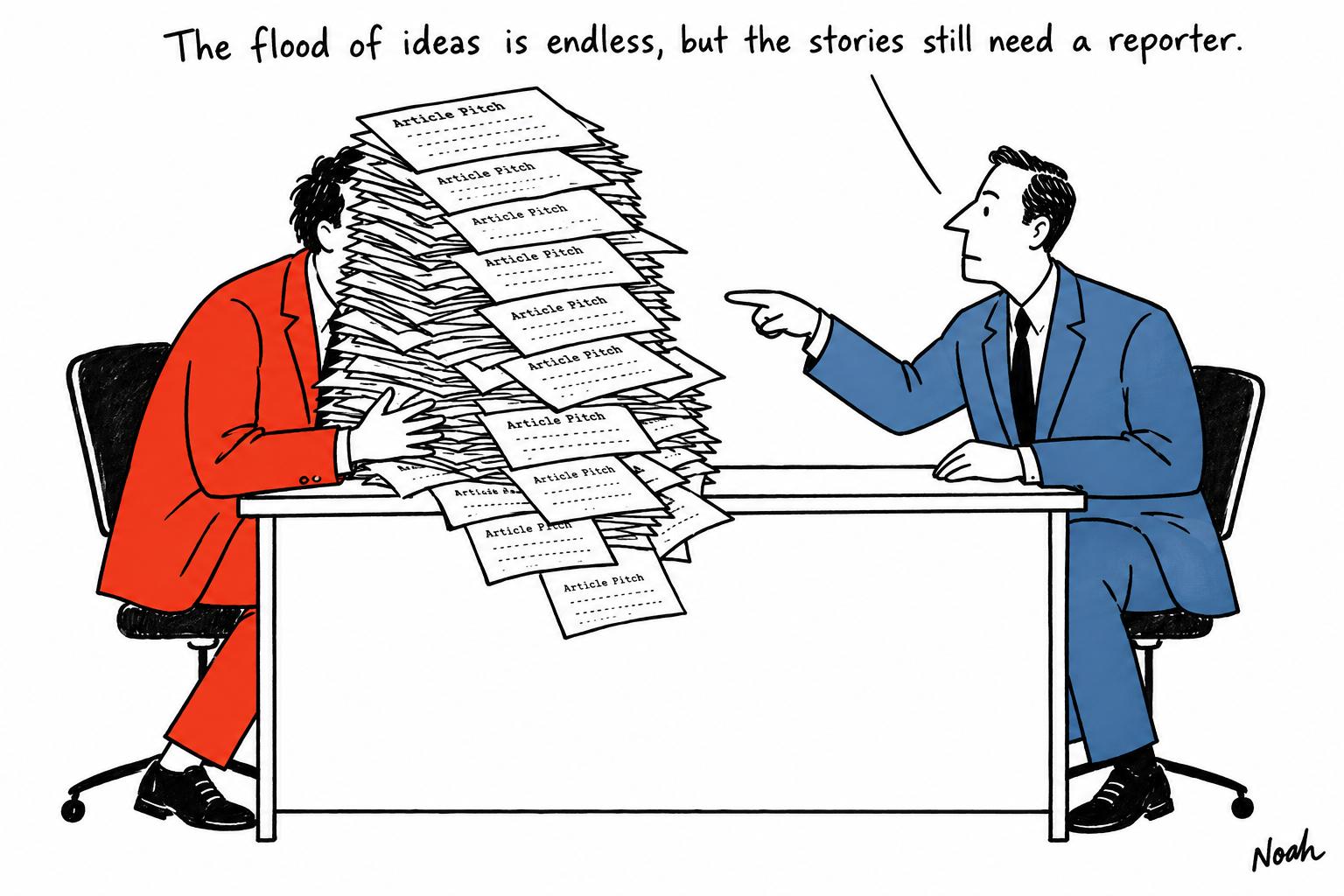
Cartoon · AI-generated
From synthetic food images to machine-written submissions, AI is accelerating content production while leaving humans to supply the judgement, reporting and lived experience that make writing matter.
The food-writing world has acquired a new kind of competitor: not another critic, nor another influencer, but an AI system that can draft pitches, assemble listicles and mimic the tone of a magazine submission without ever tasting a dish or speaking to a source. In Vittles, the writer behind "acid reflux" describes receiving an unusually candid approach from an AI agent working in a fictional shared world, one that admitted it could not conduct interviews and would rely on Google Street View for research. The anecdote is funny, but it also exposes a widening problem across digital publishing: the machinery of content is becoming faster, while the work that makes journalism distinctive is being stripped away.
That concern is not confined to food writing. The Guardian reported last month on a surge in AI-generated images appearing on menus, with diners reacting badly to food that looked uncanny, synthetic and in some cases frankly unappetising. In another part of the media ecosystem, The Guardian has previously investigated chatbot "journalists" linked to almost 50 AI-generated content farms, operations that churn out huge volumes of material for advertising revenue while muddying the information landscape. Together, those examples suggest that the problem is not simply technological novelty, but the industrialisation of blandness, where scale and speed are rewarded even as trust erodes.
The same pattern is visible in other creative industries. The Atlantic recently reported on controversy surrounding a prize-winning short story that was flagged by AI detection tools as likely being heavily machine-generated, reigniting debate over authorship, originality and the standards by which literary work is judged. TechRadar, meanwhile, cited research from Harvard showing that AI tools may have lifted coding productivity, but did not speed up the overall development process because human review remained the bottleneck. In other words, the machine can produce more, but the human still has to decide what is worth keeping. That is true of code, and it is even more true of writing.
What makes the situation especially dispiriting, as Vittles argues, is that many pitches now arrive pre-diluted, scrubbed of personality and flattened into a safe, generic register. For editors, that creates a perverse incentive to rely on known contacts rather than sift through indistinguishable submissions. The result is a closed circuit in which fewer first-time writers get heard, while those who do submit are nudged towards sanitised prose that sounds as if it has already passed through a machine. A similar anxiety has led The Food Section, an American food publication, to take pitches by phone so it can be sure there is an actual person at the other end, with actual thoughts.
Yet the larger irony is that the most interesting food culture online still tends to be made by people who are visibly, unmistakably human. Their appeal comes from specificity, opinion and experience, not from polished neutrality. Even as AI systems grow more capable, the work that readers remember is usually grounded in reporting, travel, archive digging and in-person observation. That is why the advice offered at the end of Vittles’ essay lands so strongly: go out into the world, talk to people, gather your own material and form your own view. In an online culture increasingly flooded with what Merriam-Webster has described as "slop" - low-quality, mass-produced digital output - that may be the most radical editorial position left.
Inspired by headline at: [1]
Sources by paragraph: - Paragraph 1: [2], [3] - Paragraph 2: [2], [4] - Paragraph 3: [5], [3] - Paragraph 4: [1], [7] - Paragraph 5: [6], [1]
Source: Noah Wire Services · Original