What is a hit video worth to The Economist?
The publisher gives subscribers first access to big interviews and is piloting a cheaper audio and video bundle. Its next investment turns on which viewers pay and which subscribers stay.
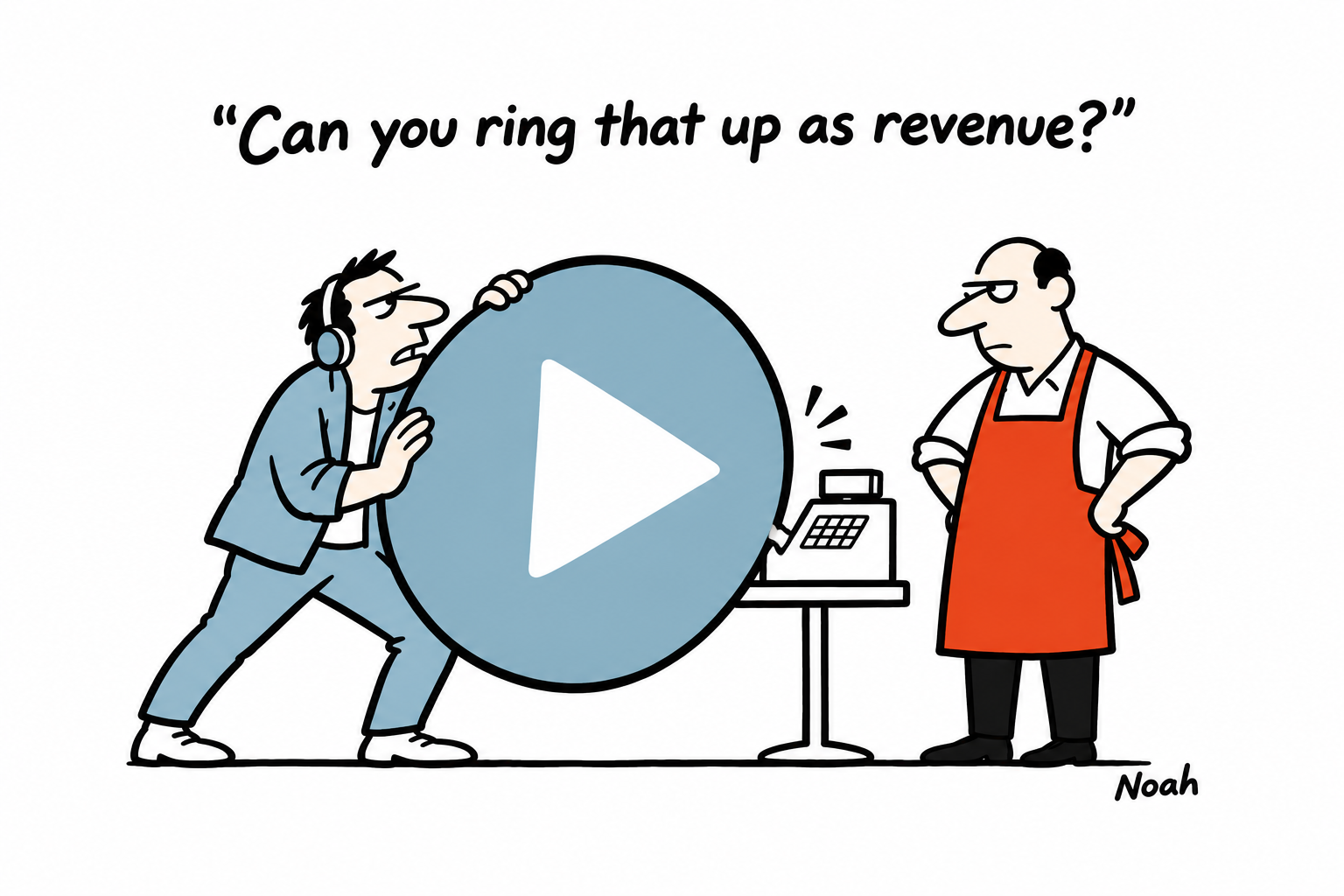
Cartoon · AI-generated
In July, The Economist interviewed Elon Musk for its subscriber video show, The Insider. It put the full interview on YouTube on 29 July, after an initial period of subscriber access. Its interim report says the video had approached eight million views by early November. The publisher also ended September with 1.357 million subscriptions, up 8% year on year. How much of that increase did the camera earn?
Viewers get access to the people behind the magazine’s analysis, and a publisher gets a new reason to ask people to pay. It also has to find studio time, edit the programme and take senior journalists away from work on other formats. Before expanding the schedule, publishers should put a value on the paid subscriptions the show can actually win or save.
Luke Bradley-Jones, the group’s chief executive, told Axios on 24 November that when subscribers watch The Insider, “their retention rate improves materially”. The company’s annual report also says people who engaged with the product renewed more often across subscription types and prior levels of engagement. That comparison is stronger than putting all viewers in one group and everybody else in another. It still leaves the size of the difference and the rate those same viewers would have renewed at anyway undisclosed.
their retention rate improves materially
The interim report gives reasons for caution about the group figures. Revenue rose 8% to £184.7m and operating profit rose 24% to £25.1m for the six months to September. Of the £14.4m increase in group revenue, £9.1m came from Economist Enterprise, which includes events. The chair, Paul Deighton, said the earlier timing of a EuroFinance event helped the half-year. He also cited new corporate clients, a strong news cycle and investment in marketing, including a television campaign. Those accounts show a growing business with several moving parts.
One interview, two release dates
The Insider’s launch announcement described two weekly shows, live and on demand, with questions from subscribers and a dedicated newsletter. That is a broader offer than a brief head start on an interview. The company says more than 75% of subscribers had engaged with Insider by the end of March 2026. Its case study includes the newsletter in its discussion of engagement and gives no separate count of how many paid subscribers watched a whole episode.
The public version of the Musk interview shows what the second release can do. The Economist’s YouTube description says it is publishing selected full interviews after a delay. A big guest can draw people who have never opened the app. Some will watch again, follow the channel or take a subscription. Others may learn to wait for a free version. A tagged link beside a public video can show who followed it to checkout. It can miss a person who watches on a television and subscribes later on a phone. It can also give the video credit for a person who was always going to buy. An editor deciding whether to commission a weekly series would want the results for a typical episode alongside the blockbusters.
Noah, a research and forecasting service, estimates only a 22% chance that, by 29 November 2027, The Economist will have changed Insider’s regular UK release model after 29 November 2026 and made at least one full-length regular interview available free to UK nonsubscribers at the same time as subscribers under that model. The publisher already gives some interviews a public release. It can do more of that while keeping an earlier screening for subscribers.
Axios also reported that The Economist sells sponsorships against its videos and earns revenue when it releases some on platforms such as YouTube. Economist Group executive Leon Saunders Calvert named Anthropic as the show’s first sponsor at launch. The terms and the scale of video income were undisclosed. Those receipts can help a show cover its costs, while a subscriber’s decision can also turn on the value of early access and what remains exclusive.
A newsroom still has to decide which discussions deserve a camera. “You simply cannot do video with a set of anonymous people,” Liv Moloney, The Economist’s head of video, told Digiday in July. The group’s annual report says the team recorded more than 50 pilot episodes and built a set and studio gallery. That investment let a magazine known for unsigned articles put named journalists on screen. A cheaper edit or an audio-only version can be commercially preferable when the exchange does not benefit from being seen. A camera makes most sense where seeing the person or the evidence adds something worth returning for.
A cheaper seat changes the arithmetic
On 1 July, The Economist started piloting Play in Canada, Denmark, Norway and Sweden. In Canada it listed the tier at C$19.80 per month at launch. It bundles The Insider with premium podcasts, daily briefings, newsletters and games. Existing Podcasts+ subscribers in the pilot markets were offered an upgrade at the same price at launch, and premium subscribers kept the benefits at no extra cost. Those people can use more of the journalism before the publisher sells a single additional subscription.
The lower tier has to win enough new payers or keep enough people who would otherwise cancel to cover any drop in revenue from customers who would have stayed on the full plan. A live trial can track each of those groups separately. It can also reveal whether people eventually move from audio and video to the full subscription. The half-year results reviewed give no separate count of those movements. Overall subscriber growth alone gives a publisher little basis for copying the price.
The Guardian is trying a different route. On 19 November its new production unit, Guardian Studios, released The Close Up, a twice-weekly culture show hosted by Carys Afoko and Lanre Bakare. It is distributed on the Guardian’s site, YouTube and audio platforms. Its first episode is offered publicly, alongside a publisher-wide business built in part on voluntary reader support. For such a show, repeat viewing and visits to other Guardian journalism may matter before a donation or subscription. A sponsor could help pay for the production, but the show’s launch gives no revenue or retention figure. The two models need different success measures.
The renewal that pays for the studio
A test could randomly send two comparable groups of existing subscribers a reminder near renewal. One points to an Insider episode and the other to an equally prominent piece of journalism in another format. Both groups keep their subscriptions and can watch. Renewal is measured in the whole groups, including the people who never click. A difference would tell the publisher what the promotion changed. It would take more than that test to learn what subscribers would do if the entire show disappeared.
Suppose, in a hypothetical test, 820 out of 1,000 people sent the video reminder renewed, against 800 out of 1,000 sent the other reminder. If the difference held up as the test expanded, and an extra renewal contributed £100 after servicing costs, those 20 extra renewals would yield £2,000 toward the show’s costs. Comparing the people who chose to watch with those who skipped the reminder would be a different exercise. It could give the show credit for the loyalty it attracted.
A balanced budget can count several sources of value, including additional subscriptions, kept renewals and attributable advertising or sponsorship. It should also include costs that the accounts may spread across production and editorial teams, and recognise when the same customer appears in more than one column. A hit earns attention immediately. The numbers that justify commissioning a second season arrive when those viewers have a choice to pay again.
Sources
- The Economist Group, interim report for the half-year ended 30 September 2026
- The Economist Group, half-year results and earlier annual comparison
- The Economist, full interview with Elon Musk and delayed-release description on YouTube
- Economist Podcasts, the 23 July Musk interview and subscriber show attribution
- Sara Fischer, Axios, interview with Luke Bradley-Jones on subscriptions and video
- The Economist Group, annual report to 31 March 2026, production and subscriber engagement
- The Economist, original Insider launch and offer
- Sara Guaglione, Digiday, interview with Liv Moloney and Nada Arnot
- The Economist, four-market pilot and launch pricing for Play
- The Guardian, launch of The Close Up from Guardian Studios
- The Guardian, public first video episode of The Close Up
- Guardian Media Group, 2025/26 statutory accounts announcement and supporter model
- Leon Saunders Calvert, launch announcement naming the inaugural sponsor
- Research notes and forecast definitions
Source: Tomorrow’s Publisher