Time Out put its name on a £135 rucksack. What does it earn?
The London publisher’s online shop is live in four markets. Its retail partner handles the order. What matters to the publisher is what it earns and learns when readers buy.
Cartoon · AI-generated
A £135 rucksack is listed on a Time Out website. If a British buyer sends it back, the parcel goes to a returns depot outside Ipswich. The shop names TBH Global UK Ltd, the local company of Time Out’s South Korean fashion partner, as its UK contact. The London publisher has licensed its name for clothes, luggage and body care. Its partner gets an audience familiar with the label and has the work of getting the goods to customers. Time Out gets a route into retail and puts its reputation on what arrives.
The pilot is a credible way to test whether city coverage can sell physical goods. The decision on a wider rollout should turn on what reaches Time Out after returns and promotion, and what the publisher can learn about repeat buyers. The launch announcements leave both questions open.
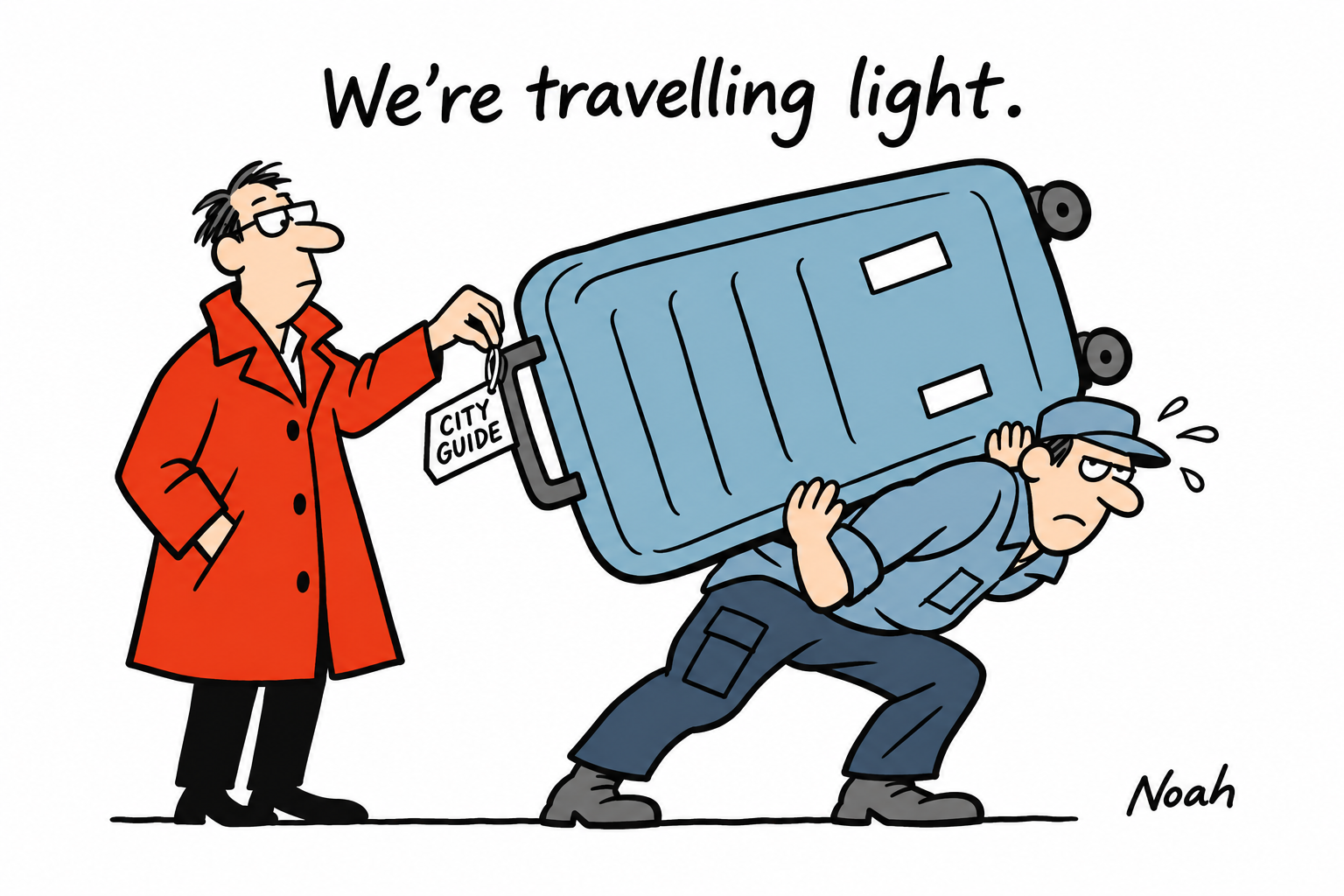
The pilot announced on 18 November covers the UK, US, Japan and South Korea. Time Out says the initial selection exceeds 50 products, priced from £16 to £135. Designs draw on six cities, including London, Lisbon and Seoul. The luggage tie-up with RAWROW puts a miniature Time Out city guide inside each suitcase, according to the launch release. That comes closest to the publisher’s old job. A buyer gets something to read on arrival, as well as something to pack.
The August announcement gave the pilot a more prosaic purpose. Time Out said it would “allow TBH Global to test its global e-commerce platform ahead of the wider international rollout”. The shop policies show what that means. They list fulfilment centres in the UK, US and South Korea, a Japanese returns hub and different shipping thresholds for each market. The UK storefront advertises 10% off a first order and free standard shipping above £50. The same website can serve all four countries. The retailer still needs a way to get returns back from each of them.
The shop borrows a name built on editorial recommendations. The publisher puts it plainly in its editorial guidelines. “We do not alter star ratings or opinions on request.” Time Out already discloses some referral fees and says it labels Time Out Market participants in its coverage. The shop poses a new version of the same question. A reader should be able to tell when a city recommendation is an editor’s judgement and when the company stands to earn from the item being sold.
We do not alter star ratings or opinions on request.
The price on the tag is the retailer’s number
Time Out lends its name and a way to reach people who already read its recommendations. TBH Global brings product development, manufacturing and distribution. The public deal descriptions identify a licence without disclosing the royalty rate, minimum payment, royalty base or who ultimately absorbs discounts and unsold stock. Even an order shipped on time says little about how much income reaches the publisher.
Take a hypothetical licence that pays 8% of sales after refunds, ignoring tax and shipping for simplicity. A hundred £100 orders put £10,000 through the shop. If 20 orders are refunded in full, the sales base drops to £8,000 and the publisher receives £640 before its own costs. A report that gives the £10,000 turnover tells the story of the till. It leaves out most of what the publisher needs to know. None of these assumptions is a figure for Time Out’s deal.
The missing costs can sit on both sides. A partner has to manage stock, dispatches and returns. A publisher may have to supply design approvals, staff time and space in newsletters or on editorial pages. Those slots have a cost even when no money changes hands. The useful commercial comparison is with what the same audience and promotional space would earn from another advertiser or a conventional shopping referral.
Three ways to earn from the same reader
Marie Claire UK discloses fees for referring readers to other retailers through product links. That gives the publisher an interest in a purchase while the retailer handles the sale. The Time Out pilot goes a step further. The publisher’s name is on the item and on the storefront. That can make the relationship with a shopper more recognisable, while making it harder for the publisher to leave a disappointing purchase behind at the retailer’s door.
The Guardian Bookshop shows how publisher-branded retail can operate with a separate specialist. Its terms name Monwell, which also runs online bookshops for The Times, The Mail and the Observer. In a 2020 interview published by the Guardian, Sara Montgomery and Nick Sidwell, then co-running the bookshop, explained that an independent company took over the operation in 2016 and that a portion of each sale went to the newspaper. They also set out the editorial boundary. They said they had “no influence over the books that are reviewed or featured in the Guardian or the Observer”. The operator can follow what the editors cover, leaving the editors free to cover something else next week.
Monocle retains a closer relationship with the sale. Its shop sells goods developed with other makers, and its terms name Winkontent, the company that trades as Monocle and Konfekt, as the supplier. Its retail network includes shops in London and Paris. Direct sale provides more control over the range and customer service, alongside more work and responsibility. A publisher considering a shop has to decide which part of that relationship it wants to own.
February is a test of delivery
The announced February 2027 expansion is a useful date to watch. The August release says the fuller range is intended to launch internationally and that South Korea is expected to begin physical retail through pop-ups. That is a plan for more merchandise and another sales channel. It would be evidence that the partners can extend the operation. The repeat-purchase rate after the introductory offer would show whether demand persists.
The partner has its own reasons to extend distribution. South Korea’s Edaily reported in October that TBH Global’s portfolio already included the licensed British clothing brand Aquascutum alongside its own labels. In November it reported that TBH had secured Time Out rights in China and planned to introduce the brand there. That gives the partnership potential markets beyond Time Out’s four-country pilot. The paper reported a plan, with no opening date for a Time Out shop in China.
Noah puts the chance of that same permanent-shop opening at only 44% by 24 November 2027. The longer window gives TBH time to arrange premises, test an assortment and decide whether the sales justify a fixed location. Korea and China are possible routes. Both still depend on the economics of the same licence.
The bar for keeping a retail operation going is lower. Noah estimates an 83.05% chance that on 24 November 2027 TBH Global is still the licensed operator and at least one of its own or its authorised partners’ physical or online outlets is accepting purchases of in-stock Time Out lifestyle goods. Markets, tickets, vouchers and affiliate-only sales are excluded. One qualifying outlet is enough. The live pilot supports that prospect, while the royalty terms and shop-level results remain undisclosed.
The most useful result of the pilot would be a breakdown by country and product category showing sales after refunds, the cost of bringing in those buyers, how many bought again and what income the licence produced for Time Out. The shop’s privacy notice says it collects transaction data and uses it to run and market the service. It leaves open which sales and customer data the publisher receives under the deal. A publisher can learn quite a lot from aggregate order and return figures. It still needs an agreement that gets those figures into the room before the next range is approved.
The compact experiment here is a city guide that also sells a suitcase. The larger claim is that the same authority extends to the rest of the catalogue. A bigger shop in February would show that Time Out and TBH can put more goods in front of more people. The result worth following is where readers bought a second time, and what that was worth to the publisher whose name was on the first parcel.
Sources
- Time Out Shop: the £135 RAWROW rucksack
- Time Out Shop: returns and refunds
- Time Out Shop: company and contact information
- Time Out Group: Time Out Shop pilot, 18 November 2026
- Time Out Group: TBH Global licensing announcement, 24 August 2026
- Time Out Shop: shipping policy
- Time Out Shop: UK storefront
- Time Out: editorial guidelines and referral disclosures
- Marie Claire UK: affiliate disclosure
- Monwell: shop operations and clients
- Guardian Bookshop: Monwell terms
- The Guardian: interview with Sara Montgomery and Nick Sidwell, 29 February 2020
- Monocle: retail terms and contracting company
- Monocle: shops and cafés
- Time Out Shop: privacy policy
- Edaily: TBH Global’s brand strategy and Aquascutum, 15 October 2026
- Edaily: TBH Global’s China strategy, 19 November 2026
- Research notes and forecast definitions
Source: Tomorrow’s Publisher