Bloomsbury’s smaller AI cheque puts recurring income to the test
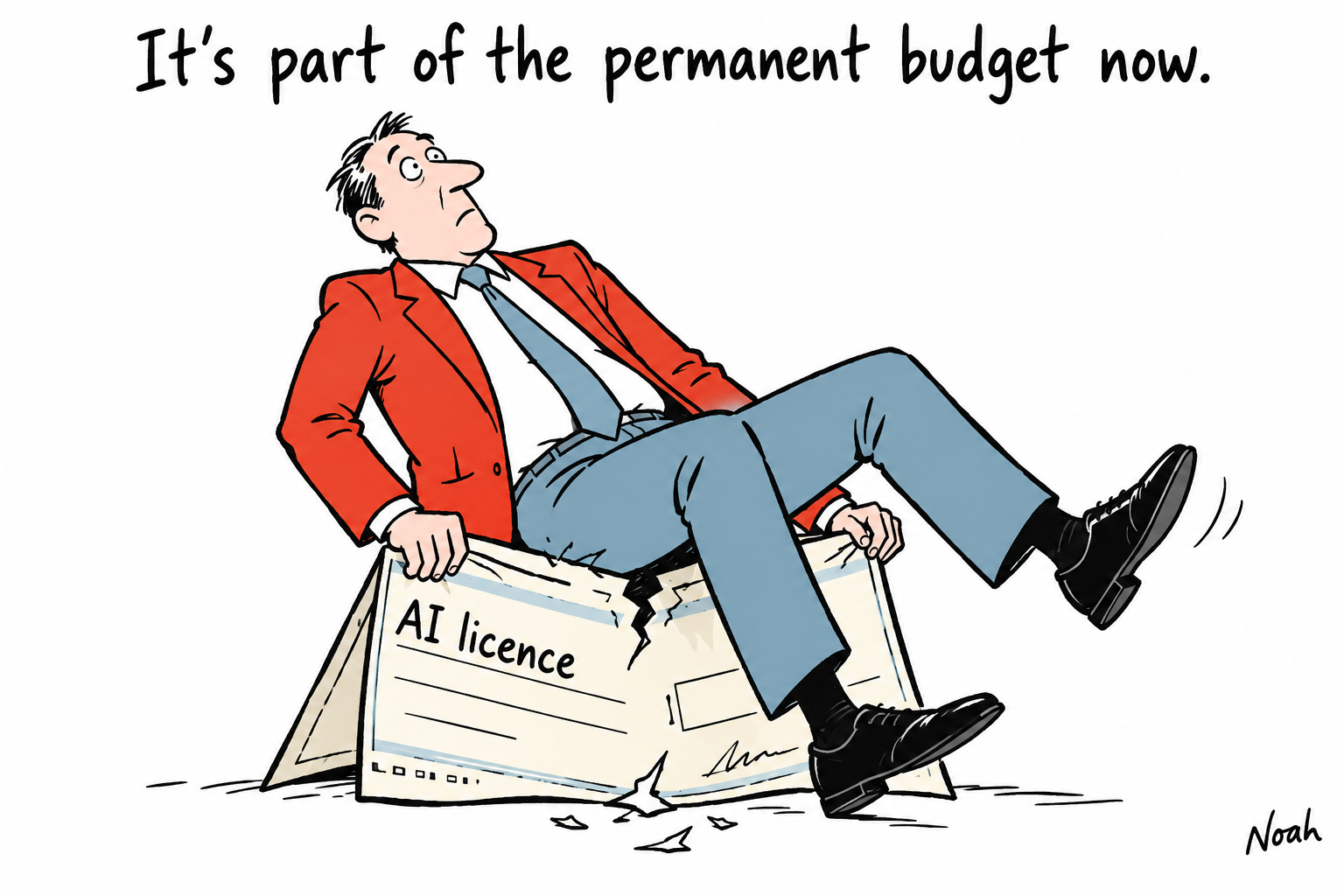
Cartoon · AI-generated
Bloomsbury has given publishers a useful warning about the AI economy: selling more can still leave less profit. Its academic business grew in the six months to August, but a smaller contribution from an ongoing AI licence helped squeeze the margin. The deal had continued; the earlier level of earnings had not.
This is good news for publishers with valuable specialist material to sell, and a warning for anyone counting the first cheque as a new annual salary. The commercial opportunity is established. Dependable income has to be demonstrated separately. Before using licensing proceeds to fund permanent jobs or commitments, a publisher needs to know what the buyer is obliged to pay next time.
The renewal test
Noah puts a 52% probability on Bloomsbury publicly confirming, by 23 October 2027, a new, renewed or extended paid AI-content licence for model training, retrieval or generated answers, executed after today. That is only a narrow lean towards another disclosed transaction. By the nearer checkpoint of 31 May 2027, the probability is only 46.75%. Both estimates require confirmation in Bloomsbury’s own results, annual report or regulatory announcement; a confidential deal could exist without satisfying either forecast.
That distinction matters to the story. Another deal would demonstrate further demand, but would not by itself establish a stable price or a predictable annual payment. Continuing the existing agreement without a new execution would not meet these particular forecasts either. They measure visible new commercial activity, not whether today’s income simply disappears.
Bloomsbury reported Academic & Professional revenue of £48.8m, up 5.9%, while adjusted profit fell from £11.0m to £6.8m. Management linked the smaller licensing contribution to a reduced margin and also reported underlying growth in print and digital, excluding AI licensing. It did not quantify how much of the total profit decline came from the licence.
The group still expects record full-year results. This is therefore a lesson about the composition of earnings, rather than evidence that Bloomsbury’s wider strategy has broken down. Its first non-exclusive AI licence was announced in July 2025, with authors opting in. Further agreements remain possible; non-exclusivity does not make them automatic.
A payment can repeat and still shrink
Consider a purely illustrative specialist publisher paid £1m for initial access to an archive, followed by £100,000 a year for updates. The buyer is still paying in year two. Yet a team costing £400,000 annually, hired on the assumption that the first payment would recur, now creates a £300,000 gap before other costs. These are hypothetical sums, not Bloomsbury’s terms.
The sensible response is to distinguish the initial archive fee, the minimum payment committed for later years, and anything dependent on usage or negotiation. Each can be attractive. They support different spending decisions. A large first payment can finance a bounded investment without safely financing the same expense indefinitely.
Taylor & Francis offers a useful comparison. Informa’s July results showed its academic division’s underlying revenue falling 4.4%, but rising 5.4% when non-recurring data contracts were excluded. A significant contract in the previous first half changed the comparison. The publishing operation and the licensing boost were telling different stories.
These figures should not be turned into a league table of AI profitability. The companies report different measures and business mixes. Their shared lesson is simpler: a headline growth rate can conceal how dependent earnings have become on a payment that does not return at the same scale.
A better margin is possible, not the base assumption
Noah gives only a 43% probability that Bloomsbury’s academic division achieves an adjusted operating margin of at least 18% for the year ending February 2027, verified from full-year records available by 23 October 2027. That would be a meaningful improvement from the roughly 14.3% operating margin calculable for the first half.
Operating margin means the share of revenue left after operating costs, before financing and tax. It is a different measure from the company’s headline adjusted-profit margin, which includes financing. The forecast concerns the whole academic division, so a recovery could come from costs, sales mix or timing as well as licensing. It cannot be read as odds that AI alone restores profitability.
Stronger second-half trading could improve the result. Smaller licensing receipts could also leave a harder comparison. The practical decision is to test the business plan against the lower-income case now, while keeping worthwhile product investment available. A promising revenue source should earn its place in the recurring budget.
Recurring income has a working example
Wiley supplies important evidence against dismissing the opportunity. Its 2026 shareholder letter reports that recurring AI revenue grew from $1m to $8m, within total AI revenue of $49m. It also reports 19 corporate customers for AI subscription knowledge feeds. Those are company-reported figures, but they describe a commercial proposition more specific than a partnership announcement.
A knowledge feed supplies material to a customer on an ongoing basis. For a specialist publisher, the potential advantage is the need for fresh, organised, trustworthy information. The sales question becomes what a customer will keep paying to receive, rather than merely what an archive fetched once.
That does not make a feed cheap to run. Rights clearance, delivery, updates and customer support consume money. The relevant figure is the contribution left after those costs and author payments. An owned service also brings responsibility for winning and retaining customers. Licensing access and building a product are choices to compare, not interchangeable labels for easy income.
Noah assigns a 52% probability that at least two UK-listed publishing groups other than Bloomsbury publicly confirm by 23 October 2027 that they executed new paid text-content licences to AI companies after today. The licences may cover training, retrieval or generated answers. This is a cautious estimate of further disclosed transactions, not a forecast of universal adoption or of the prices those publishers will secure.
Training helps create or improve a model; retrieval brings material into an answer when it is requested. The distinction matters commercially because a buyer’s need for fresh information may differ from its need for an initial archive. Publishers should establish which use is being purchased before comparing the value of two deals.
The numbers publishers still need
Do not expect every useful benchmark to become public. Noah gives only a 25% probability that Bloomsbury publishes a separate sterling figure for its February 2027 financial year’s AI-content licensing income by 30 June 2027. That is a disclosure forecast. Bloomsbury can keep earning the money without publishing that standalone amount.
Without comparable figures, rival deal announcements are weak evidence for a smaller publisher’s own budget. A prospective buyer should be asked what is committed, what can vary, what rights are covered and what delivery costs fall on the publisher. Author permissions and payments belong in that commercial calculation from the start.
The opportunity is worth pursuing. Wiley’s reported recurring business shows why; Bloomsbury’s changing contribution shows why discipline matters. Treat a first cheque as capital to allocate carefully. Treat later income as dependable only to the extent that the agreement and the customer’s continuing need justify it.
Research note
Research note: Noah completed the trend programme and a bounded follow-up investigation. Neither established a comparable publisher-level dataset of licensing profits or renewals. The article’s financial findings come from the linked company records. The probabilities are modelled estimates, not observed market frequencies; four of the five concern public disclosure. Full definitions, ranges and audit references are linked below.
Sources
- Bloomsbury: interim results, 22 October 2026
- Bloomsbury: interim financial statements, including segment operating profit
- Bloomsbury: full-year results and author opt-in, 20 May 2026
- Informa: 2026 half-year results
- Wiley: 2026 shareholder letter and recurring AI revenue
- Forecast definitions, uncertainty ranges and claim audit
Source: Tomorrow’s Publisher