Raid’s real test is a campaign local publishers can point to
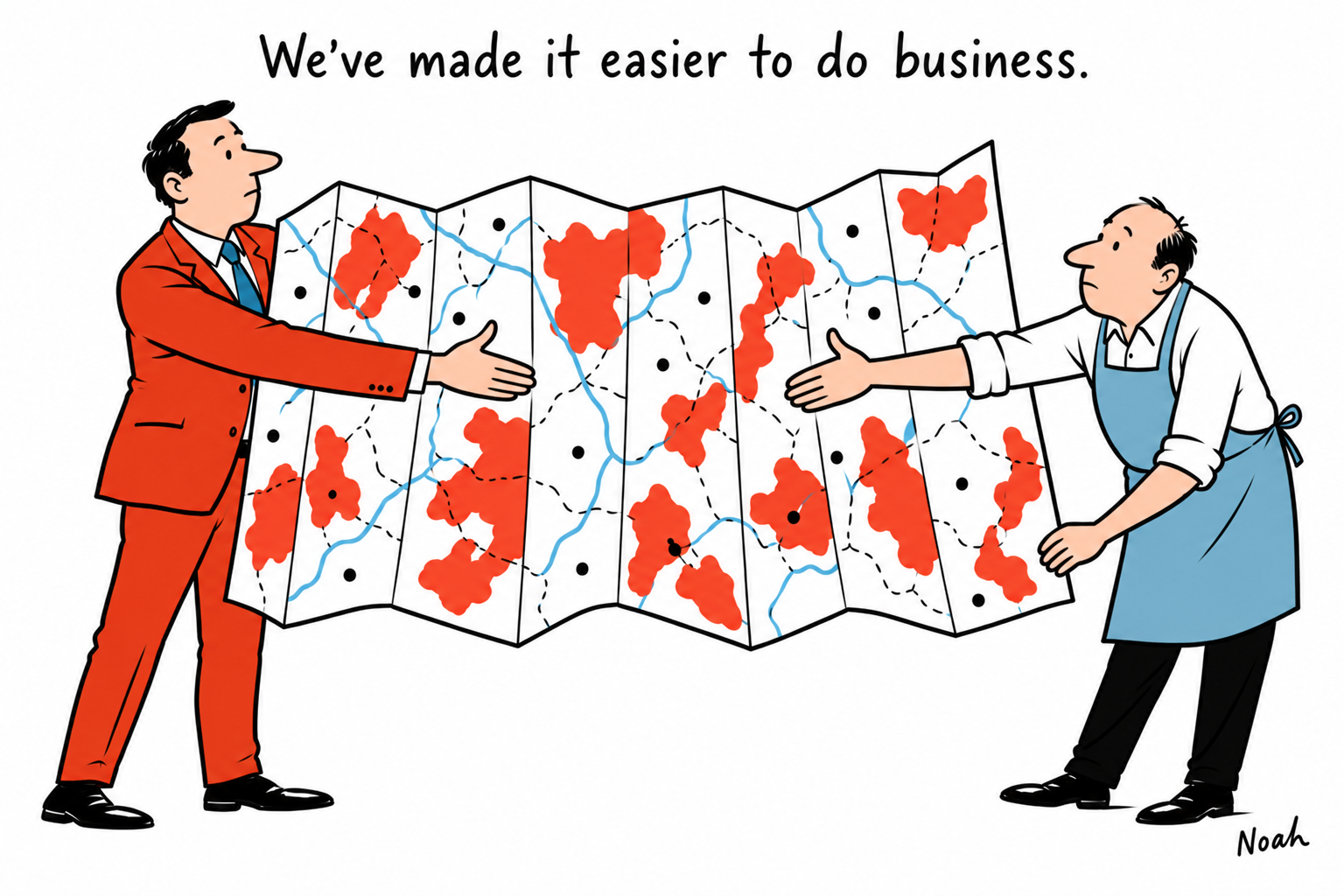
Cartoon · AI-generated
Noah’s original quick forecast puts the chance at 25%: by 1 October 2027, a paid UK local-news advertising campaign will have completed delivery across at least two unaffiliated publisher groups, with a participant publicly confirming that Raid planned its audience or geography in an NMA or RAM Penetrace case study or a named participant’s campaign report. That is a test of both completed use and public proof. It is not a forecast that Raid has only a one-in-four chance of being useful.
The estimate’s uncertainty range is 10–45%. It reflects sparse evidence about bookings, delivery and public case studies, rather than a measured historical failure rate. A privately successful campaign that never produces the specified public confirmation would not satisfy it. The useful question for publishers is what turns a new audience measure into something an advertiser can actually buy.
The News Media Association launched Regional Audience Intelligence Data, or Raid, on 1 October. Developed by RAM Penetrace, it combines digital measurement with print readership research to give local news publishers a shared audience-planning proposition. JICREG remains available as a legacy service. A new system has arrived; the old one has not simply disappeared.
For Newsquest, Reach, Iconic Media Group and their competitors, the commercial opportunity is substantial in principle. A planner who cannot compare local news audiences with the rest of a campaign may leave them out before anyone discusses the journalism. Making that comparison easier can get publishers into the room. What happens inside it is a different test.
A person is not a pageview
Raid starts with activity collected through RAM Penetrace’s Inviso website tag. It combines that with an opt-in UK internet panel, weighted against population statistics, to estimate the people behind the traffic. Print readership and geographic information contribute to the combined audience, with overlap removed.
The distinction is basic but commercially consequential. A reader returning to a website several times has not become several people. Someone reading both the paper and its website should not be presented as two additional customers merely because the publisher can count two channels.
Deduplicated reach is a better starting point for a plan. It is still an audience estimate over a defined period. It does not establish that everyone saw an advertisement, visited a shop or bought anything.
Imagine a retailer opening a second branch. A publisher’s overall monthly audience may be impressive, but the useful proposal concerns the branch’s catchment, the campaign dates and the placements available. The audience currency earns its keep when it helps answer those questions, rather than supplying a larger number for the first slide.
Local precision needs an explanation
Raid’s geographic reporting addresses an obvious need: a business with a tightly defined trading area wants evidence about people in that area. Its public methodology also makes a qualification that sales teams should understand before clients start treating estimates as guarantees.
The full digital audience is not directly observed at postal-sector level. Local estimates combine inputs, while narrow groups can require modelling, grouping or suppression. Updated print readership and print/digital overlap evidence may arrive on a different timetable from current digital measurement.
These are conditions for interpreting a number, rather than reasons to abandon research. A broader defensible estimate can be more useful than an unstable narrow cut. The publisher should explain the period, geography and audience definition behind a proposal, and distinguish the planning opportunity from the delivery commitment.
There is another boundary for publishers investing in direct reader relationships: Raid’s Methodology at a Glance says native-app usage is outside version 1.0. App measurement is being explored for version 2.0, without a committed date in the document inspected.
A strong app relationship therefore does not automatically appear in this website-based measure. Adding an app total separately without checking overlap could recreate the double-counting problem. Publishers need to show what the shared currency covers, then explain additional product evidence on its own terms.
Access also matters. Raid’s public guidance specifies audited circulation and NMA membership for print-title participation; the material inspected does not settle every digital-only inclusion case. User tiers offer different capabilities, and the light tier cannot create or save custom areas. A common currency is useful only if people understand who is included and what their subscription lets them do.
The campaign is the next test
The NMA reported that more than 100 publishers and planners attended introductory webinars. That demonstrates interest in learning about the product. It is not evidence of 100 publisher customers, 100 adopting companies or 100 advertising campaigns.
The next meaningful stages are different: recurring planner use, a proposal informed by Raid, a booking, completed delivery and a client willing to buy again. They should not be collapsed into one adoption statistic.
Newsquest’s LOCALiQ illustrates why the distinction matters. Its public commercial pages describe a broad marketing service, including search, social, display and website work, alongside its local news relationships. Its client reporting centre is presented as a way to inspect campaign results. These are provider descriptions, not independent evidence of return on investment.
A business buying marketing assistance may have its budget spread across several platforms. Money managed by a publisher’s marketing service is not necessarily money spent on that publisher’s news properties. Raid can describe the local news part of the plan; it does not replace channel selection, creative work, campaign management or the explanation of results.
Reach’s public business model likewise separates direct and indirect advertising from other revenue streams. Iconic’s NationalWorld.com has described Raid’s launch to its own readers. Those accounts help explain the publishers’ propositions and their communication of the initiative. Neither establishes that Raid has already produced additional advertising revenue.
I would judge the early commercial progress by whether a buyer can turn the evidence into a proposal that is straightforward to purchase and deliver. Counting mastheads is insufficient for that test. Several titles can belong to one publisher group; a campaign spanning independent owners requires a further level of coordination.
Noah’s campaign forecast: 25% by October 2027; 37% by October 2028
For the identical completed-campaign and public-confirmation test, Noah’s native estimate rises from 25% by 1 October 2027 to 37% by 1 October 2028. The respective uncertainty ranges are 10–45% and 16–62%. Both concern a paid UK local-news campaign spanning at least two unaffiliated publisher groups, with Raid’s audience or geographic planning role explicitly confirmed by a participant in the specified NMA/RAM Penetrace case study or named participant report.
The extra year allows another planning cycle; it does not change what qualifies. A launch, a webinar, a booking that has not completed delivery or activity within one publisher group is insufficient. Noah sees a plausible commercial incentive to coordinate local inventory, offset by uncertainty about operational cooperation and public documentation. A named completed case would be more informative than another general expression of support. These are two horizons for one event, not two independent predictions.
Outcomes require another layer
An audience measure does not need to prove an immediate sector-wide revenue increase to be useful. Saving planning time or preventing duplicated reach from distorting a proposal is already a gain. But it should not be sold as evidence of an outcome it has not measured.
After a campaign, distinguish what was booked, what was served and what happened. Impressions can establish delivery; they cannot alone establish changed behaviour. Enquiries, sales, store visits or brand lift may be appropriate objectives, depending on the campaign, but attribution needs its own design.
A restaurant advertising a new menu over a holiday weekend might receive more bookings. That is encouraging. It does not establish how much of the increase came from the advertisement rather than the menu, the weather or the holiday. The credible report explains what is observed and what remains an inference.
Nor should publishers reduce every campaign to the last click before a purchase. Building familiarity or consideration can be a legitimate objective. The point is to agree a suitable test, not to insist that every advertisement must produce the same kind of response.
Noah’s product forecast: 26% for outcome measurement in October 2027
Noah assigns a 26% probability that, on 1 October 2027, the UK Raid product will offer advertisers or agencies a generally available service linking advertising exposure to at least one of brand lift, web or app conversion, sales or store visits, documented in operative NMA or RAM Penetrace product material. Its uncertainty range is 13–42%.
A one-off bespoke study does not qualify, nor do audience planning, reach, frequency or delivery measures alone. Partner integration is a possible route; building a standard service with suitable exposure data and outcome linkage is a different task from estimating audiences. The public material checked for this article describes the planning proposition and does not establish that such an outcome service is available today. The forecast is an estimate of a future documented product, not an announcement of a roadmap.
A shared platform needs a task people can finish
Noah’s original archive research surfaced a useful comparison: the Public Notice Portal. Its operator’s guidance describes consultation feedback and downloadable responses for verified local-authority users, with full functionality dated to March 2026. I have not tested its private dashboard.
The comparison is about a concrete task. A public body publishes a notice, receives responses and retrieves them in a usable form. That is a clearer explanation of utility than an audience total alone. Raid serves a different purpose, and public notices have a different commercial context from discretionary advertising. The portal does not prove that a Raid-planned campaign has happened. It does show why the task completed by the user deserves attention alongside the scale of a shared platform.
A growing market can still leave local news behind
AA/WARC’s July release reported total UK advertising expenditure up 9.3% in the first quarter of 2026, while regional newsbrands fell 9.7%. Its full-year regional projections were a 4.8% fall in 2026 followed by just 0.4% growth in 2027. Those annual figures are forecasts, not completed-year results.
That is the commercial setting for Raid: a sector trying to stabilise within a growing market. A better audience-planning system may help publishers compete. It does not automatically award them a share of that growth.
Even a later sector-wide increase would not establish that Raid caused it. Prices, the economy, the print/digital mix and publishers’ individual sales efforts would all matter. The AA/WARC regional category covers both print and digital. Its projected increase concerns nominal spending, not an inflation-adjusted recovery.
The practical opportunity is to make local knowledge easier to buy. Start with the advertiser’s geography and purpose, use a defensible audience definition, specify placements and delivery, and agree how results will be assessed. The client should understand the proposal well enough to buy it and the result well enough to return. Showing the audience starts that work; it does not finish it.
The forecasts at a glance
25% by 1 October 2027: at least one paid UK local-news campaign completes across two or more unaffiliated publisher groups, with a participant publicly confirming Raid audience/geographic planning in an NMA or RAM Penetrace case study or a named participant’s campaign report. Uncertainty range: 10–45%.
37% by 1 October 2028: the same completed UK campaign and specified public-confirmation test, with one more year to qualify. Uncertainty range: 16–62%.
26% on 1 October 2027: operative NMA or RAM Penetrace documentation establishes that UK Raid offers advertisers/agencies a generally available exposure-linked service measuring brand lift, web/app conversion, sales or store visits; bespoke studies and audience/delivery measures alone are excluded. Uncertainty range: 13–42%.
These are Noah’s original native quick forecasts, with low confidence and broad uncertainty, not empirical frequencies. Its optional final reassessment did not return results before the original estimates were released through Noah’s native fallback. The estimates have not been updated with the additional primary-source checks in this article. A fourth, on regional advertising expenditure, is excluded because its stated missing inputs include an AA/WARC projection available in the primary material checked here; the uncompleted reassessment could not incorporate that evidence. No host estimate has been substituted.
Research note: Noah completed 38 of 39 planned research checks across 19 distinct lines of enquiry; 1 unfinished check remains outside the conclusion; the detailed method and source trail are retained in the Claim audit.
Method: launch statements, Raid’s public site and two-page methodology, publisher commercial material, AA/WARC and the Public Notice Portal were checked on 17 October 2026. The full technical manual, subscriber dataset and underlying panel records were not inspected. Commercial descriptions are attributed to their providers and hypothetical campaigns are identified. A supplementary archive follow-up completed execution but its evidence could not be retrieved because of conflicting programme records; no findings from it are used. Full forecast definitions, native references and source qualifications are retained in the private Claim audit.
Sources
- NMA: Raid launch, 1 October 2026
- Raid: product, access and frequently asked questions
- Raid: Methodology at a Glance (PDF)
- Newsquest: commercial brands
- LOCALiQ: services
- Reach: business model
- NationalWorld: Raid launch account
- AA/WARC: July 2026 expenditure release
- AA/WARC: expenditure methodology
- Public Notice Portal: local-authority guidance
Source: Tomorrow’s Publisher