Computer Weekly’s next commercial frontier is the reader’s working day
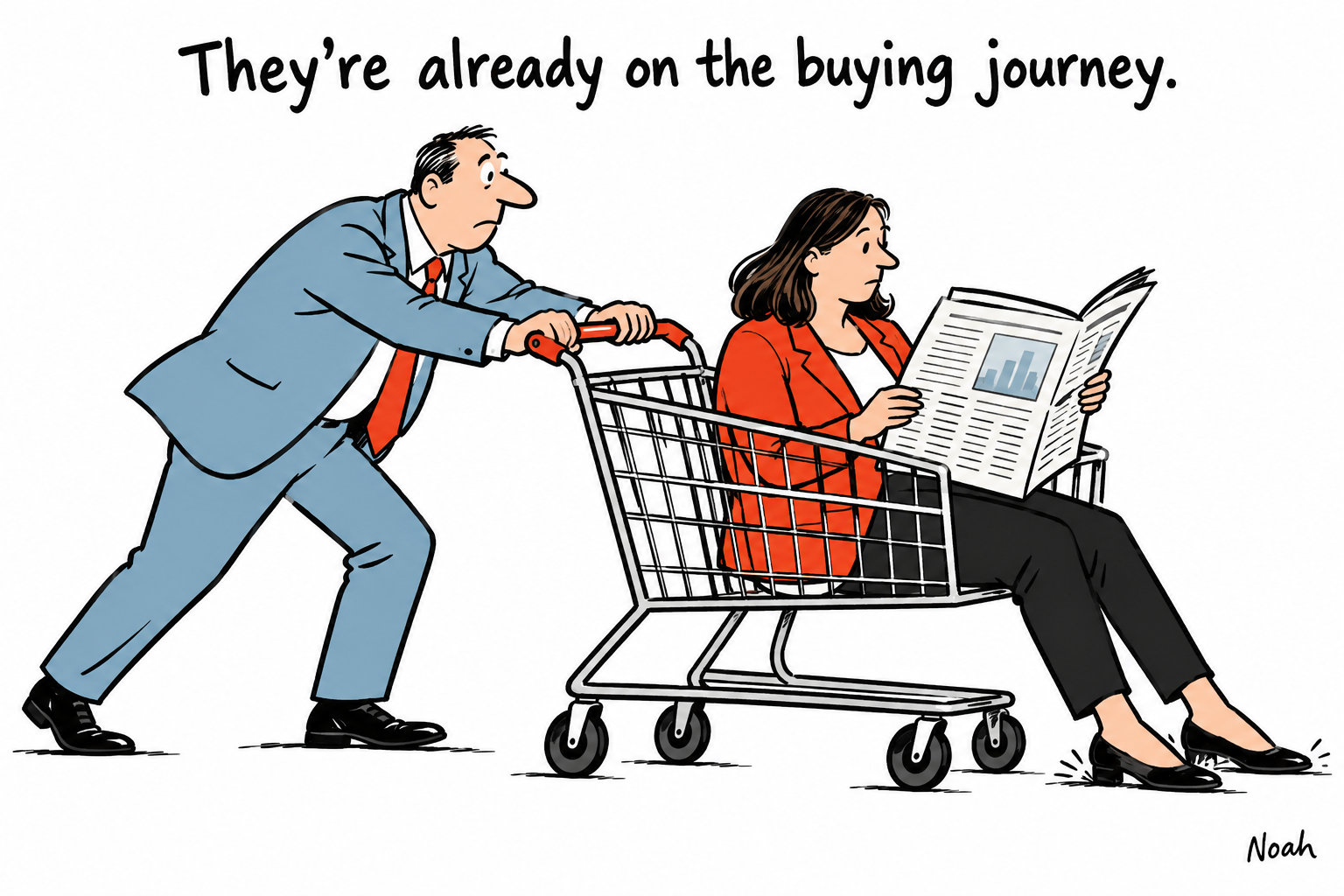
Cartoon · AI-generated
Noah puts the chance of Informa TechTarget’s FY2026 Brand to Demand revenue exceeding its stated FY2025 comparative, in results available on 31 March 2027, at 55%. The commercial direction is clear; the growth outcome is close to evenly balanced. For UK specialist publishers, that is a useful distinction. An identified professional audience can support products much richer than advertising impressions, while still leaving the business exposed to hesitant customers and demanding sales execution.
Computer Weekly’s most commercially interesting reader may be the person trying to solve a problem at work. That person needs reliable reporting. A technology supplier wants to know what the problem is, who else is involved and whether a purchase might follow. A specialist publisher can build a business between those needs, provided it understands the difference between useful evidence and a sales assumption.
The UK title’s recent anniversary offers an unusually concrete starting point. Alice Brooker’s 22 September Press Gazette interview with editor Bryan Glick reported that its full-time editorial team had grown from 18 to 30 since 2016. The title makes its journalism available to registered readers and earns revenue through audience intelligence and lead generation. Its own commercial pages offer brand awareness, demand generation and content services.
The new development is what its parent is doing with that relationship. Informa TechTarget launched Buyer Intelligence on 15 September, adding tools to interpret content engagement and suggest sales messages. On 29 September it announced access through a Model Context Protocol server, connecting that information to customers’ AI workflows. Those are announced product capabilities. They do not establish how many customers use them, what those customers earn or what Computer Weekly itself contributes financially.
Journalism creates the reason to return
The attractive part of Computer Weekly’s model is the connection between a specialised reporting purpose and a specialised commercial audience. Its editorial mission is to help senior IT professionals make better decisions and understand the systems on which their organisations depend. A useful investigation or explanation can draw a reader back because the subject matters to their job.
That can be a more durable relationship than a fleeting visit to a popular story. It also gives the publisher a way to understand interests across time: which topics attract attention, whether someone returns and which formats they choose. None of this makes a reader’s next decision certain.
Glick’s account of newsroom expansion is encouraging evidence about the title. It is not an audited measure of the financial return from an additional journalist. The publication has developed an international remit, and the public reporting does not isolate the contribution of reporting, distribution, group investment and commercial execution. Those limits matter if another publisher is trying to copy the model.
A smaller business cannot acquire the advantages of a large network simply by putting a registration box in front of its articles. It first needs something a defined community has a reason to read, then a credible explanation of what happens to the information supplied in return.
Knowing the reader is only the beginning
Informa TechTarget’s product explanation distinguishes activity observed from a known professional from a person inferred from anonymous traffic. Its Buyer Intelligence proposition starts with what someone has read or watched across its network and builds towards an account view. The proposed value is context: a salesperson can approach a company with some understanding of the subjects being researched.
The September launch describes three functions. Pain Points interprets the content being consumed to suggest problems under investigation. Pitch Assist proposes messaging angles. Persona and ICP Intelligence helps customers review the types of organisations and people they should target. These are the supplier’s descriptions; I have not independently tested the system’s matching accuracy or its interpretation of a reader’s intentions.
A useful distinction remains even if identification is accurate. A security manager researching an incident may be repairing an existing system, preparing a briefing or learning about a competitor. Reading about a product category does not alone establish an approved budget, a purchasing timetable or the authority to select a supplier.
The company’s own demand-generation range recognises different levels of qualification. It describes Highly Qualified Leads as having a directly verified need or confirmed active project. That is a more specific product promise than observing engagement. A publisher should be able to explain which sort of evidence the customer is buying, how recent it is and what remains unknown.
The product moves into the customer’s working day
The 29 September announcement makes the next commercial direction visible. Audience intelligence can be used through a portal, a customer relationship management system, a data platform or an AI assistant. The work might be account analysis, meeting preparation or drafting an approach to a prospective customer.
For publishers, that changes the product-design question. A dashboard can display valuable information and still become another place an overstretched customer rarely visits. A useful connection puts appropriately scoped information where a decision is being made. The interface matters because repeated manual transfer is work the customer must otherwise absorb.
The deeper responsibility travels with the data. A signal exported into a sales workflow still needs its date, source and meaning. If research activity becomes an unqualified statement that somebody intends to buy, an automated message can amplify a weak inference. Faster distribution improves the value of good information and the reach of a mistake.
This is a product opportunity for specialist publishers with recognisable professional communities. It is also an argument for maintaining careful definitions. A known person, an active researcher, a verified project and a paying customer are different states. Keeping those distinctions intact is part of what the customer should be paying for.
Follow the lead beyond delivery
Noah’s archive research surfaced a second route into the customer’s business: Partner Demand Assurance, announced in July with UK-based partner-marketing agency The Sherpa Group. The companies describe combining audience data and demand generation with partner support and lead-status tracking through Sherpa’s EdisonAI platform. The problem being addressed is what happens after a lead reaches a technology supplier’s partners.
That extends the commercial task beyond identifying somebody who read an article. It brings the publisher into a network of sales relationships, where a lead can be ignored, handled poorly or converted through work done by another company. The launch establishes an offer, not independently verified improvements in conversion. It does suggest why a publisher might need a partner’s operational expertise alongside its own audience data. The commercial value can lie in helping a customer use the information, as well as collecting it.
A 33% test of wider UK adoption
The direction extends beyond one group. Future’s May half-year statement describes a unified B2B data platform and combined commercial packages across SmartBrief, Actual Tech and IT Pro. That is the company’s account of its strategy, rather than an independently demonstrated return from any one brand. It shows why the technology and sales infrastructure behind a specialist title are becoming part of the publishing proposition.
Incisive Media’s Target IQ offers a different example in financial services. Its published process combines target-account lists, audience segmentation and distribution through its sites, newsletters and the wider web. Account reporting includes impressions, clicks and engagement; its lead package adds a gated resource and specified lead delivery. These are service commitments, not evidence that every resulting contact purchases anything.
The comparison should encourage precision rather than a race for the largest database. Account-based advertising and person-level research intelligence answer different questions. Buyers need to know whether they are paying to reach selected companies, identify interested people, verify a project or influence a subsequent decision. A single phrase such as “high-value audience” cannot establish all four.
For a publisher, a coherent niche may make the first commercial conversation easier. The harder work is maintaining reliable identities, useful classifications, an intelligible data exchange and a sales operation that delivers what was promised.
Noah puts a demanding adoption outcome at 33%: on 31 December 2028, at least four of Haymarket Media Group, William Reed, Mark Allen Group, Wilmington plc and Incisive Media publicly offering advertisers a product whose current official documentation connects registered or authenticated first-party content engagement to either company-level buying-intent prioritisation or explicitly qualified contact leads. This is a forecast about a fixed group and qualifying public product evidence. It is not a forecast that only a third of UK publishing will use reader data.
The qualification matters. Incisive’s offer is a relevant precursor, but its current public description does not clearly establish every part of that exact test. An older William Reed-hosted report describes the registration and behavioural-data foundations; that is not evidence of a current qualifying product. General lead-generation terms are also insufficient. A publisher may operate useful services without documenting the particular combination the forecast requires.
There is a more substantial complication in the fixed group. Wilmington’s FY2026 interim presentation describes a strategic refocus away from media and publishing towards governance, risk and compliance. Portfolio exits can change the number of businesses trying to sell advertiser services at all. If Wilmington remains outside that market, the four-of-five outcome effectively needs every other named company to qualify. That helps explain the 33% estimate. It does not establish failure by a business pursuing a different strategy.
The countercase is that the necessary technology is feasible, advertisers already buy related services and two more product-planning cycles allow offers to mature. The best lesson is to examine each company’s chosen market and actual product definition before describing a single industry transition.
The 55% growth call meets the accounts
Informa TechTarget’s financial results resist an uncomplicated growth narrative. Brand to Demand revenue rose 1.2% in the six months to 30 June 2026, but fell 1.7% in the second quarter compared with the same quarter a year earlier. The company reported that customers were taking longer to commit to sales and marketing spending.
Those figures concern a segment containing multiple businesses. They do not disclose Computer Weekly’s revenue or profit, and they predate September’s Buyer Intelligence launches. They cannot prove that the new tools have succeeded or failed.
They do show that a publisher can have a plausible, differentiated offer and remain exposed to customer budgets. Selling a route to professional buyers changes the commercial proposition; it does not remove the need for advertisers to spend or for sales teams to close business. Group efficiencies and cross-selling may also influence the result. Editorial expansion at one title and pressure elsewhere in the same company can coexist.
The 55% forecast allows a modest recovery to preserve the first-half gain. Its principal countercase is that weaker second-quarter spending persists and erases that small cushion. September’s launches offer a route to additional business, but a launch announcement is not booked revenue. The test uses the segment’s full-year comparison as the company eventually states it, including any recast comparative; group-wide growth guidance cannot settle it. Nor would a positive result isolate the contribution of Computer Weekly or Buyer Intelligence.
Trust is part of the inventory
The public privacy policy explains the data exchange behind free access. It describes personalised content, advertising and communications from TechTarget and partners, including information supplied during registration and collected through engagement. Readers are offered ways to unsubscribe and exercise choices. That description should be understood alongside the actual registration and download journey; a policy page alone does not demonstrate what every reader understood.
The editorial boundary is equally important. Computer Weekly’s published code reserves coverage decisions to editors, rejects trading advertising for favourable coverage and requires clear labelling where advertising could be confused with editorial. These are stated standards, not a claim that every individual interaction has been independently audited.
I think the commercial logic strengthens the case for those boundaries. If a reader suspects that the reporting exists primarily to guide them towards a sponsor, the publisher risks weakening the reason they came. Original journalism attracts the professional community; commercial intelligence should be built around that relationship without turning editorial judgements into promises to advertisers.
Noah puts a specific regulatory outcome at 17.64% by 31 December 2028: at least one published ICO monetary-penalty notice or enforcement notice naming a B2B publisher, buyer-intent provider or lead-generation provider and finding unlawful use of registered readers’ content-engagement data for profiling or direct marketing. This is a sector-level event forecast. It makes no allegation about Computer Weekly, Informa TechTarget or any other company discussed here.
That comparatively low probability should not be read as permission to neglect the data exchange. The forecast requires a particular violation, provider category, data type and formal enforcement instrument to coincide before the deadline. Guidance, an investigation or an unrelated privacy case would not satisfy it. The ICO already addresses profiling and marketing-data responsibilities in its guidance, although the relevant page is under review following the Data (Use and Access) Act. A formal case can also take time. Commercial exposure may grow faster than publicly completed enforcement. Clear explanations and sensible limits are useful before any regulator intervenes.
A newsroom forecast with a disclosure boundary
Noah’s fourth forecast is 40% that Computer Weekly’s official publisher-controlled team or editor pages will list at least 30 named staff in journalist or editor roles on 31 December 2027. Commercial employees, outside contributors and vacancies do not count. This is deliberately a public-roster test, not a prediction of 30 jobs or a claim that the reported international team will shrink.
The English-language editor directory checked for this report contains 18 qualifying entries before its separate contributor section. Computer Weekly’s own editorial policy describes journalists across the UK, Germany, Singapore and Mexico; its international pages have not been reconciled into a complete named roster here. An incomplete directory can understate the actual team. Conversely, the interview’s reported total of 30 does not establish that 30 qualifying names will appear on official pages at the forecast date. The useful implication is about verification: anyone assessing editorial investment needs a consistent definition and a genuinely comparable staff count.
The four forecasts at a glance
55% — FY2026 Brand to Demand revenue above Informa TechTarget’s stated FY2025 comparative, in its results or SEC annual filing available on 31 March 2027. This is a segment result, not Computer Weekly’s standalone performance.
33% — On 31 December 2028, at least four of Haymarket Media Group, William Reed, Mark Allen Group, Wilmington plc and Incisive Media have current official advertiser-product documentation showing registered/authenticated first-party content engagement used for company-level buying-intent prioritisation or explicitly qualified contact leads. This is a fixed-group, public-documentation threshold.
17.64% — By 31 December 2028, at least one published ICO monetary penalty or enforcement notice finds unlawful reuse of registered readers’ content-engagement data for profiling or direct marketing by a B2B publisher, buyer-intent provider or lead-generation provider. This is not a named-company allegation.
40% — On 31 December 2027, Computer Weekly’s official team/editor pages list at least 30 named editorial journalists or editors, excluding commercial staff, contributors and vacancies. Public listing and actual employment remain different measures.
Build a useful service around a useful publication
The transferable lesson is to define the community and the decisions it needs help making. Create reporting worth returning to, explain the exchange for access and separate observed behaviour from claims about future purchases. Then sell a service whose evidence and limitations a customer can understand.
Computer Weekly’s newsroom record makes that possibility worth taking seriously. Informa TechTarget’s product launches show how far the commercial packaging can travel beyond the website. Its segment results show why the argument still has to meet a market test. A valuable reader relationship can support several revenue streams; its value depends on continuing to serve the reader well.
A supplementary archive check could not be retrieved; its findings are not used here.
Research note: Noah completed the planned research checks; the exact method, counts, calculations and source trail are retained in the Claim audit.
Sources
- Press Gazette: Bryan Glick on Computer Weekly’s decade of digital change, 22 September 2026
- Informa TechTarget: Buyer Intelligence launch, 15 September 2026
- Informa TechTarget: MCP server announcement, 29 September 2026
- Informa TechTarget: Buyer Intelligence product
- Informa TechTarget: demand-generation and lead qualification products
- Informa TechTarget and Sherpa: Partner Demand Assurance launch, 14 July 2026
- Future: half-year results, 14 May 2026
- Incisive Media: Target IQ product
- William Reed-hosted specialist media report, 2023 PDF
- Wilmington: FY2026 interim results presentation and portfolio strategy
- Informa TechTarget: SEC filing for quarter ended 30 June 2026
- Informa TechTarget: second-quarter results, 6 August 2026
- Informa TechTarget: privacy policy, updated 17 June 2026
- Computer Weekly: editorial policies and code of conduct
- Computer Weekly: public editor directory
- ICO: organisations using marketing services of data brokers
- ICO: published enforcement actions
- Computer Weekly: commercial media kit
Source: Tomorrow’s Publisher