AI agents lift newsroom output by 40% — but editors remain in charge
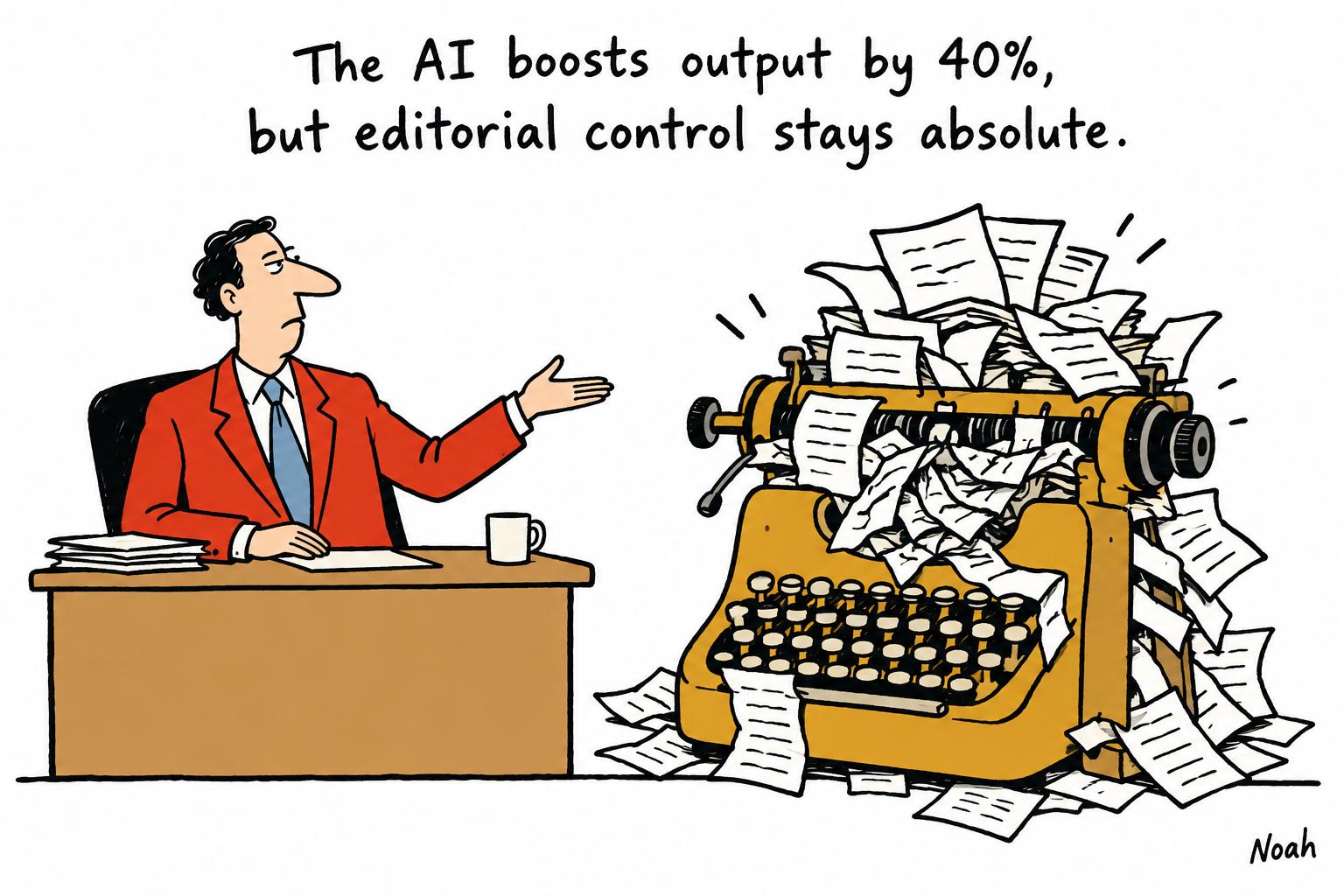
Cartoon · AI-generated
News organisations are using AI agents to speed up research, transcription and drafting, but say human oversight must remain central to editorial decisions.
Across newsrooms, the arrival of AI agents is no longer a theoretical discussion about the future of journalism but a practical question about how news is made now. The debate inside the wider technology sector over whether advanced AI systems are being developed too quickly has sharpened that sense of urgency, with Anthropic chief executive Dario Amodei among those urging a slowdown, while OpenAI’s Sam Altman and Elon Musk have also warned about the risks of moving too fast. Others, including Meta’s Mark Zuckerberg and Nvidia’s Jensen Huang, have pushed back against the idea of a coordinated pause, preferring company-led approaches to safety.
What is unfolding in journalism is less dramatic than the headline-grabbing arguments around frontier AI, but potentially more consequential for day-to-day newsroom practice. According to TUKO.co.ke, the publication has begun using an AI agent as an editorial assistant to handle tasks such as scanning sources, processing documents, transcribing interviews and preparing early drafts. The argument is not that technology should replace journalists, but that it can absorb the repetitive work that often slows reporting, leaving reporters with more time for interviews, verification and original reporting.
That distinction matters because, as Nieman Lab has reported, larger news organisations are increasingly treating AI agents as operational tools rather than experimental novelties. The publication said the most advanced newsrooms are using them to support research, drafting and editing, while still insisting that editorial standards, transparency and human judgement remain essential. In that sense, the technology is being folded into existing workflows rather than allowed to define them.
TUKO.co.ke says the effect has been measurable. Since introducing its AI assistant, it has reported a rise in output of roughly 40 per cent, with one journalist’s daily article count climbing from around six to about 10. The publication also says routine production steps that once took much of the day can now be completed far more quickly, freeing reporters to concentrate on more demanding work. That is a familiar promise of automation in many industries, but in journalism it carries particular weight because speed can never come at the expense of accuracy, context or editorial responsibility.
The risks, however, are not only about how quickly AI develops. Axios reported this month that organisations adopting AI agents are already wrestling with basic management questions: who is responsible when an AI system fails, which department oversees it, and how companies should train staff to work alongside it. Those questions echo the broader warning from The Atlantic, which has argued that newsrooms must be cautious about financial ties to AI companies, particularly where the same firms are building models on journalists’ work. For media organisations, the lesson is that adoption must come with clear safeguards, human oversight and transparent boundaries. The technology may be ready to assist journalism, but it is not ready to be trusted with editorial judgement.
Inspired by headline at: [1]
Sources by paragraph: - Paragraph 1: [2] - Paragraph 2: [2] - Paragraph 3: [3] - Paragraph 4: [1] - Paragraph 5: [4], [5]
Source: Noah Wire Services · Original