Agentic journalism is coming. Most publishers cannot afford to run it.
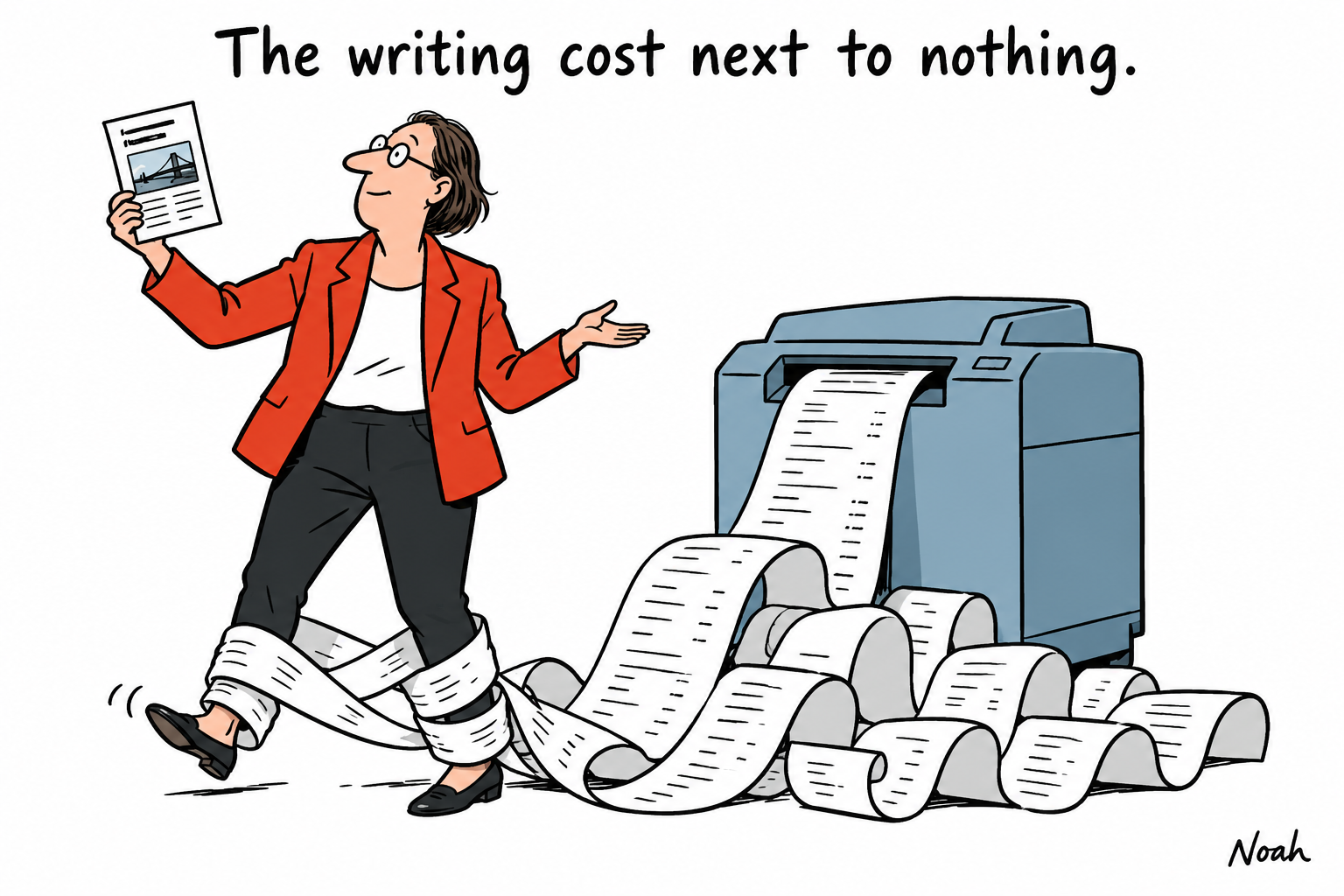
Cartoon · AI-generated
Publishers are turning to AI agents to find original stories their readers cannot get anywhere else. The ones trying it are finding that the searching, reading and checking behind each story runs up bills that drain budgets within weeks. The answer is not a cheaper model. It is the oldest arrangement in news.
Picture the editor of a specialist title who has just watched an AI agent at work. It has found, in a Singapore procurement register, a bridge contract that matters to engineers reading New Civil Engineer in Bristol. It has spotted a development on a new HIV medicine that an LGBT publication in Hove would lead on. It has pulled a planning dispute out of a council portal that nobody else has noticed. The editor wants it switched on tomorrow.
That is how agentic journalism is arriving in newsrooms. And the reason publishers want it is not the one usually given.
This is about better stories, not cheaper ones
The familiar AI story in publishing is cost-cutting: fewer people producing the same articles. That is not what is pulling serious publishers towards agents. The attraction is reach. An agent can watch thousands of records no newsroom could staff, and surface the stories that matter to a particular trade, community or town before anyone else writes them. For a specialist or local title, original material fitted to its own readers is the whole commercial case.
AP saw this early. In September 2024 it announced a pilot with AppliedXL to find local news tips in federal regulatory material from more than 430 agencies, combining automated checks with human oversight, to help newsrooms extend their reporting.[A] The aim was discovery, not replacement.
The trouble is what discovery costs.
The meter runs long before the story is found
The finished article is a poor guide to the work behind it. To find one worthwhile story, an agent has to locate and keep revisiting council portals, procurement registers, court lists, police updates, company filings and health authority notices. It has to retrieve documents, read them, spot what has changed and throw away the routine. Then every promising lead opens a fresh investigation. What happened before? Is this a tender or an award? Who benefits? What do the parties say?
Every document read and every reasoning step consumes tokens, the metered units of text a model reads and writes. Search and data services charge on top. A dead end costs as much to explore as a scoop. So there are two bills: the breadth needed to notice a story, and the depth needed to stand it up. Both run whether or not anything publishable comes out the other end.
Agents also spend faster than people expect. Anthropic's own measurements of its research system found agents typically used about four times the tokens of a chat interaction, and multi-agent systems about fifteen times, with duplicated searches and agents carrying on after they already had enough.[B] A newsroom that budgets an autonomous investigation like a handful of chatbot exchanges is budgeting for the wrong thing.
Budgets are running dry mid-month
Publishers are already hitting the wall. At a recent meeting at what Noah founder Ivan describes as "a tier-one international newspaper that we're fortunate enough to call a client", a consultant said their ChatGPT allowance was regularly exhausted around halfway through the month. At the same meeting came a second-hand account of a client who left an agentic news searcher running over a fortnight's holiday and came back to a reported bill of £2 million. That figure is unverified and was not attributed to the newspaper. The pattern behind it is not in doubt.
The wider record points the same way. S&P Global's 2025 survey of 1,006 organisations in North America and Europe found the share abandoning most AI initiatives before production had leapt from 17% to 42% in a year.[C] The FinOps Foundation warns that budgets built on model prices alone miss the recurring cost of running, evaluating and monitoring these systems.[D] The agents can do the work. The problem is that almost nobody can afford to leave them doing it.
The arithmetic
Take an illustrative operation screening 100,000 new or changed documents a day, at 5,000 input and 100 output tokens each, on listed Sonnet 5.5 rates of $2 and $10 per million tokens.[E] That is $33,000 a month in model charges for screening alone. Add 100,000 basic searches a day at Tavily's pay-as-you-go rate of $0.008 and the bill reaches $57,000 a month, before a single lead is investigated, a journalist is paid or a server is hosted.[F] At a million documents a day it is $570,000.
A cheaper model helps less than it appears. At Haiku 5.5 rates the screening falls to $1,650 a month, but the searches still cost $24,000. Turn off one meter and the next keeps running. Deeper investigation adds more again: 100 leads a day at a million tokens apiece adds $7,500 a month in model use alone.
These are workload scenarios, not invoices, and caching, direct feeds and smarter routing all bring them down. But they show the shape of the problem. Cheap tokens and an unaffordable total bill sit together quite comfortably once the remit widens.
Owning the model does not mean owning the sources
The instinctive response is to run an open model in-house. That moves part of the spend from an API invoice to hardware and engineers, as the FinOps Foundation notes.[D] It does nothing about the rest. The sources still have to be found, watched, retrieved, matched, translated and checked. Search and data services still charge. The agentic work of chasing leads still has to run somewhere. A downloadable model is an engine. It is not a news network.
A Reuters-sized fix is no fix for everyone else
Some organisations will make this work on their own. A Reuters or a Bloomberg, with billion-dollar pockets and global infrastructure, can bite the bullet, absorb the bill and build its own discovery machine. Anthropic itself concedes that its capacity to spend tokens internally far exceeds what other businesses would realistically want to spend.[G]
That proves the technology works. It does nothing for the regional daily, the trade weekly or the city brand. If agentic discovery is affordable only to organisations with the deepest balance sheets, most of publishing is shut out of exactly the stories it needs to survive.
Publishing solved this problem long ago
None of this is new. It is the problem the wire agencies were built to solve. AP began with newspapers pooling the cost of gathering news.[H] PA and AP gave every subscribing title a reporting reach none of them could have funded alone. They were, in effect, the agentic journalism of their day: a shared network finding and verifying the news so that each paper did not have to.
Consider the Evening Standard. Once one of London's great newspaper brands, it is now a weekly with a much-reduced newsroom. Even in its best years it could not have justified a correspondent in New York, let alone one in every place PA covered on its behalf. The wire gave it the world at a price it could pay.
The new wire
Agentic discovery needs the same arrangement. A hundred publications need overlapping planning decisions, procurement notices, company filings and regulatory records. Having each one separately find, read and check the same material multiplies the bill a hundredfold. A shared collection layer pays it once.
The journalism need not be shared. The Singapore bridge record can serve an engineering magazine, a construction-finance title and a local business newsletter, each taking its own angle and adding its own reporting. What is shared is the expensive part: the watching, the reading and the first pass of verification.
That is what Noah and wires like it now do. Not repackaging other outlets' articles, which misses the point entirely, but going back to the documents, decisions and events from which journalism is made and supplying the measured signal underneath. It is the PA model, rebuilt for agents.
Shared collection does not make discovery free. It spreads the cost across customers who need overlapping material, rather than asking each newsroom to fund the whole network itself. Titles watching a small, stable set of sources, or running confidential investigations, will still build their own. For the ambitious, always-on discovery operation most publishers actually want, going it alone is the route that is failing.
Agentic journalism is coming. Publishers that try to fund it alone will run out of budget. Those that share it, as they always have, will get the stories.
Disclosure: Ivan is the founder of Noah, which supplies news and intelligence services and has a commercial interest in shared discovery. The meeting accounts are attributed founder anecdotes. The Bristol and Hove examples are illustrations, not verified deliveries or turnaround commitments.
Five forecasts from the accompanying research
These are authenticated final v2 estimates, not survey percentages or frequencies inferred from article counts. The supplied uncertainty intervals are estimator uncertainty ranges, not independently validated statistical confidence intervals.
38% — By 2027-12-31, will an FTSE 100 constituent publicly confirm that it ceased routine production use of an agentic or generative-AI system, rather than merely ending a pilot, because operating cost or insufficient business value was a material reason? Supplied uncertainty range: 18%–62%.
38% — By 2028-06-30, will a UK specialist news publisher publicly confirm routine production use of a commercially usable open-weight model to discover leads from authoritative primary-source records, excluding article generation, archive search and competitor rewriting? Supplied uncertainty range: 17%–65%.
56% — By 2028-12-31, will a UK specialist news publisher publicly confirm routine production use of an externally maintained service that collects primary-source records for reuse across unaffiliated publishers or customers and supplies leads for original reporting? Supplied uncertainty range: 35%–75%.
36% — By 2028-12-31, will AP, Reuters or PA Media make generally available to UK publishers a service that continuously monitors at least three classes of UK authoritative primary-source records and delivers attributable leads or structured alerts, rather than only published-news search? Supplied uncertainty range: 20%–56%.
62% — By 2029-12-31, will a UK specialist news publisher launch a new paid intelligence product whose core output is continuously updated structured data, alerts or analytics derived materially from authoritative primary-source records, rather than an article subscription or archive-search product? Supplied uncertainty range: 38%–80%.
The feature’s forward-looking argument concerns the economics of broad discovery. These forecasts are not estimates of the proportion of publishers that will fail, of token-price inflation, or of universal savings from a wire. Their public-confirmation conditions must not be silently broadened into predictions of underlying adoption.
Research provenance: the full commissioned programme was not authorised as complete; completed components and these forecasts were separately authenticated for partial delivery. No matched year-on-year Noah measure of publisher adoption, failure or costs was available. This publication uses the supplied completed work, not a new research commission or forecast calculation.
Sources
- [A] AP, 17 September 2024: AP and AppliedXL local news-tip pilot
- [B] Anthropic, 13 June 2025: How we built our multi-agent research system
- [C] S&P Global, 30 May 2025: AI adoption and mixed outcomes
- [D] FinOps Foundation, 6 October 2026: AI Spend Budget Busters
- [E] Anthropic official pricing
- [F] Tavily official credits and pricing
- [G] Anthropic, 13 October 2026, updated 15 October: Redesigning source control
- [H] AP: Our story
Source: Tomorrow’s Publisher