A credible AI business case starts with one workflow
Cartoon · AI-generated
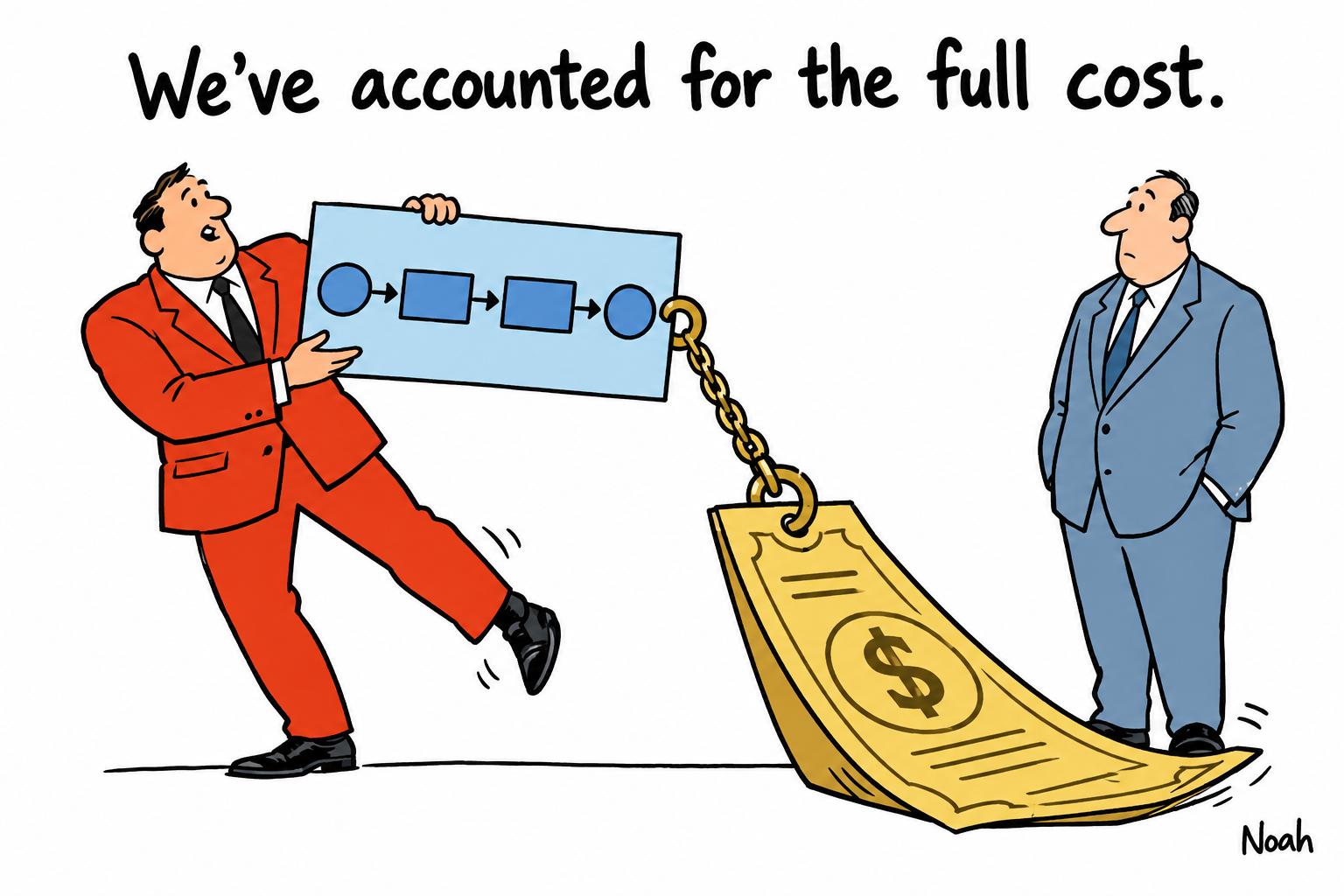
Before funding AI, organisations should compare a defined workflow with credible alternatives, account for the full costs and test whether measured benefits justify scaling.
A credible AI investment case begins with a specific workflow, not a forecast of organisation-wide transformation. Decision-makers need to know what process would change, who would use the system, what the alternative is, how much the change would cost and what evidence would justify expanding it. Microsoft’s guidance similarly centres assessment on a defined business process, with costs and expected benefits compared across feasible implementation options.
The comparison should start with a documented picture of how the work is done now. Record representative volumes, completion times, quality and error rates, review and rework, staffing and current costs. Then define the proposed AI-assisted process and a genuine no-AI alternative, which might involve keeping the existing method, changing the process or using current software differently. Microsoft’s guidance on measuring agent value stresses establishing a baseline and linking system use to outcomes; adoption or activity figures alone do not demonstrate that a process has improved.
Costs should reflect the whole workflow, not just a licence or model charge. Depending on the deployment, the estimate may need to include implementation, integration, data preparation, security and evaluation, employee training, infrastructure, monitoring, support and human review, as well as ongoing usage. Federal Reserve analysis distinguishes the fixed work of adapting business processes from the marginal cost of running a model, while AWS’s cost examples show how supporting services can add to inference charges. Neither a low token price nor an illustrative cloud estimate establishes what a particular organisation will spend.
Benefits require the same discipline. Measure successful work against agreed quality standards, including the time and expense of checking, correcting or escalating AI-assisted outputs. AWS recommends using cost per outcome as one useful unit-economics measure, but it is not a substitute for calculating overall return. Time saved may create useful capacity without reducing payroll: the business case should explain whether that capacity will avoid recruitment or overtime, enable additional work or produce another measurable financial benefit. Microsoft’s agent-value guidance likewise connects use to the outcome a workflow is intended to achieve.
A defensible model uses benefits and costs for the same period. Net benefit is the attributable financial value minus the full cost of the AI workflow; ROI is net benefit divided by that cost, expressed as a percentage. Payback should be reported only when recurring net benefits are positive and sufficiently reliable. For longer investments, show the timing of costs and benefits rather than comparing an upfront implementation bill with an unqualified future gain. Federal Reserve analysis also cautions against judging alternatives on token prices alone: usage, task performance and output quality affect the economics of completing useful work.
Forecasts should make uncertainty visible. Test conservative, expected and optimistic assumptions for adoption, successful task volume, time saved, retries, operating costs, quality and the proportion of released capacity that can actually be realised. Keep alternatives comparable by using the same workflow boundary, period and quality threshold. Microsoft’s framework for evaluating AI solutions supports comparing build, buy and extend options against process requirements, rather than assuming one route will always be cheapest or most effective.
A pilot should be designed to resolve the assumptions that matter to the funding decision. Set its boundaries, baseline, success criteria, quality limits, measurement responsibilities and full-cost tracking before it begins. Establish in advance what results would warrant scaling, what shortfall could be addressed through revision and what failures would mean stopping. AWS guidance supports tracking cost per outcome over time, while its application-cost documentation illustrates why actual workload and architecture matter; pilot evidence can therefore replace estimates of usage, retries and supporting costs with observed results.
Risk controls belong in the operating plan and the budget. Review, monitoring and incident response can affect both costs and outcomes, and the controls required will depend on the task and its consequences. NIST’s AI Risk Management Framework Playbook organises adaptable guidance around Govern, Map, Measure and Manage, but its FAQs make clear that it is not a mandatory checklist or a universal sequence. A demonstration or a favourable test result should not be treated as proof that a system is suitable for every live setting.
The final funding memo should state the decision requested, workflow scope, baseline, alternatives, full costs, measured or assumed benefits and the evidence behind the most influential assumptions. It should separate capacity gains from realised financial savings and include pilot owners, duration, controls and decision thresholds. Microsoft’s guidance offers a structure for assessing costs, benefits and implementation choices; the organisation must still supply local data and establish whether observed outcomes support the investment.
Inspired by headline at: [1]
Sources by paragraph: - Paragraph 1: [2] - Paragraph 2: [3] - Paragraph 3: [4], [6] - Paragraph 4: [3], [5] - Paragraph 5: [4] - Paragraph 6: [2] - Paragraph 7: [5], [6] - Paragraph 8: [7] - Paragraph 9: [2]
Source: Noah Wire Services · Original