Young voters swing to Democrats, but online right’s decline is harder to prove
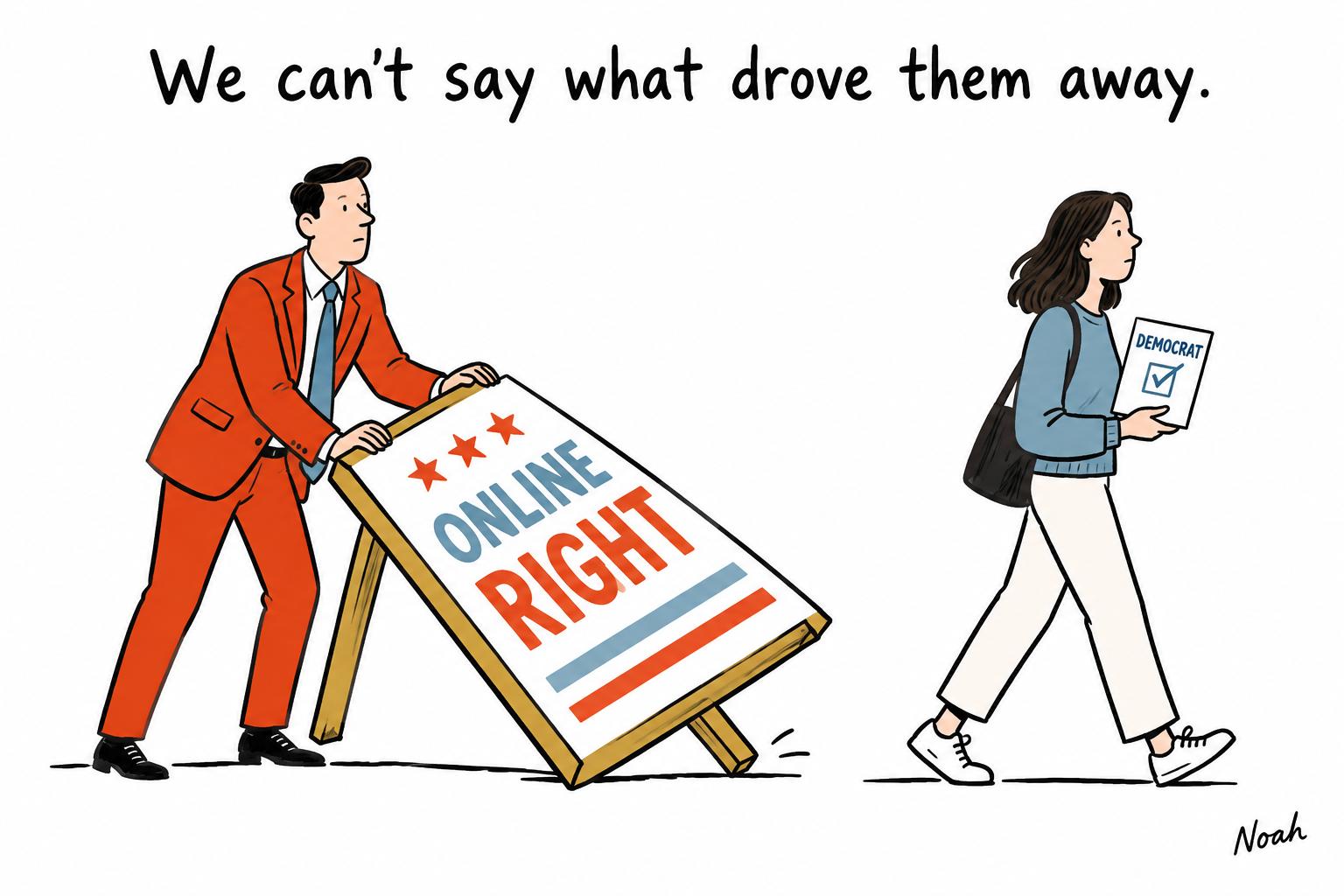
Cartoon · AI-generated
About seven in ten voters under 30 backed Democratic House candidates, while economic anxiety and dissatisfaction with the administration shaped the wider result. The polling points to a Republican setback among younger voters, but cannot show that the online right’s influence was the cause.
The Democratic gains in the 2026 midterm elections have prompted a broader question than which party won control of Congress: what has happened to the online coalition of young men that helped energise the American right over the past decade? Garbage Day argues that Republicans failed to carry that support into a new generation. The available polling points to a sharp shift among younger voters, though it does not by itself confirm the newsletter’s more specific claim about men aged 18 to 29.
The Associated Press’s AP Voter Poll found that about seven in ten voters under 30 backed Democratic candidates in their local House races, against roughly three in ten who supported Republicans. That is a marked change from the 2024 presidential contest, when younger voters were much more evenly divided. The group made up only about one in ten voters, however, and the poll does not establish that young men moved left by nearly 40 percentage points.
The shift sits within a wider rebuke of the governing party. AP’s analysis of voter motivations found that cost-of-living concerns and anxiety about democracy were prominent, while many voters wanted Congress to act more assertively as a check on the presidency. CBS News’s early exit-poll findings also showed deep dissatisfaction with the country’s direction and a low approval rating for Donald Trump. These results suggest that opposition to the administration and economic unease mattered more broadly than any single online trend.
Democrats’ gains were substantial: Axios reported, citing Associated Press projections on election night, that the party had taken control of both chambers of Congress. The result opens the way to investigations and subpoenas involving the administration, while raising the prospect of legislative gridlock. Axios also reported that voters were particularly concerned about living costs and government corruption. Election-night projections are not the same as certified results, and the explanations for the outcome remain varied.
Technology and the cost of infrastructure may also have played a part in some races. Axios reported that local resistance to data-centre construction helped shape campaigns, with voters backing moratoriums and candidates calling for tighter controls. Concerns included the effect of large facilities on electricity bills, water supplies, air quality and property rights. The reporting suggests that AI infrastructure became a tangible local issue in some areas, but does not show that it drove the national result.
Elon Musk’s political spending likewise failed to secure victories for some of the candidates he backed. The Atlantic reported that more than $168 million went to super PACs supporting Texas Senate candidate Ken Paxton, who lost to Democrat James Talarico. The magazine’s analysis describes Musk as the cycle’s largest non-candidate donor, while noting that inflation, the war in Iran and candidate-specific weaknesses may have mattered more to many voters. The defeats underline the limits of political spending, rather than proving that Musk’s role alone shaped the outcome.
Garbage Day’s wider argument is that right-wing digital figures may have mistaken their own online environment for the electorate at large. That interpretation is difficult to establish from election polling, but it speaks to a possible gap between highly visible online communities and voters’ priorities. AP’s findings on younger voters, cost-of-living pressures and dissatisfaction with the administration offer a more measurable account of the forces behind the result; they do not settle how much political content, social-media algorithms or internet subcultures contributed.
The election therefore offers evidence of a generational and political setback for Republicans, but not a single explanation for it. Younger voters moved decisively towards Democrats, while economic worries, concerns about democracy and resistance to aspects of technology expansion also featured in the reporting. The online culture that once helped Republicans attract young men may be less effective than it was, but the available evidence cannot show that its decline, on its own, produced the Democratic gains.
Inspired by headline at: [1]
Sources by paragraph: - Paragraph 1: [2] - Paragraph 2: [2] - Paragraph 3: [3], [7] - Paragraph 4: [4] - Paragraph 5: [6] - Paragraph 6: [5] - Paragraph 7: [2], [3] - Paragraph 8: [2], [3], [6]
Source: Noah Wire Services · Original