Who gets the first slot for local news?
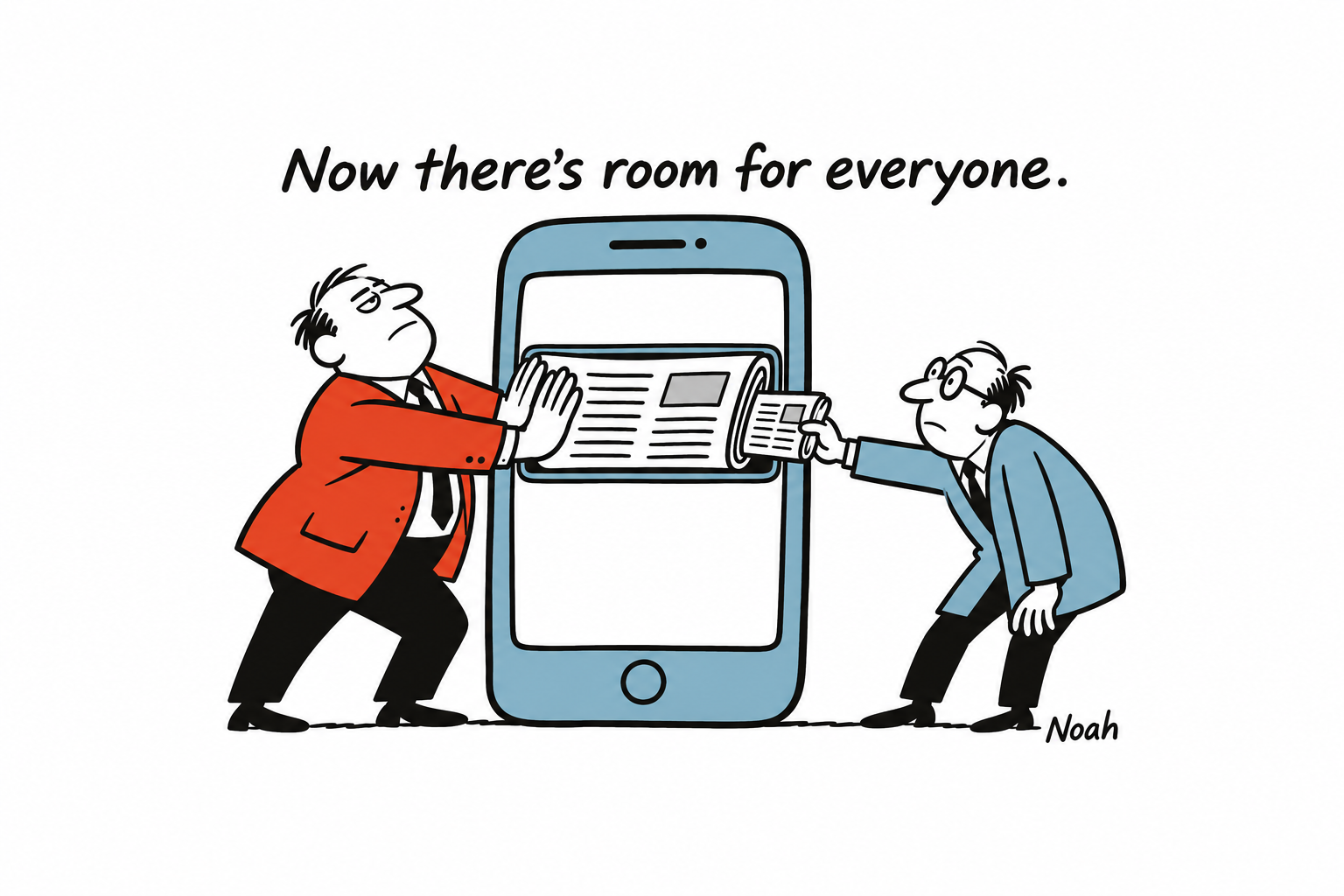
Regional editors have challenged a UK plan to give trusted news more space on social media. A better position could help readers find real reporting, depending on whose stories appear and where the links lead.
Cartoon · AI-generated
Someone looking for news about Liverpool on Facebook could see residents’ posts, clips from broadcasters and stories from the Liverpool Echo on the same screen. Ministers are considering rules that would make trustworthy reporting easier to find on social media. On 25 November, Steve Graves, the Echo’s editor, joined editors from the Kent Messenger and Bradford Telegraph & Argus in asking Culture Secretary Lisa Nandy to rethink the approach.
A more visible place for reliable reporting could help readers and the publishers admitted to it. It could also make smaller outlets harder to find if the same big brands take the best positions across several towns. Before choosing who gets preference, ministers should test what people in a few different places would actually see and which publishers they would visit. A national average would hide the difference.
In their joint letter, quoted by the News Media Association, the editors warned of “thousands of micro-regimes that no regulator could audit to assess compliance”. The signatories include Edd Moore of Reach, Joe Walker of Iliffe Media Group and James Preston of Baylis Community Media. They also warned about favouring public service broadcasters and questioned how the rules would treat paid articles.
thousands of micro-regimes that no regulator could audit to assess compliance
There is a case for testing the idea. Ofcom’s 2026 survey found that 48% of UK adults used social media for local news and information. Among people who had seen or heard news on Facebook in the previous month, 54% said they had encountered local news there. The corresponding figure among YouTube news users was 28%. The figures describe what people recall seeing. They give no measure of visits to publishers’ sites.
One national rule, many local markets
The government’s June Green Paper, Watch This Space, explores legislation that would require social media platforms, and potentially video-sharing platforms, to make trusted news easier to discover. Public service media could be joined by commercial national and local publishers. Ministers highlighted a possible example in which news from trusted sources appears higher when people look for it. Media minister Ian Murray was still describing it as an option in the Commons on 18 November, after the public consultation had closed.
Noah, a research and forecasting service, estimates only a 37.44% chance by 30 June 2027 and only a 48.78% chance by 27 November 2027 of the government publishing a final response to Watch This Space that commits to a news prominence regime open to commercial local publishers unaffiliated with public service broadcasters. The consultation includes that option. A response that leaves local eligibility open would fall short. For independent editors the first decision is whether they can qualify at all.
Ofcom’s 26 November final code for connected televisions recommends putting designated public service apps among the first nine on menus that show the same line-up across the UK. It recommends a higher relative position for S4C on regionalised menus in Wales. The code implements a separate law. It shows how priority can be checked when the list of services and the relevant screen are known.
One starting point is the Online Safety Act’s definition of a recognised news publisher. For organisations outside the specified broadcaster categories, the Act includes conditions covering editorial control, a standards code and procedures for resolving complaints. It also requires news material created by different people. If the eventual prominence rules reused that test unchanged, a one-person local outlet could have to show how it meets the contributors condition. The definition does not dictate whose council story comes first among the qualifying publishers.
Ofcom chief executive Dame Melanie Dawes told the Commons Culture, Media and Sport Committee in October that Ofcom should have clear instructions from lawmakers. “We do not want Ofcom to be left having to determine this from first principles,” she said. The Public Interest News Foundation, which works with independent local publishers, has welcomed the push for prominence and argued for a proportionate regime. A published application process and an appeal would give new outlets a way in.
We do not want Ofcom to be left having to determine this from first principles
Geography is a separate design decision. A local news search can specify the town, which makes it easier to test without inferring a person’s precise location. An automatic feed intervention would have a harder job. The relevant area for a council decision can differ from the catchment of a football club or a commuter railway, and a single regional provider may cover several of them. A pilot should test the match between the story and the place. Three mastheads can also look like a wider choice than they are if one group owns them all.
A better slot has a price
In an eye-tracking experiment commissioned by Ofcom and published in 2024, news items at the top of a simulated social feed were roughly 4.5 times as likely to be looked at as items at the bottom. In that experiment, 9.6% of news posts placed near the top were clicked to open the article, against 0.7% near the bottom. These are clicks in a simulated feed with 615 usable eye-tracking records. The test cannot establish what happens to real visits or subscriptions.
Reach, which owns the Liverpool Echo, said digital revenue fell 20.3% year on year in the third quarter. The group highlighted continued disruption to referrals, principally from Google, and said a smaller audience on its own sites had hit indirect revenue, which includes automatically sold advertising. Those results cover the whole group and make the value of actual visits clear.
Take a hypothetical local story shown 10,000 times. If a card sends two readers in every 100 to the publisher, it produces 200 visits. A different format that doubles the number of displays and sends one reader in every 200 produces 100 visits. Even those visits might yield very different numbers of registrations, renewals or sales. For a publisher paying a reporter to cover a council meeting, being able to trace the path to its own site matters as much as counting people who saw its name.
Meta announced the removal of its dedicated Facebook News tab in the UK, France and Germany in 2023 while leaving people and publishers able to share article links. The distinction still matters. A clearly attributed link lets a publisher offer a newsletter, present a subscription or show advertising that helps pay for further reporting. A platform can give readers a useful account on the spot. The publisher’s business may still depend on someone following the link.
The BBC has proposed a target of 50 million annual referrals from BBC Nations online content to Local News Partners under the next Charter. It is a target, and the headline figure leaves open how the traffic would be shared. It does, however, give a better model for what to measure. Publish the total alongside the share reaching smaller outlets and the number of places where local coverage has become easier to find. Those numbers would answer a question the total misses.
The test is what readers can reach
Trial designs could start with explicit local searches, where the reader has already given the system a place. In a large city, a county town and an area with few dedicated outlets, compare ordinary results with results that make more eligible sources visible. Measure exposure by parent publisher, clicks to original reporting and whether the story serves the place it claims to cover. Keep free and paid results visible as such so a trial does not make free access a condition by accident. A limited test can show whether there is a genuine trade-off without asking a regulator to check every feed in the country.
Give readers a fair chance to find the reporter who covered the story. Give the newsroom a fair chance to earn their next visit. A prominence rule can do both, but only if the government measures what happens after a story appears on the screen.
Sources
- News Media Association, excerpts and signatories of the 25 November letter to Lisa Nandy
- DCMS, Watch This Space green paper, section 2.2 on online news prominence
- Ian Murray, House of Commons debate on free-to-air television news, Hansard
- DCMS consultation landing page, marked closed
- DCMS, examples of placements under consideration
- Online Safety Act 2023, section 56 on recognised news publishers
- Ofcom, News Report 2026 local findings
- Ofcom, news consumption supporting slides, p. 28
- Dame Melanie Dawes to the Commons Culture, Media and Sport Committee, Q101
- Beckie Shuker, Public Interest News Foundation, on prominence and proportionality
- Ofcom, Online news research update and simulated feed experiment
- Lumen Research for Ofcom, Attention to News on Social Media, method and click study
- Meta, announcement on removing Facebook News tab in the UK, France and Germany
- BBC, A BBC For All, Charter Green Paper response, p. 32
- BBC written evidence to Parliament, BBC0097, on its local referral target
- Press Recognition Panel response to media Green Paper
- CMA, case on Meta’s commercial terms
- Reach plc, Q3 trading update for the three months to 30 September 2026
- Ofcom, connected-TV prominence and accessibility final code, recommendations A1.3 and A1.4
- Research notes and forecast definitions
Source: Tomorrow’s Publisher