Who gets paid to write England’s free lessons?
The High Court challenge to Oak National Academy comes as England rewrites its curriculum. Publishers face a choice between selling to schools and bidding to supply the free materials.
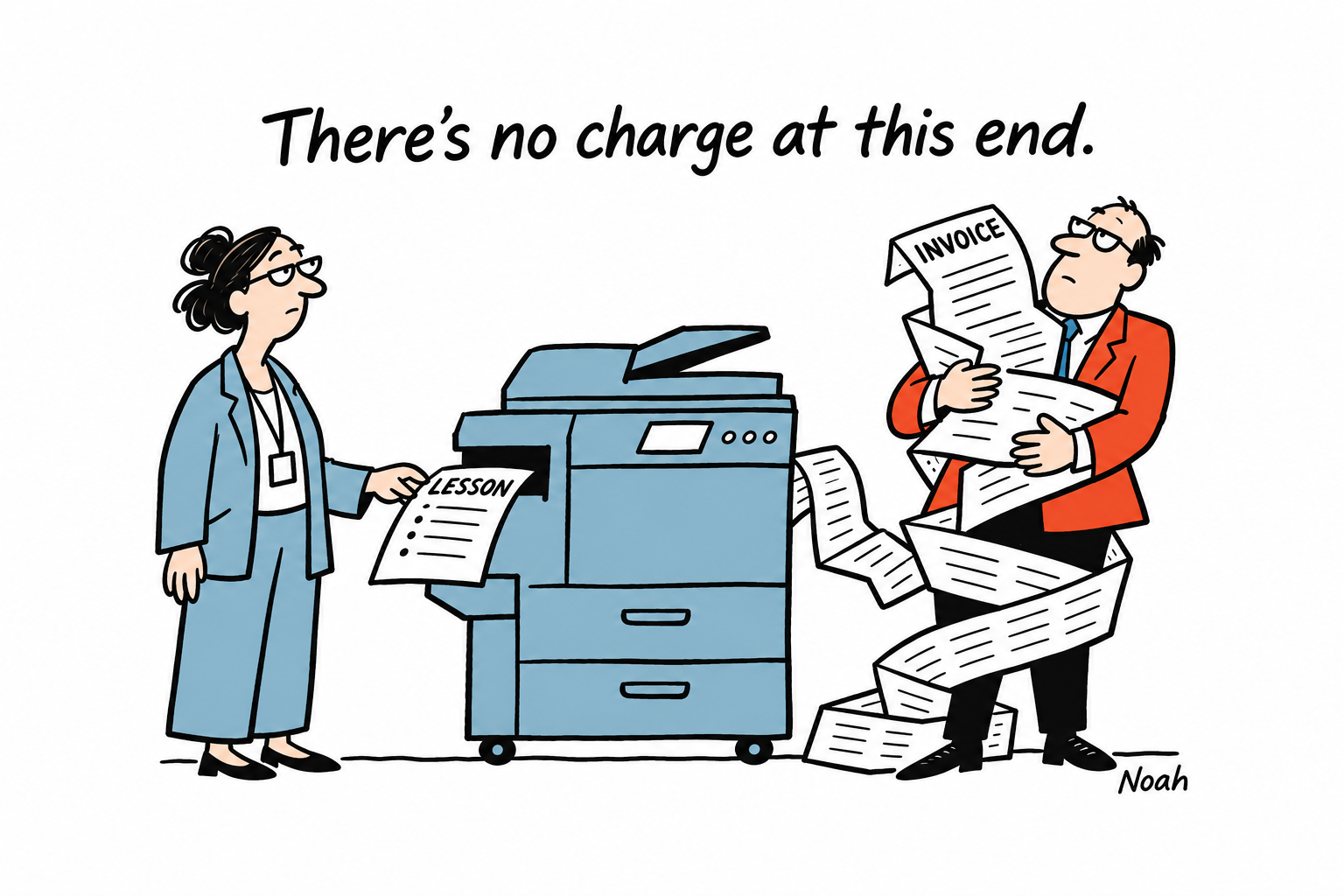
Cartoon · AI-generated
A history teacher in England can download a lesson from Oak National Academy, change the slides and teach it the next morning. Pearson helped write the primary history materials. The teacher pays nothing at the point of use. That transaction is the publishing story inside a legal challenge to Oak that the Publishers Association said was due to be heard at the High Court on 24 and 25 November.
The strongest case for Oak is that it gives teachers a usable starting point. Its own evaluation suggests that many use the materials a lesson at a time. The financial risk sits with suppliers whose paid products can be replaced wholesale, while some publishers can earn money writing the free alternatives. With a revised curriculum due for first teaching from September 2028, both the government and publishers have a decision to make about which work schools should buy and which the state should commission once for everyone.
The Publishers Association, the British Educational Suppliers Association and the Society of Authors are challenging the government’s decision to establish Oak. The grounds described by the Publishers Association include failure to consult and an allegation of unlawful subsidy. Those are the claimants’ allegations. In July, education minister Georgia Gould told Parliament that £22.8 million had been allocated to Oak for 2026/27, with funding for the next financial year subject to business planning.
In an October written answer to Parliament about the impact on commercial publishers, education minister Baroness Smith of Malvern said the department had concluded that Oak had “a modest impact on the domestic curriculum resources market”. The department’s own assessment also found that Oak’s establishment contributed to a reduction in investment in resources for the domestic market. It drew on teacher and supplier feedback and desk research, and identified other pressures, including inflation and constrained school budgets. Its evidence gives a reason to watch investment in the next round of curriculum products. It does not put a reliable cash figure on sales diverted by Oak.
a modest impact on the domestic curriculum resources market
A lesson can displace a subscription, or leave it intact
Oak reported this month that about 240,000 teachers from around nine in ten English schools used the platform at some point in 2025/26. About 68,800 used it in a typical week. The gap matters to a publisher deciding what still sells. Occasional use of a free worksheet tells a sales team very little about whether the department intends to renew an annual licence.
ImpactEd’s evaluation, commissioned by Oak, gets closer to that question. Among 567 Oak users who answered a question about curriculum changes, 36% described adding or substituting individual lessons and 26% reported changes to sequences of lessons. Ten per cent said Oak had become their main curriculum. These are answers from teachers who took part in a voluntary survey. They establish what some users did and give no direct measure of how many schools stopped buying commercial products.
Take a hypothetical 100 departments each paying £400 a year for a package. If ten drop it because free lessons replace it, the supplier loses £4,000 in annual sales. If all 100 use free material occasionally and renew the package, the loss on those subscriptions is zero. Both situations would register as wide use of the free service. Renewal data, with schools’ reasons for cancelling, would tell a publisher considerably more about exposure than download totals.
The state is already a customer
Pearson co-created Oak’s primary history materials. Future Academies Trust developed the secondary materials. Users can download editable resources, including slide decks and worksheets. Oak’s terms generally apply the Open Government Licence to lessons published on its main site after 1 September 2022, subject to stated exceptions. That licence permits reuse, adaptation and commercial use with attribution and leaves third-party rights outside its scope. The public sector pays for work that many teachers and businesses can subsequently use.
That places a premium on getting paid for the work up front. An August award notice named Study Mind as the supplier for an Oak Reception curriculum contract valued at £383,542 before VAT. The notice recorded the signature as pending at the time. A separate July planning notice envisaged enhancements to primary and early secondary materials. The published value for Reception gives potential bidders a view of one commission’s scale. It gives authors no basis for assuming what reaches freelancers, how revisions will be paid for or whether the same supplier will win the next commission.
Lara Newman’s 2025 independent review of Oak recommended giving suppliers more prominent branding on the materials they help create. This has a practical bearing on bids. In a market where schools can freely adapt finished lessons, visible credit can help a supplier sell related work. If a contributor’s name is mostly seen at the end of a slide deck, it is harder to turn that work into a sales lead. A bid should make commercial sense on its fee and update obligations even if it generates little follow-on business.
The independent review also found that “the need for in house quality assurance was initially underestimated”. Oak brought in temporary staff to help. That matters when comparing the cost of commissioning a free national product with the price schools pay for an existing one. The contract award is one line of the budget. Checking work from several suppliers and keeping it consistent also takes staff time.
What to measure during the curriculum rewrite
The government expects to publish the final revised curriculum in spring 2027. That gives existing suppliers a live decision about the next edition of a textbook, digital course or school-wide package. A publisher with strong renewal rates can test which part of the service a school still values once it can assemble individual lessons free of charge. Assessment, implementation support and keeping a department’s materials current carry their own costs. The evidence for investing in those services will come from what schools keep buying when the cheaper option is available.
Noah estimates an 84.36% chance that on 26 November 2027 Oak will still operate its England curriculum resource service with a Department for Education grant covering that date and core lessons available to teachers without a subscription charge. Existing use supports that forecast. The department’s published allocation covers 2026/27, so grant coverage for the forecast date is still a separate decision.
For the Department for Education, teacher reach is a measure of whether public money buys something useful. It needs a second measure of whether schools retain a choice of viable suppliers. Repeat surveys matched to anonymised procurement data could distinguish schools using Oak alongside paid products from schools dropping those products. Publishing the cost and update terms of competed work, along with who wins successive commissions, would show whether smaller suppliers have a viable route into the market. The court will address the legal challenge. The next curriculum cycle offers the chance to find out what teachers keep using, what schools keep buying and who can afford to keep writing it.
Sources
- Publishers Association, judicial review hearing update (23 November 2026)
- British Educational Suppliers Association, procedural update on Oak’s judicial review (February 2026)
- Georgia Gould, written parliamentary answer on Oak’s funding (16 July 2026)
- Baroness Smith of Malvern, written parliamentary answer on Oak (6 October 2026)
- Department for Education, Oak market impact assessment (September 2025)
- Independent review of Oak National Academy, led by Lara Newman (September 2025)
- Oak National Academy, summary of 2025/26 evaluation and usage (16 November 2026)
- ImpactEd, Oak evaluation 2025/26, figure 3.14
- Oak National Academy, history curriculum and development partners
- Oak National Academy, terms and conditions
- National Archives, Open Government Licence v3.0
- Oak National Academy, Reception curriculum contract award notice (1 August 2026)
- Oak National Academy, curriculum enhancement planned procurement notice (July 2026)
- Department for Education, government response to the curriculum and assessment review (November 2025)
- Georgia Gould, written parliamentary answer on Oak’s funding (16 July 2026) (official data record)
- Baroness Smith of Malvern, written parliamentary answer on Oak (6 October 2026) (official data record)
- Research notes and forecast definitions
Source: Tomorrow’s Publisher