Carbon Brief’s paid community puts a price on journalists’ time
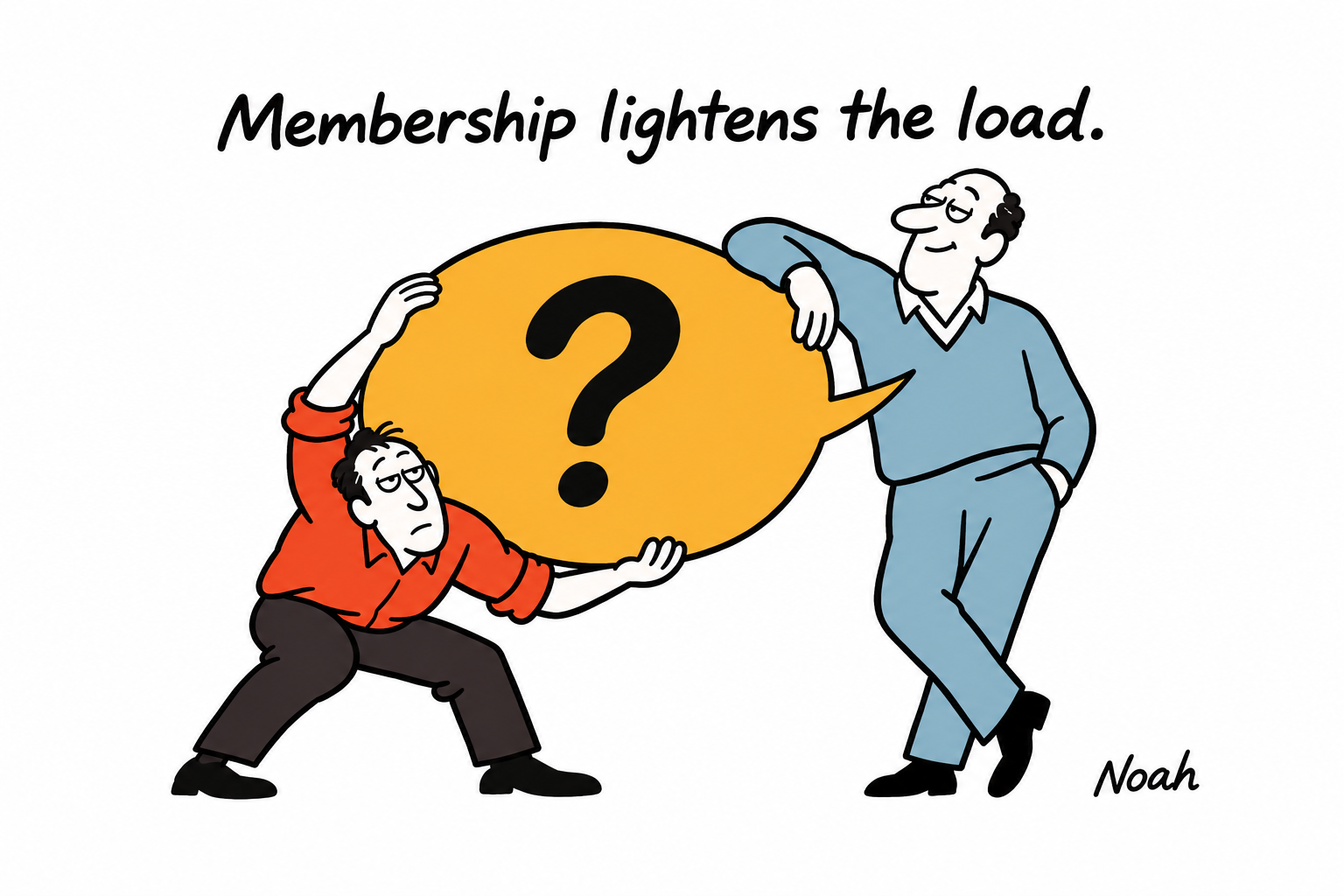
Cartoon · AI-generated
Carbon Brief’s new membership has moved beyond a list of promised benefits. On 12 November, the climate publication published an interview in which Ed Miliband answered questions readers had submitted through CB Connect, its new discussion forum. Participation helped shape the reporting; the resulting interview was available on the open website.
That is the useful distinction in CB+, the membership launched this month. A publisher can charge for organised access and specialist services while allowing its journalism to reach everyone. Readers gain a more direct relationship, and the newsroom gains a potential income stream. The cost is the continuing work of answering, convening and moderating. Publishers considering the model should define that workload before expanding the benefits.
CB+ has a £5-a-month Supporter tier and a £10 Pro tier. Its live offer includes discussion, expert Q&As and a monthly forward-looking newsletter. Pro adds a journalist-run WhatsApp group and an extra afternoon media briefing. These are services surrounding the reporting, rather than a requirement to pay before reading the main website.
Carbon Brief editor Leo Hickman told Press Gazette that readers wanted to “drill down deeper and have a more constructive and nuanced discussion”, according to its 3 November report republished by Marketing Now. That describes an editorial job as much as a technology product. A forum provides somewhere to meet; useful discussion still needs knowledgeable people and attention.
The Miliband interview makes the distinction concrete. Simon Evans conducted it at COP31 in Antalya, using questions submitted through the forum. It demonstrates that reader participation can feed a published editorial output. It does not establish how many people joined because of that opportunity, how many submitted questions or whether those members will renew.
The counterargument deserves weight. Not every member wants personal attention every week. Some will pay primarily to support the journalism; others may find a well-edited briefing sufficient. A community does not have to become a permanent helpdesk. Its economics depend on which of those expectations the publisher creates and can reliably meet.
Noah, a research and forecasting service, puts a 62.4% chance on Carbon Brief delivering at least three CB+ members-only live online climate or energy briefings or Q&As, on separate dates, between 17 November 2026 and 16 May 2027, where members can question its journalists. The estimate for the same test by 16 November 2027 is 66.81%. Conference-access packages, recruitment presentations and asynchronous discussions are excluded. Earlier webinars demonstrate capability, but no qualifying forward calendar has been verified. These are estimates of a defined minimum service, not its profitability or members’ willingness to renew.
The conference test has a denominator
There is evidence of willingness to pay, but it belongs to a specific product. Press Gazette’s own 3 November newsletter reported that about 1,500 people had paid $10 each for a two-week WhatsApp offer around the previous climate conference in Brazil. Carbon Brief’s COP30 material describes an Insider Pass combining conference updates, a dedicated newsletter and webinars.
An original report dated 17 November 2025 also confirms that Carbon Brief held a second webinar answering Insider Pass holders’ questions. This was delivered editorial work, not simply a landing page advertising future access. The event gave readers a defined period, an urgent subject and a reason to return.
Those ingredients make the experiment commercially interesting and limit what it proves. A fortnight at a major negotiation is different from paying through an ordinary month. The reported 1,500 is not the subscriber count for CB+, and the conference price is not an annual membership price. Neither source supplies the cost of producing that service or the share of buyers who later purchased something else.
The current introductory offer sharpens the distinction. Supporter starts at £1 a month and Pro at £2 for three months, before moving to the standard monthly prices. The offer ends on 1 December. Joining at a discount tests initial interest. Continuing at the ordinary price tests a different decision, after the most obvious event-driven use has passed.
That does not make discounting a mistake. It lowers the cost of trying an unfamiliar product. But a launch total should not be presented as recurring demand until the publisher knows which paying cohort it represents and what happens when the introductory period ends.
Community changes the cost of another member
Carbon Brief’s membership terms name a collection of familiar tools: Memberful for membership administration, Stripe for payments, Discourse for discussion and WhatsApp as an optional channel. The practical attraction is that a publisher can assemble a service without building every component itself. It still owns the promise made to the member.
The public price of Memberful’s Standard plan is $49 a month plus a 4.9% transaction fee. That is a supplier’s advertised tariff, not evidence of Carbon Brief’s negotiated bill. It illustrates why the subscription price is gross revenue before platform charges, payment costs and the work of producing the benefits.
Consider a deliberately hypothetical specialist title with 500 members paying £10 a month. It bills £5,000 monthly before tax, fees or costs. If 100 members each require 15 minutes of individual attention, that alone consumes 25 staff hours. Another 500 quiet readers might add little work; another 100 demanding conversations might add a great deal. These are illustrative assumptions, not Carbon Brief’s membership numbers or workload.
The lesson is not to make the forum quiet. Activity may be precisely what makes membership valuable. The distinction is between useful participation shared among members and a growing obligation for reporters to provide individual consultancy at a mass-market price. A newsroom needs to know which activity it is encouraging.
Moderation belongs in that calculation. The published rules prohibit harassment and spam and allow access restrictions for serious or repeated breaches. A paid door does not itself perform those judgements. Someone must decide when a conversation has become abusive, repetitive or misleading, including when the person involved is a paying customer.
Organisational seats change the buyer
CB+ also offers group packages with Pro access for each seat. That is a consequential distinction for a specialist publisher. An individual may join out of interest or affinity; an employer may need staff to follow a policy process, understand research or prepare for a meeting. The same journalism can support different purchasing decisions.
An organisation buying seats is not automatically evidence of higher engagement. Its administrator can assign and reassign access, under Carbon Brief’s terms. The useful question is whether the people receiving those seats actually use the service and whether the organisation finds enough continuing value to keep paying. A contract and a community are different assets.
The British market already contains related approaches. The Bureau of Investigative Journalism’s Insiders offer asks for recurring support and lists a member newsletter and priority event access. Its membership explanation explicitly keeps public-interest reporting free. Carbon Brief is developing the more specialised proposition of an ongoing conversation around a defined professional subject.
The comparison becomes sharper at edie, which announced an EU Climate Policy Tracker and membership offer on 20 July. The promised utility is keeping sustainability professionals abreast of legislation. That gives a professional buyer a recurring task to justify the expense. A launch announcement still supplies no evidence of renewal or a positive margin.
Professional relevance does not always make the reader the payer. Investment Week’s current access offer is free for people advising, managing or analysing investments, while charging professionals outside those roles £1 a day. That establishes an eligibility-based offer, not its profitability or the source of its funding. It challenges the assumption that identifying a valuable professional audience automatically identifies a subscription buyer.
Nor does moving a conversation away from a social feed eliminate dependence on other companies. WhatsApp access remains optional and subject to that platform’s conditions. A direct paying relationship gives a publisher something valuable, but payment, identity, email and conversation still run through services with their own rules and costs.
The durable product is the editorial service
The strongest part of Carbon Brief’s experiment is the connection between an established specialism and a specific reason to participate. The Miliband questions and last year’s conference webinars show what that can produce. The missing evidence is commercial: recurring paid uptake, use outside major events, retention after introductory pricing and contribution after delivery costs.
Publishers should take the idea seriously without mistaking a list of benefits for a new margin. The editorial discipline is to offer something repeatable: a well-chosen discussion, an interpretable briefing or a bounded chance to question someone knowledgeable. Each must justify the time spent producing it as well as the money collected.
CB+ offers a credible way to sell more of a newsroom’s expertise without making its public reporting scarce. Its success will turn on whether members keep finding that service useful at the ordinary price, and whether delivering it leaves resources for the journalism that made them join. The conversation can help pay for reporting. It also has to be paid for.
Sources
- Carbon Brief: reader questions and published Miliband interview, 12 November 2026
- Carbon Brief: current CB+ membership offer, checked 16 November 2026
- Carbon Brief: free-to-read publishing mission
- Press Gazette reporting, republished by Marketing Now, 3 November 2026
- Press Gazette's original newsletter: prior conference offer, 3 November 2026
- Carbon Brief: second delivered COP30 webinar, 17 November 2025
- Carbon Brief: membership terms and service providers
- Memberful: advertised Standard pricing, checked 16 November 2026
- TBIJ: current Bureau Insiders offer
- TBIJ: membership explanation, 17 December 2025
- edie: EU Climate Policy Tracker and membership launch, 20 July 2026
- Investment Week: qualifying professional access offer on Friday Briefing, 3 August 2026; checked 16 November
- Research, method and complete automatic forecast notes
Source: Tomorrow’s Publisher