The medical journal team dismissed to train its AI replacement
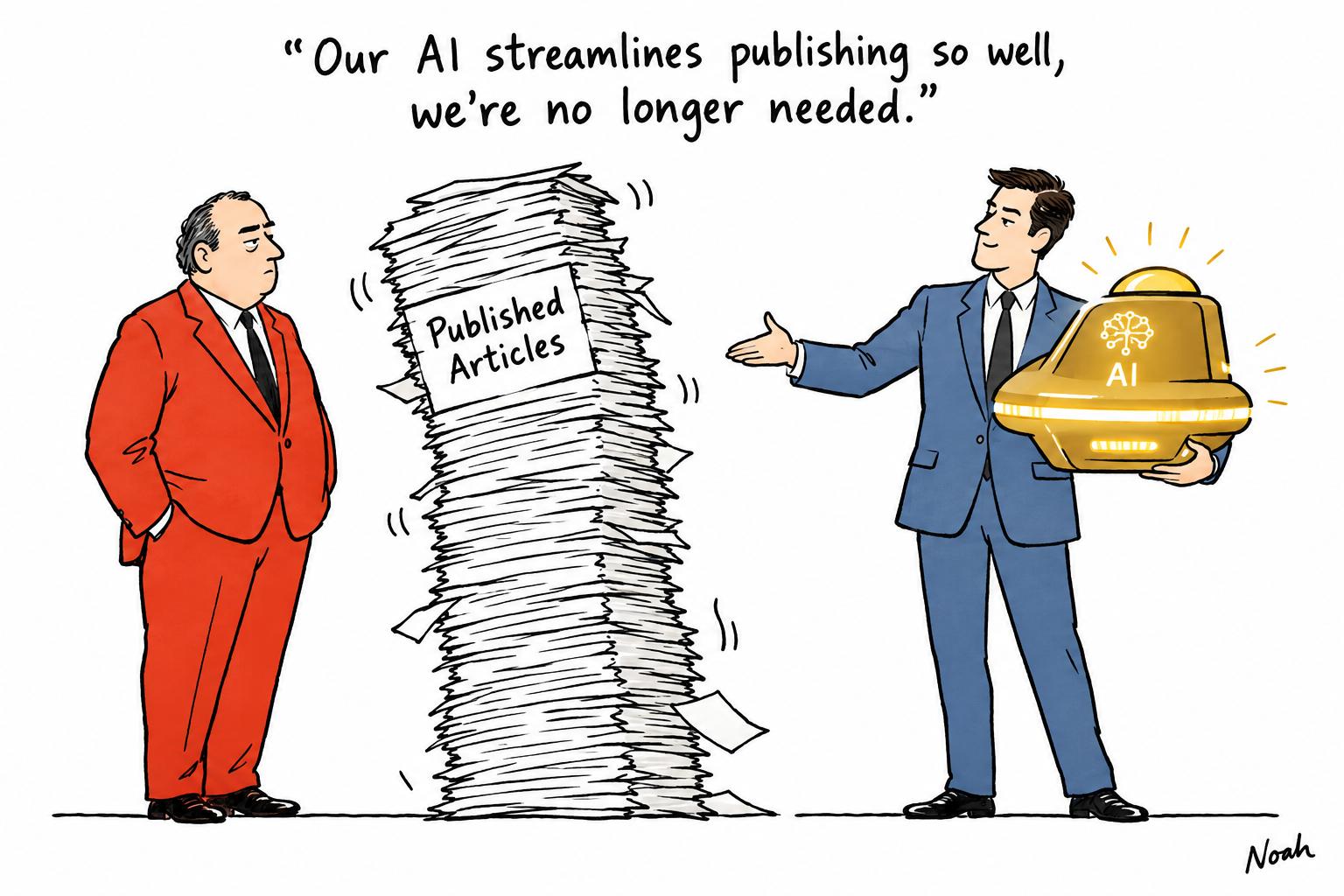
Cartoon · AI-generated
A former medical journal editor says his team was made redundant after executives chose an AI publishing platform, highlighting the uneven and human cost of automation.
Artificial intelligence is often sold as a tool that will streamline routine work rather than replace people outright. Yet for one medical journal editor, the technology arrived less as a convenience than as the mechanism for his own redundancy.
Writing in Persuasion, the former senior editor described a long career spent improving articles, answering authors’ queries, managing production and helping to raise a specialist journal’s profile over two decades. He portrayed the work as a mixture of editorial judgement, linguistic skill and judgement calls that could not be reduced to a simple checklist, even if much of it sat within the broad category of office-based symbolic labour.
That arrangement changed after a new executive director arrived in 2021 with an enthusiasm for technology and asked the journal to seek a quote from Straive, a Singapore-based AI publishing platform. The journal’s board had previously reassured staff that it had no intention of outsourcing the production operation that had been painstakingly built up over 15 years, but within weeks the team was summoned to a Zoom call and informed their roles were no longer required. According to the account, the staff were offered $1,000 in severance on the condition that they sign a confidentiality agreement and remain for a further month to help train the system. They declined.
The dismissal was presented to the staff as a financial decision rather than a judgement on performance, and the article says a bonus arrangement in the new executive director’s contract rewarded lower costs. The consequences for the team were uneven and, in some cases, bleak: one colleague moved into a stronger editorial position elsewhere, another took a lower-paid role in publishing, and the production manager moved from work she did not enjoy into temporary and contract assignments after another lay-off.
The episode lands at a moment when employers across the United States are experimenting with AI more aggressively. Gallup said in early 2026 that half of employed adults were using AI at work, with daily use at a record high, even as a sizeable minority reported disruption. At the same time, a study from the US National Bureau of Economic Research found that although most firms had adopted AI, the vast majority reported no major effect on employment or productivity so far, suggesting that the technology’s labour-market impact remains uneven rather than uniform.
Even so, warnings about the erosion of entry-level work are growing louder. A Stanford University study cited by Tom’s Hardware found that AI adoption has coincided with a drop in junior vacancies in fields such as software development and customer service, especially for workers in their early twenties. Meanwhile, Harvard Medical School has highlighted NEJM AI, a new journal designed to examine evidence for medical uses of artificial intelligence, underscoring the speed with which the technology is moving from a force disrupting publishing workflows to one being studied and governed by the institutions it is reshaping.
Inspired by headline at: [1]
Sources by paragraph: - Paragraph 1: [1] - Paragraph 2: [1] - Paragraph 3: [1] - Paragraph 4: [4], [5] - Paragraph 5: [3], [6], [7], [2]
Source: Noah Wire Services · Original