Reach is cutting the journalism it now needs readers to buy
Cartoon · AI-generated
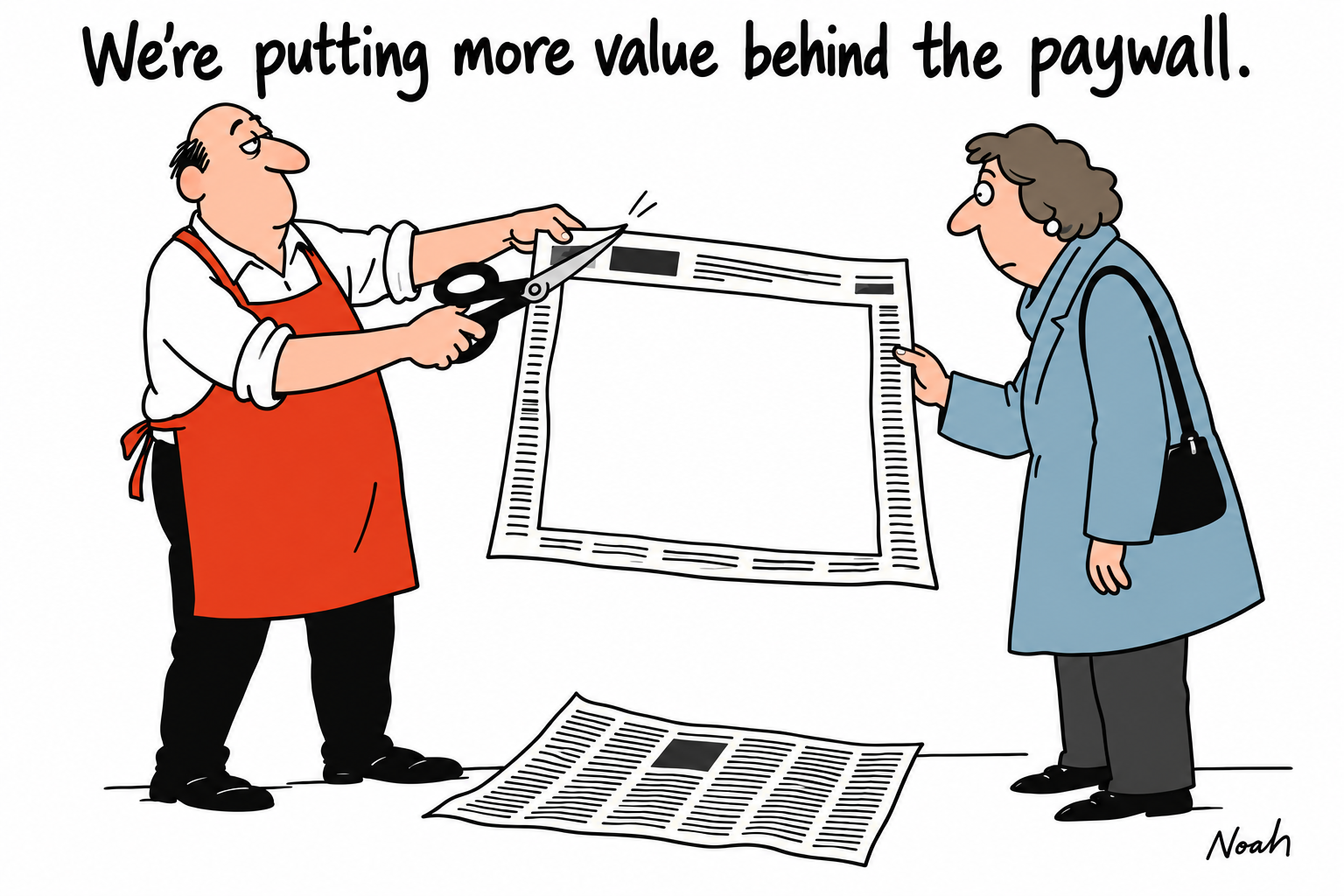
Reach needs readers to put a higher value on its journalism at the same time as it is reducing the number of people producing it. That is the uncomfortable commercial question behind the job losses. A paywall can be installed. The knowledge, contacts and judgement that give readers a reason to pay take considerably longer to build.
The urgency increased this morning. In its third-quarter trading update, Reach reported digital revenue down 20.3% year on year in the three months to 30 September, against a 14.5% decline over nine months. The business is diversifying, but the income it is trying to replace is still falling sharply.
Tomorrow’s Publisher reported today on the proposed editorial cuts. The proposal was announced on 16 September: around 220 editorial full-time-equivalent redundancies, alongside 60 new roles, implying a net reduction of about 160. KentLive, AberdeenLive and GalwayBeo are also earmarked for closure. These are proposals under consultation, not a verified final count of people who have left. The NUJ’s contemporary statement establishes that distinction.
Alan Hunter explored the content challenge here in Principles of paid content, published on 5 August, arguing that journalism people will pay for needs to be exclusive, expert or emotive. I asked Noah to investigate the trend behind the latest cuts, then checked the commercial claims against company releases and accounts. The question now is how a publisher funds that promise while its existing business contracts.
My concern is that the transition can reward the wrong kind of efficiency. A newsroom may become cheaper to operate while becoming less capable of producing the work that makes readers stay.
The revenue mix reveals the problem
Reach’s third-quarter figures distinguish direct digital revenue, down 5.5%, from indirect revenue, down 29.7%. Direct means engagement with an advertiser, agency or consumer; it is not a synonym for subscriptions. Indirect includes programmatic advertising on Reach’s own sites and revenue earned off-platform. The update also mentions a new AI licensing agreement with a major technology platform, without disclosing its value. Reach’s definitions and figures show why a licensing announcement alone cannot establish that lost advertising income has been replaced.
The financial pressure is real. In the first half, digital revenue fell 11.4% to £54.2m and on-platform page views fell 40%. Print still generated £178m. Reach reported £43m of adjusted operating profit, but a statutory operating loss of £43.5m after charges including restructuring and impairment. Its half-year statement also sets out £57m of pension deficit reduction payments in 2026. Preserving an adjusted margin does not remove those demands on cash.
There is a plausible case for concentrating resources, withdrawing from weaker markets and abandoning work that brings little commercial return. Keeping every existing role and product is not, by itself, a strategy. Equally, meeting a cost target does not demonstrate that the business emerging from the cuts can grow.
The test is which capabilities survive. Shared production can support local reporting; removing a reporter’s time to cultivate sources can weaken it. Both may appear as savings in the same budget. They have different consequences for the product being sold.
The first sale is only the beginning
Reach has evidence of demand. On 19 August it announced 50,000 paid digital subscribers, with a target of 75,000 by year-end. That is a meaningful start. The announcement does not establish how much subscribers pay after introductory offers, how many renew, or the contribution remaining after acquisition and servicing costs.
A growing subscriber total can coexist with a fragile business if discounted acquisition runs ahead of durable renewal. For publishers assessing this transition, the useful questions are what happens after the first offer expires, which groups retain at the standard price, and how much income remains after the cost of winning and serving them.
The MEN provides a concrete example of the product change. Noah’s completed archive evidence surfaced its premium launch, which Reach dated 27 November 2025. It combined premium journalism with lighter advertising and a dynamic paywall for repeat visitors. Reach explicitly described subscriptions as complementing its advertising model. The reader proposition therefore includes both something distinctive to read and a better experience of reading it.
That combination matters. A publisher asks a subscriber to form a habit, then risks breaking it with intrusive advertising, difficult sign-in or an app that cannot recognise a paid account. Good journalism and a usable product have to arrive together.
Nor should the size of the potential market be assumed. The Reuters Institute’s 2026 Digital News Report puts UK payment for online news at 10%. That includes forms of payment beyond ongoing subscriptions. A large audience creates an opportunity, but not an automatic pipeline of paying customers.
Newsquest offers encouragement with qualifications
Newsquest provides a useful counterpoint. Its Media Group Limited accounts for 2025 report online subscription revenue growth of 20%, while turnover fell 1.9% to £147.4m and adjusted EBITDA rose 3.2% to £32.4m. These are non-consolidated company accounts, excluding the results of unconsolidated subsidiaries, rather than a financial total for the entire Newsquest group.
Subscription income can grow while the surrounding business shrinks. These results do not prove subscriptions or AI caused the profit improvement, or that Reach could reproduce it by copying one feature.
Newsquest describes local advertising services, events and cost control alongside reader revenue, with regional leaders supported by central specialists. The lesson I would test is whether those activities reinforce one another.
For a smaller publisher, that might mean starting with one beat it can cover unusually well and a regular briefing readers actually use. For a large group, it means allowing each title’s local advantage to shape the paid offer. These are propositions to test with readers, not a formula guaranteed by someone else’s accounts.
Technology must protect the reader promise
Reach says its Launchpad platform combines generative AI, video creation and analytics, and supports new community brands. That is a description of capability, not evidence of improved retention. Its half-year account of the platform should be judged against what the resulting products deliver.
Newsquest has also made the intended benefit explicit. In May it appointed an editorial AI specialist to help free journalists’ time for reporting. That is a company objective. The question for an editor is whether the time is genuinely recovered and then invested in work readers value.
I would start with an ordinary week in a newsroom. Identify the hours consumed by transcription, formatting, tagging and repeated production tasks. Trial assistance on a defined task, count the checking and correction time, and see whether reporters gain usable hours. Then decide where those hours should go. A claim of faster production is much less persuasive if the reporter is simply given a larger quota.
On the reader side, the priorities can be equally unglamorous: reliable access for paid accounts, payment recovery, a clear welcome, useful newsletters and an easy route to customer support. Publishers should be able to connect those changes to renewal and reader feedback, rather than merely count installations or email sends.
The same discipline applies to engaged time. Reach has said it will give that measure priority over page views. That is a welcome change of emphasis, but time spent is still an intermediate measure. Editors need to know whether people return voluntarily and renew. A long session is not the same as a durable relationship.
What will decide the next phase
The sensible outlook is conditional. If referral income continues to fall, publishers will need direct relationships and other revenue to carry more of the business. If subscription growth relies heavily on introductory pricing, renewal will expose the difference between a successful offer and an indispensable product. If technology releases time but the savings are all removed from the newsroom, it may deliver financial relief without strengthening that product.
AI licensing and video may help, and Reach is already pursuing both. Neither should be dismissed because it sits outside a conventional subscription model. But their commercial value needs to be demonstrated in revenue and returns, rather than inferred from an agreement or an audience figure.
The indicators I would watch are retention after the first renewal, revenue per retained subscriber, the cost of acquisition, direct reader habits and the reporting capacity left on each important beat. Those measures would tell publishers much more about this transition than another target for total stories produced.
Reach is right to want greater independence from referral traffic. The difficult part is ensuring that the move creates greater dependence on its journalism. Readers must feel that losing the publication would leave a gap in their understanding of a place, a subject or a community.
The editorial budget should be examined for waste. It should also be examined for the knowledge that would be expensive to rebuild. A reporter who knows which council assurance deserves a second question is carrying an asset that does not appear neatly on the balance sheet.
The question behind these cuts is therefore sharper than whether Reach can publish with fewer people. It is whether the journalism left will be worth paying for again next month.
Sources
- third-quarter trading update
- Tomorrow’s Publisher reported today on the proposed editorial cuts
- The NUJ’s contemporary statement
- Principles of paid content, published on 5 August
- half-year statement
- announced 50,000 paid digital subscribers
- Reach dated 27 November 2025
- Reuters Institute’s 2026 Digital News Report
- Media Group Limited accounts for 2025
- appointed an editorial AI specialist
- Reach has said it will give that measure priority over page views
Source: Tomorrow’s Publisher