Publishers embrace AI but struggle to prove its commercial value
Cartoon · AI-generated
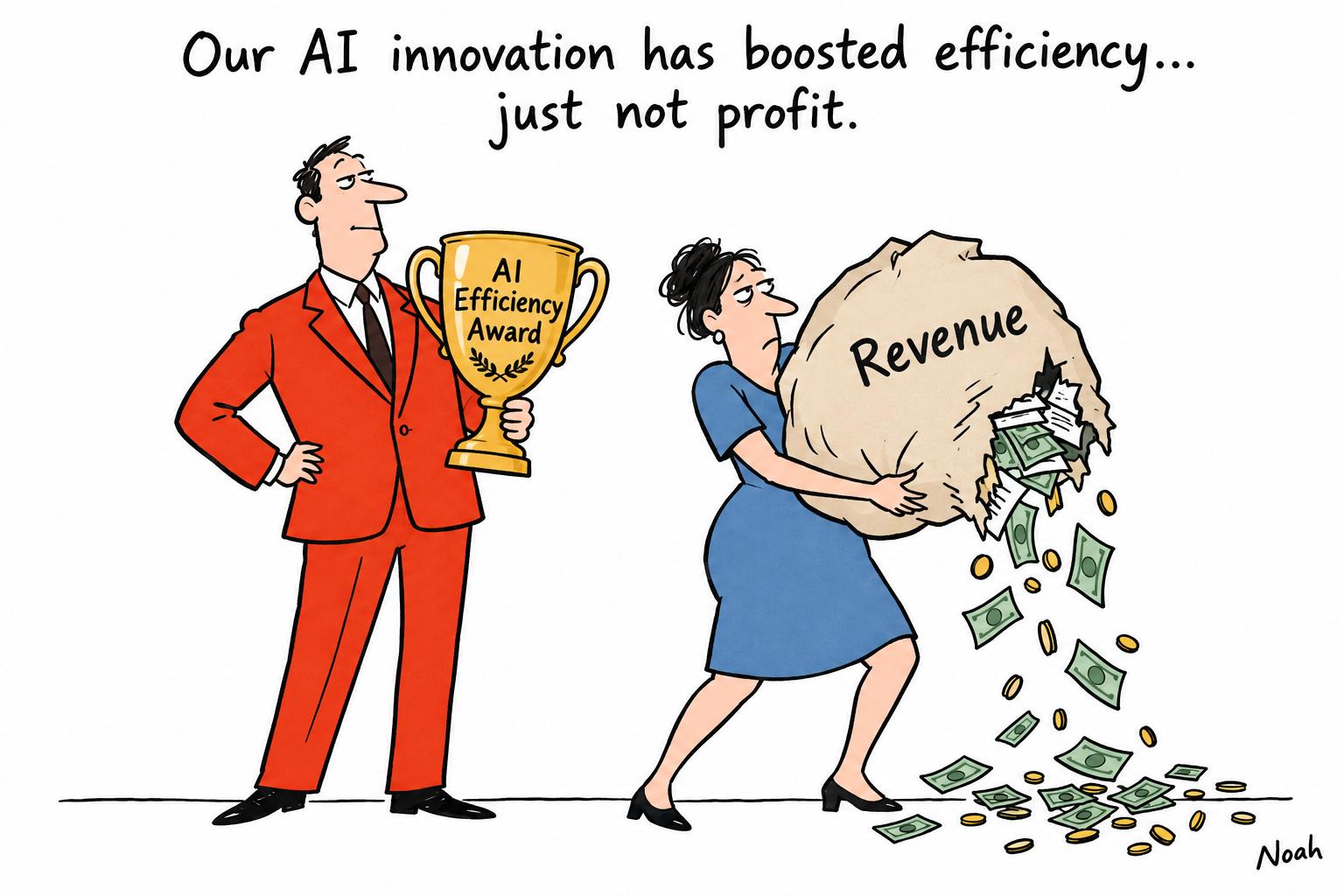
AI is now widespread across publishing, but new industry research shows most organisations are still unable to measure its impact or convert efficiency gains into revenue.
Publishers are moving well past the experimental stage of artificial intelligence, but the industry is still struggling to turn that activity into hard business gains. A WAN-IFRA report based on a survey of 125 publishing executives in 40 countries found that about 80 per cent describe their organisations’ AI use as emerging or advanced, yet 78 per cent say it is difficult to measure the technology’s value and only 10 per cent believe it has helped generate revenue. That tension mirrors broader industry research showing that AI is now embedded in many newsrooms, but is still being judged mainly on efficiency rather than direct commercial return. Presenc AI’s 2026 statistics, for example, say 81 per cent of newsrooms have adopted AI, largely to improve content production efficiency, while publishers are also trying to adapt to changing patterns of reader attention as AI reshapes how audiences discover information.
The WAN-IFRA findings suggest that publishers are now being forced to think more strategically about where AI fits within the business, rather than simply whether to use it. In the report, Ezra Eeman examines the gap between productivity gains and the more difficult questions around search referrals, licensing and revenue attribution. A wider perspective from Katya Gorchinskaya, using her Jindex.ai database of more than 3,150 publicly disclosed AI use cases, points to a market in which adoption is widespread but organisational transformation remains uneven. Separate industry research also indicates that adoption is accelerating across publishing sectors: the Book Industry Study Group and BookNet Canada said in a 2026 report that 63 per cent of respondents in the North American book industry now use AI, up from 48 per cent a year earlier.
The case studies in the WAN-IFRA report show how that experimentation is translating into different editorial and product strategies. Nikkei is using AI-assisted drafts to widen corporate coverage, while POLITICO is applying AI to help subscribers search specialist reporting more easily. Frankfurter Allgemeine Zeitung and The Hindu are using propensity models to shape reader journeys, and Ippen is examining how its journalism appears inside AI conversations. The Mail is also testing how visible its content remains in AI-generated answers. Taken together, those examples point to a publishing sector that is no longer asking only what AI can do, but where it can genuinely improve discovery, engagement and workflow.
That more mature phase is also exposing how unfinished the commercial model remains. Publishers appear increasingly comfortable using AI in back-end production, search and recommendation systems, but the WAN-IFRA report suggests they have yet to solve the problem of proving return on investment. The next phase, then, is less about adoption itself and more about governance, measurement and control: how to trace value, protect editorial standards and decide which AI applications deserve to become permanent parts of the business. Without those answers, the technology may remain broadly deployed but only partially understood.
Inspired by headline at: [1]
Sources by paragraph: - Paragraph 1: [2], [3] - Paragraph 2: [2], [4] - Paragraph 3: [2], [5], [6] - Paragraph 4: [2]
Source: Noah Wire Services · Original