Publishers have learned to use AI. Now they must account for the time it saves.
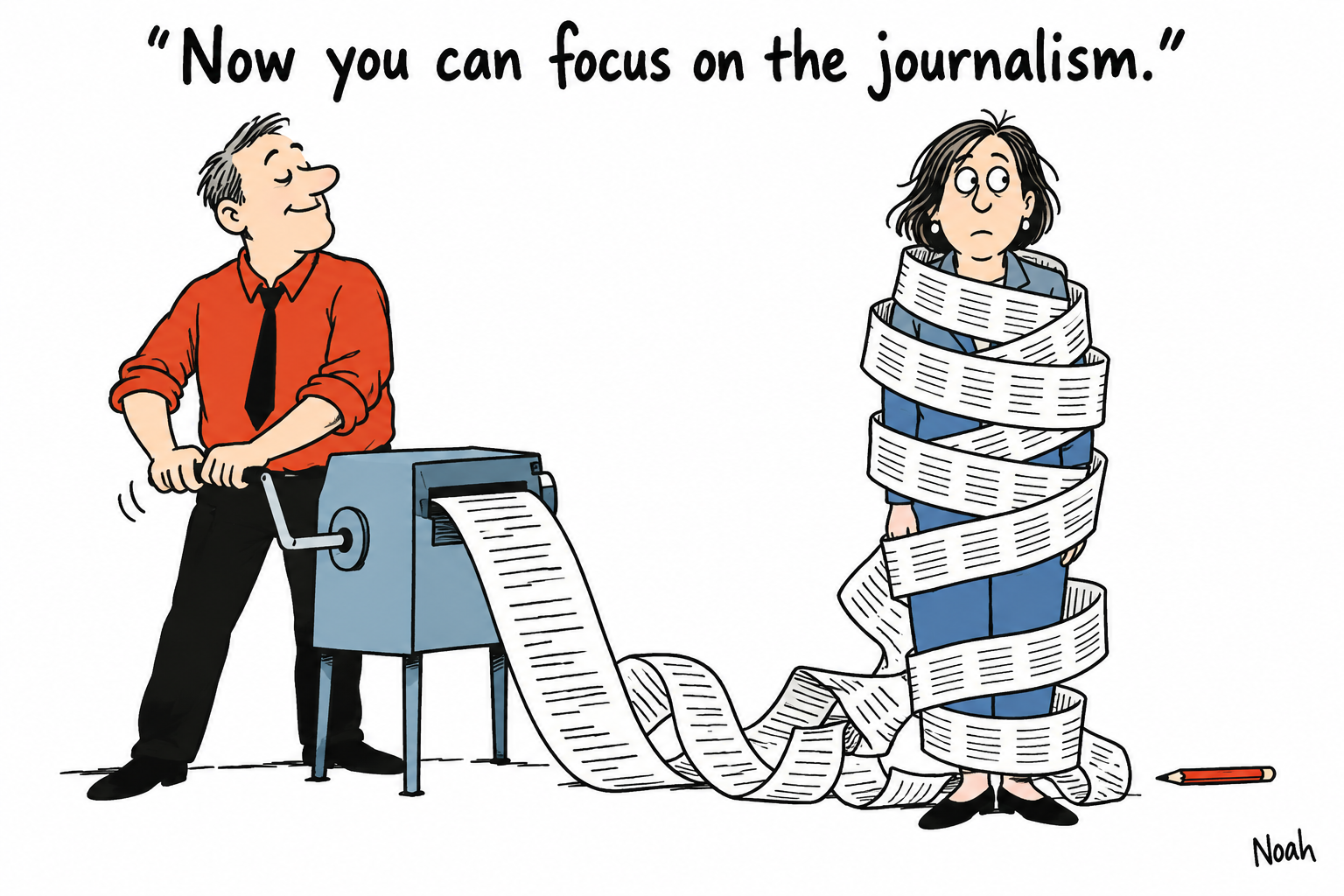
Cartoon · AI-generated
A faster first draft is an impressive demonstration. It is an incomplete business case. Until somebody checks the work, publishes something useful and discovers what readers do with it, the newsroom has measured only the easiest part.
That is the question behind WAN-IFRA’s research published on 14 October. In its survey of 125 publishing executives across 40 countries, about 80% described their organisation’s AI use as emerging or advanced. Yet 78% found its value difficult to measure, and just 10% said it had helped generate revenue.
These are responses from an international sample, not a census of British publishers. Nor does the revenue figure establish that the other respondents have wasted their money. A tool can improve reporting or reduce drudgery without creating a separately identifiable sale. The finding is nevertheless uncomfortable: adoption is becoming easier to describe than its consequences.
I think the useful question for a UK publisher is what happens to the saved time. Is it spent on an extra interview, checking an allegation, responding to subscribers, or simply making more material that another overstretched colleague must review?
The Mail offers a useful place to start
In September, dmg media described an internal session showcasing its innovation team’s work. It named social-media automation, The Daily Download audio bulletin and assistance with analysing complex datasets. Chris Clemo’s team, global editorial director Ben Bailey and innovation editor Cameron Roy featured in that account. This is a concrete account of newsroom experimentation by a major British publisher, rather than an abstract promise about transformation.
It is also a company account. The published page does not provide a controlled assessment of net savings or isolate the tools’ effect on subscription growth. That is a limit on what an outside observer can conclude, not evidence that the projects are unsuccessful.
The distinction matters because those applications solve different problems. Distributing an existing story more efficiently, making an audio product and helping a reporter interrogate documents should not compete on a single league table of prompts entered or minutes saved.
A document tool might be valuable because it helps a journalist find a consequential lead. An audio product might be valuable because an audience uses it habitually. Neither proposition is established by demonstrating that the software produces an output quickly.
The stopwatch is already winning
There is older evidence that this measurement problem runs deeper than one survey. The Future Newsrooms Study 2026, published by FT Strategies and WAN-IFRA with support from Arc XP, drew on 448 responses from newsrooms across 86 countries. Its AI-success question had 390 responses: 42% selected time savings as their primary measure, while 9% selected revenue impact. The study was released in June, so it provides context rather than a second piece of October news.
Those figures describe what respondents chose to measure. They do not quantify how much time anyone saved, or demonstrate that measuring time is wrong. A dependable reduction in repetitive work can be a perfectly sensible objective.
The problem begins when a task-level improvement is booked as an organisational gain before anyone follows the work downstream. A reporter who receives a plausible but unreliable summary may have acquired a checking job. An editor who receives twice as many drafts has not necessarily gained capacity. A faster production process can move the queue rather than remove it.
Consider a hypothetical local newsroom testing an automated account of council papers. The relevant comparison includes finding the right documents, generating the account, checking quotations and numbers, making corrections and preparing publication. Timing only the generation rewards the tool for finishing before the most responsible work begins.
This is also a question of whose time counts. A saving for one desk should not disappear from the calculation when it becomes work for another.
There are more concrete claims to examine. A case surfaced by Noah’s archive research led to WAN-IFRA’s August account of print-production automation. EidosMedia reported its system operating across more than 60 titles, producing over 46,000 pages during 2026 and saving more than 12,000 hours of layout and quality-assurance work. The account also describes editors retaining control of story priorities.
That is a supplier-reported result, rather than an independently audited net return. It does, however, challenge a blanket claim that nobody can identify useful savings. It also points to a more tractable kind of automation: applying a title’s production rules to material that its editors have already selected. An outside observer still needs to know how the savings were calculated, what implementation cost and how the recovered capacity was used.
Capacity needs an editorial destination
AOP’s UK-focused outlook research, published in February, found that 64% of publisher respondents reported using AI within editorial teams to improve workflows and free staff for journalism. The underlying survey included 163 participants, 83% from publishers, and was conducted between November 2025 and January 2026. It records what respondents said, rather than an independent time-and-motion study.
The ambition is sound. The missing step in any individual newsroom is a decision about what the released capacity is for.
An editor could protect it for an investigation, a neglected beat or subscriber questions. Those are editorial choices with observable consequences: additional original reporting, more reliable service, or a closer relationship with a defined readership. They need not all resolve into a short-term revenue figure.
But that destination should be agreed before the spare minutes are absorbed by a larger publishing target. Otherwise a pilot may succeed technically while the newsroom becomes busier and no more distinctive.
I would ask every project owner to finish a plain sentence before the trial begins: this tool will let this team do this useful thing that it cannot currently do reliably or affordably. The sentence should name the beneficiary. “Use more AI” is not one.
A subscriber product is a different test
WAN-IFRA’s public introduction to the new report describes several kinds of application: Nikkei’s assisted corporate reporting, POLITICO’s subscriber discovery tools, propensity models at Frankfurter Allgemeine Zeitung and The Hindu, and the Mail’s work on visibility in AI answers. These are descriptions of the report’s case studies, not a set of independently verified commercial results. The full report is available through its member Knowledge Hub.
They nevertheless illustrate why publishers need different questions for different projects. A tool used by subscribers should help them complete a task well enough to return. A newsroom assistant should make a reporting or production process better. A discovery experiment should bring the right people into a useful relationship with the publication.
Counting more sessions cannot, by itself, settle whether an answer service is useful. A reader might need several attempts because it works badly. Equally, a single successful visit might be valuable because the reader found precisely what they needed. The measurement must fit the reason the product exists.
The counterargument deserves a hearing. Not every early experiment should carry the burden of proving a financial return. A small exploratory project can teach a newsroom what its audience wants or expose a technical limitation before a larger commitment. Requiring a clean revenue attribution too soon could favour easily counted activity over worthwhile learning.
That is an argument for giving a trial a defined learning objective and a limited budget. It is not an argument for leaving it permanently beyond evaluation.
Count the checking, then count the consequence
For a workflow pilot, I would record the ordinary process before introducing the tool, then compare similar tasks with the complete assisted process. The record should include review time, material errors and the work needed when the tool fails. The comparison will be imperfect; it should still be more informative than a memorable demonstration.
For a reader product, I would establish whether people successfully complete the intended task, whether they come back, and whether the observed behaviour supports the commercial purpose. Where the scale and design permit, a comparison group can help separate a product effect from changes that would have happened anyway.
For both, somebody should own the decision to continue, revise or stop. A modest useful tool does not need to become an all-purpose platform to earn its keep. An expensive, impressive experiment should not survive solely because retiring it would look embarrassing.
The important accounting is broader than the software bill. Integration, training, support and verification all draw on resources. Some benefits are editorial and should be defended in those terms. Others are commercial and should eventually withstand commercial scrutiny.
The new research gives British publishers a reason to move beyond congratulating themselves on participation. The Mail and its peers can make a stronger case for innovation by showing what changed after the demonstration ended.
The most persuasive AI success story in publishing may turn out to be an ordinary piece of reporting that would otherwise never have happened. To claim that success honestly, the publisher needs to show where the time went.
Method note
This is an editorial assessment of checked public primary sources as at 15 October 2026. The October WAN-IFRA findings are taken from its public launch summary; the member-only report has not been inspected. The June Future Newsrooms PDF was inspected directly. Survey results, company descriptions and hypothetical examples are distinguished throughout. Noah’s archive research and a targeted follow-up were reviewed alongside those sources. They surfaced the print-production counterexample but did not establish comparable net-return figures for the named UK publishers. Broad search totals are excluded from the argument because their scope did not reliably isolate newsroom AI outcomes.
Sources
- WAN-IFRA — Beyond adoption: How publishers are using AI now
- dmg media — AI takes centre stage
- FT Strategies / WAN-IFRA / Arc XP — Future Newsrooms Study 2026, pp. 10 and 24
- WAN-IFRA — Future Newsrooms Study 2026 release
- AOP — Digital Publishers Firmly Focused on Growth as Attitudes to AI Mature
- WAN-IFRA — Thinking beyond just adoption — the next AI phase for publishers
- WAN-IFRA — What happens when AI starts building the newspaper page?
Source: Tomorrow’s Publisher