SPUR has the publishers. Now it needs the receipts.
Cartoon · AI-generated
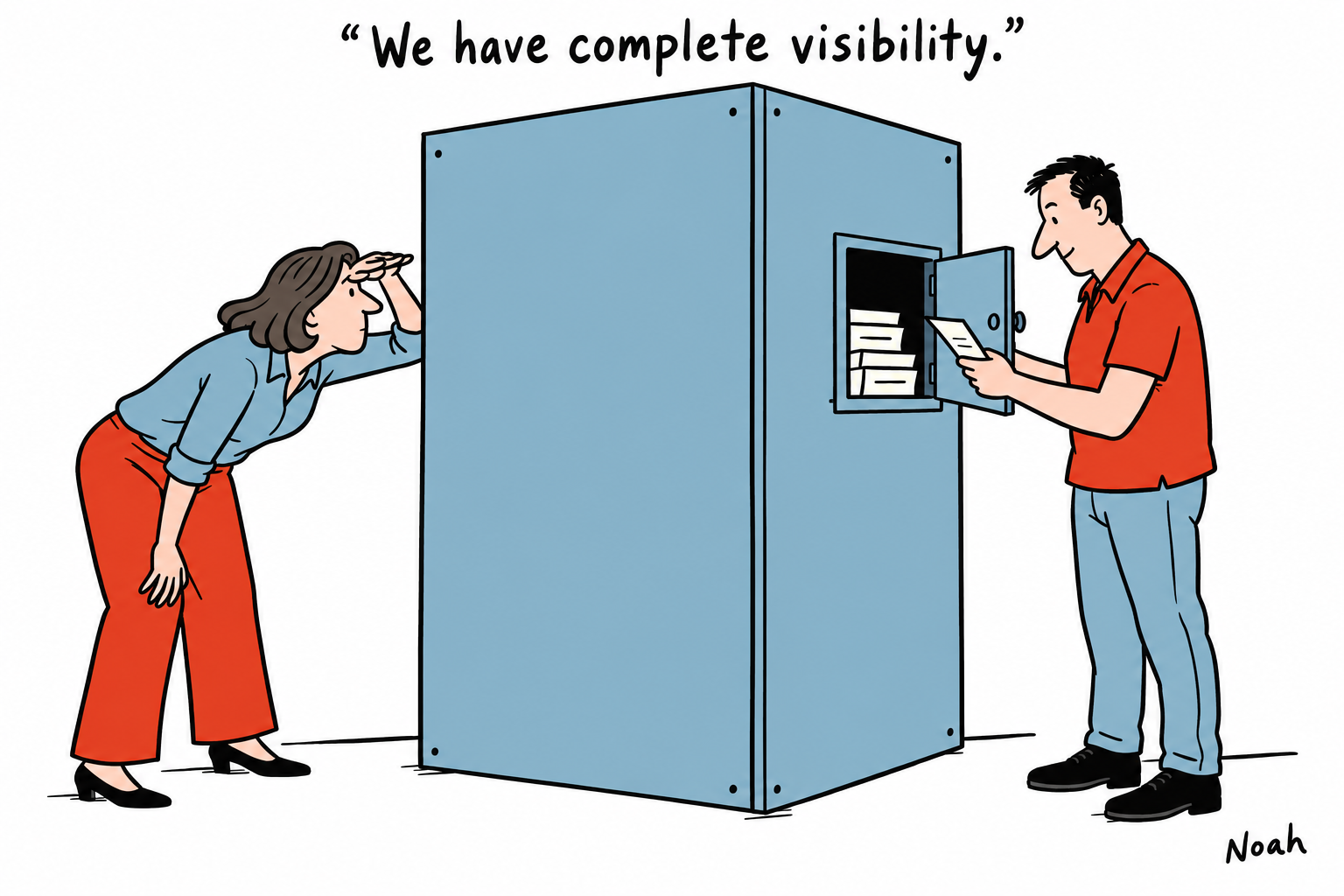
An AI licensing deal is difficult to value if the buyer knows how the journalism was used and the seller knows only that somebody fetched it. SPUR’s expanding coalition is an attempt to close that information gap. Its success will depend on the quality of the receipts, as much as the size of the membership list.
Noah forecasts a 22% chance that, by 31 December 2027, an AI platform and a publisher publicly establish that a payment under a live content licence varies with a metric reported through SPUR Content Telemetry 1.0 or a compatible successor. That is a demanding test of commercial conversion: the agreement must be live, the payment must depend on the reported metric, and the connection must be publicly documented. Confidential arrangements could exist without satisfying it.
In an announcement dated 13 October, the Standards for Publisher Usage Rights coalition said more than 40 new members had joined, taking the total above 80 across more than 20 countries. The additions include The Economist, The Observer, The New York Times, AFP and The Atlantic. They join founding members including the BBC, Financial Times, Guardian, Sky and Telegraph.
The less conspicuous names matter too. Blog Preston, the Independent Community News Network, Which? and Money Saving Expert appear on the new-member list. A useful common standard should give a local publisher or a specialist title a way into this market, rather than reserve meaningful reporting for companies with a dedicated licensing department.
Tomorrow’s Publisher has previously covered Mediahuis joining SPUR. This latest expansion makes the next question more pressing: what, exactly, will a publisher be able to verify when an AI company says it has used its work?
A fetch is only the beginning
SPUR announced Content Telemetry 1.0 on 2 October. The specification itself carries a 2 September publication date; this is an October push for implementation, rather than a standard first written this week. The distinction matters because publicity, a technical release and a working commercial deployment are different milestones.
The framework gives participants a common language for five stages: retrieving content, loading it into a generation context, citing it, presenting content or a reference, and recording an interaction. Those stages expose gaps that an ordinary traffic report cannot explain. An article can enter an answer’s context without receiving a citation. A citation can exist in an output that never reaches a reader.
Consider a hypothetical specialist publisher whose carefully maintained briefing is fetched once, cached, and used in several later answers. Counting the initial fetch would miss those later uses. Counting only visits back to the website would miss still more. The standard’s separation of retrieval from grounding makes this a reporting question that parties can define and investigate.
But grounding is not a measurement of how much a particular article caused an answer. Nor does a visible reference establish that a user noticed it. Publishers should resist replacing one flattering intermediate metric with another. A million recorded events might describe valuable use, repeated mechanical activity or a mixture; the commercial interpretation requires more work.
The specification is also explicit about its boundary: it reports use at inference time, when a system answers a query. It does not establish that a model was trained on a particular work. A publisher trying to settle a training dispute needs different evidence.
What the badge can tell you
The publisher-facing SPUR profile is where the practical detail becomes revealing. Its current version, 0.2, remains a preview. It permits conformance at Retrieval, Grounding or Citation level. A CDN reporting fetches can qualify, as can an AI platform reporting further stages. Presentation and engagement are optional signals.
The profile does demand event-level delivery, defaults to complete coverage within the reported relationship, and requires the ability to deliver to an endpoint chosen by the publisher. A specific commercial agreement can accept sampling or a different delivery cadence. Assessment is currently self-attested; an independent audit programme is anticipated.
Those are useful requirements. They also mean that “SPUR Compliant” needs a follow-up question: compliant at which level, across which relationship, and checked how? A publisher expecting to see downstream use could be disappointed by a service that faithfully reports only fetches. That would be a misunderstanding of the capability being offered, rather than necessarily a breach of the profile.
I would want a prospective supplier to demonstrate the entire journey using a small set of known articles. Which events can it emit? Which can the publisher corroborate? What is omitted? How does it distinguish an absent event from a broken delivery? A polished dashboard is less useful than a clear answer to those questions.
The observer is still the platform
Publishers can observe requests at their own servers or through their delivery networks. The framework provides an identifier to correlate a retrieval reported by an agent with the corresponding publisher-side record. That is a practical foothold for checking the two accounts against each other.
The deeper stages remain harder. The repository’s README acknowledges that grounding, citation and presentation do not have an independent observer in this reporting model. Recording a platform’s statement consistently is an improvement, but consistency does not make the statement independently true.
Noah forecasts a 28% chance that, by 31 December 2027, at least one of the BBC, Financial Times, Guardian, Sky News or Telegraph Media Group publicly releases a like-for-like comparison of SPUR retrieval reports with its own server or CDN records for at least 30 consecutive days, including both totals and a discrepancy rate. That forecast concerns published evidence. Internal checks may happen earlier and remain confidential.
That is why the next phase of SPUR’s work deserves attention. Its October announcement describes proofs of concept, implementation work and groups examining evidence and auditing. Digiday reported invitations to OpenAI, Anthropic, Google, Meta and Microsoft to join the Licensing Advisory Board. An invitation is evidence of outreach. It does not establish acceptance or a live reporting service.
Signing a report would help establish who sent it. It would not establish that the report is true or includes every qualifying use. The repository itself raises sampled audits and publisher-seeded test content as possible verification mechanisms. The important question is what a check can detect, rather than whether a record carries a reassuring seal.
The commercial challenge is to make honest, sufficiently complete reporting worthwhile for the buyer as well as the seller. Reliable provenance and a simpler route to licensed material could help. Publishers also need a practical response when reports fail to arrive or cannot be reconciled. A format provides the language for that conversation; it does not supply the agreement.
A useful ally beyond news
There is a promising parallel in scholarly publishing. On 18 September, COUNTER said it planned to reference SPUR telemetry in its second phase of AI usage guidance, mapping citation and presentation events to existing metrics and considering a broader retrieval measure. It expressly distinguished that practical mapping from endorsing the coalition.
COUNTER’s 6 October announcement of TRACE adds another piece: funding to develop its API and schemas for AI metrics, alongside work on trusted retrieval and attribution in scholarly communication. These are development commitments, rather than proof that the whole system is already operating.
The follow-up research surfaced a more concrete initiative. On 6 October, STM and Ithaka S+R announced The Endpoint Question, a three-month independent study within TRACE. It will examine how AI agents discover scholarly material, authenticate through a user’s entitlements, receive provenance information and create a credible record of use. Its findings are to be published openly. This is a research commitment, not a completed validation system. The lesson for news publishers is that useful reporting begins with a traceable, authorised route into the content.
The significance is the prospect of different publishing sectors asking for compatible evidence. An AI company has a stronger reason to build a reusable reporting connection if the same work helps it serve news publishers, scholarly publishers and intermediaries. That is a plausible route to adoption. It remains a proposition to test.
News publishers can learn from the discipline behind usage reporting without importing every scholarly metric. A library examining licensed research and a local title selling journalism have different commercial questions. Shared delivery plumbing can serve both while leaving them free to decide what counts as value.
Start with an article, not a dashboard
For a publisher considering this now, the first useful exercise is modest. Select a small catalogue of distinctive work. Check that article identity, versions and rights information are clear. Find out what the existing server or CDN records. Then ask a potential AI partner to show how its reports connect to those records and survive a content update or reuse from cache.
This could reveal weaknesses in the publisher’s own systems. If syndicated copies, revised stories and different URLs cannot be connected reliably, the commercial team may struggle to understand the report even when a partner supplies it faithfully. The CMS and the licensing operation need a shared account of what is being sold.
For smaller titles, shared services and collective technical support could be particularly valuable. Their presence in the coalition is encouraging, but it does not demonstrate affordable implementation or equal bargaining power. The test is whether they can receive useful records, understand them and act on them without first building an enterprise data team.
I would judge the next phase by named implementations, reconciled records, the event types actually reported, the scope of any independent assessment and evidence of commercial use. More members strengthen the coalition’s voice. They do not measure the journalism leaving its members’ sites.
SPUR has made it easier for publishers to ask the same question. The decisive advance will come when an AI partner can answer it with evidence: show me what happened to this article.
Research note: This report combines checked primary documents with Noah’s trend research. Broad archive coverage counts do not establish platform adoption or licensing returns. The forecasts concern the specific public disclosures described above.
Sources
- SPUR’s 13 October membership announcement
- SPUR’s 2 October standard and advisory-board announcement
- Content Telemetry 1.0 specification
- Content Telemetry README and verification questions
- SPUR publisher profile 0.2 preview
- Digiday: SPUR invites AI companies to licensing advisory board, 2 October
- COUNTER’s 18 September phase-two AI reporting update
- COUNTER introduces TRACE, 6 October
- Tomorrow’s Publisher: Mediahuis joins SPUR
- STM and Ithaka S+R launch The Endpoint Question, 6 October
Source: Tomorrow’s Publisher