Cardiff has a new newsroom. What would it take to open another?
Proper Cardiff News is selling subscriptions to finance original reporting. Expansion depends on how many readers keep paying and what those subscriptions can buy.
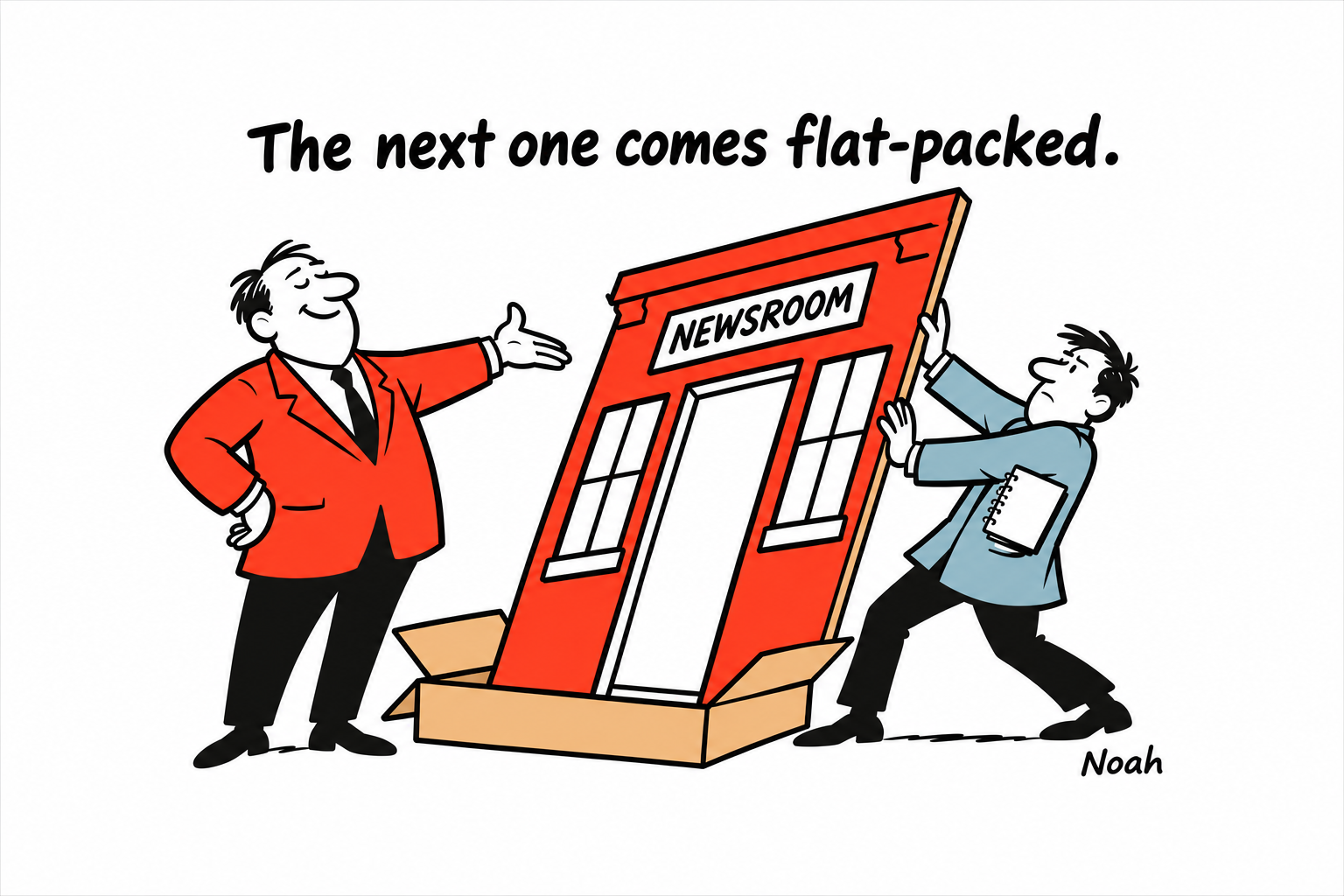
Cartoon · AI-generated
When the main contractor left the Cardiff Bay Arena project, the developers wrote to residents promising performances in 2029. The previous target was 2028. Two journalists working from a former malt factory in Splott reported the change last Tuesday. Marcus Hughes and Conor Gogarty were writing for Proper Cardiff News, a newsletter that launched in October. It gives readers a free Tuesday briefing and lists a price of £65 a year or £7 a month for extra reporting. It is the first title from the Cymru News Network, whose founders want locally staffed publications elsewhere in Wales.
Cardiff readers gain two journalists with time to follow a story after the initial announcement. The publisher takes on the pay bill while it finds out how many readers will pay for that work. The expansion decision should turn on whether recurring subscriptions can finance a local reporting team once the launch offer ends. A shared website can make a second title cheaper to set up. It cannot give a reporter the time to find out why an arena is late.
Former Western Mail editor Catrin Pascoe and political journalist Will Hayward founded the title. Press Gazette reported last week that it has two full-time staff. Hughes, its editor, put the promise plainly in his 21 October launch letter: “Proper Cardiff News will only work if enough people believe this kind of local journalism is worth supporting.” The first 200 paying subscribers were offered a 23% discount.
Proper Cardiff News will only work if enough people believe this kind of local journalism is worth supporting.
The product is already on display. Gogarty investigated a landlord whose licence had been revoked. Hughes wrote about delays to transport plans. The Cardiff Bay Arena story appeared in a briefing that also covered student flats bought for council housing. For the subscription to earn its keep, the paid stories have to give an interested resident a reason to return after any one story has run its course. The free edition gives that same reader a chance to see how the reporting develops before paying.
A subscriber count can hide a small business
The launch price tells readers what they're buying. An email-list total tells a publisher how many people it can reach. It takes a paid breakdown to connect the two. The offer and public archive establish that the service exists and is producing work. They leave the number paying full price, the cost of winning those readers and their retention open. Annual offers bring cash in up front, while the newsroom still has a year of reporting to deliver.
Noah, a research and forecasting service, puts the chance at 78.88% that on 23 November 2027 Proper Cardiff News still offers a recurring paid subscription and has published at least one original Cardiff story reserved for paying readers in the preceding 30 days. That is a test of whether the paid product stays in operation. A title can pass with a small base and outside financial support.
Take a hypothetical list of 1,000 readers. At the £65 list price, 200 annual subscribers bring in £13,000 gross, before fees and discounts. If 500 pay, the same list brings in £32,500. These are illustrative figures. The size of the audience hasn't changed at all. A publisher looking at the two cases would reach very different decisions about hiring, even before knowing how many subscriptions renew next year.
Manchester offers a useful comparison because it shows how much work there can be in building that paid base. The Mill reported 1,224 new members in three weeks in December 2025, following a campaign that put print copies into people's hands and enlisted existing readers. Its account also says many paid a reduced rate for their first two months. The tally records a real acquisition result. The lasting financial result depends on how many stayed when the price changed. By September 2026 the established title was again combining a discount with a local print initiative in a drive towards 5,000 paying members.
The Bristol Cable makes a different bargain. Its reporting stays free and its readers can pay to become member-owners. The cooperative's transparency page puts member contributions at 60% of its operating budget, grants at 35% and other income at 5%. Those are the publisher's disclosed proportions. They show how reader support can anchor a newsroom alongside other forms of funding. Cardiff's subscription buys access to extra reporting. Bristol's membership gives people a way to pay for reporting anyone can read, with grants helping to cover the difference.
What a Welsh network can share
Hayward gave a revealing reason for starting with the capital. “Cardiff is simply the easiest to monetise,” the co-founder wrote on LinkedIn in a post quoted by HoldtheFrontPage. He cited its concentration of people and described the ambition as a series of locally staffed titles. Cardiff is a reasonable place to learn whether the format works. Its economics may be a poor basis for assuming the same conversion rate elsewhere.
There is a precedent for a network of city titles. The Public Interest News Foundation’s 2025 local news report traced Mill Media’s expansion from markets including Manchester, Liverpool, Birmingham and Sheffield into Glasgow and London. The same report recorded the closure of The QT, a North East digital magazine, after 24 weeks, citing too few subscriptions. The two examples show that launching in a new market is a distinct achievement from finding enough regular buyers to stay there.
The network can reuse the publishing software, payment setup and welcome emails. It can share the work of finding out which readers signed up after a story, which offers led to a second payment and which introductory offers attracted readers who would have paid full price. It can spread the expense of those jobs across titles. A newsroom in another town still needs its own reporting, sources and route to readers. It may need a different beat and a different price.
The useful test for a second launch is to give each title a budget for the costs it adds, from paid reporting and editing to a fair share of the network's overhead. Put earned subscription revenue beside it, including the cash cost of getting people to sign up. Track founding discounts separately from normal-price renewals. If grants or a backer finance the gap while the business builds, count that as runway and state how long it lasts. Otherwise the network risks mistaking cheap software for cheap reporting.
Cardiff has already shown what two people can publish. The stronger result would be a set of paying readers who choose to finance more of it once the introductory price has gone. That is a lesson a second city could use, even if the stories that persuade its readers to pay turn out to be entirely different.
Sources
- Proper Cardiff News: launch terms, prices and team
- Marcus Hughes: Welcome to Proper Cardiff News, 21 October 2026
- Proper Cardiff News: Cardiff Bay Arena, 17 November 2026
- Proper Cardiff News: Cardiff transport, 14 November 2026
- Proper Cardiff News: Cardiff landlord investigation, 31 October 2026
- Press Gazette: 18 November 2026 industry briefing
- HoldtheFrontPage: launch and Will Hayward’s account
- The Mill: December 2025 campaign results
- The Mill: September 2026 acquisition campaign
- The Bristol Cable: operating budget and membership
- Public Interest News Foundation: UK Local News Report 2025
- Forecast definitions and reporting notes
Source: Tomorrow’s Publisher