People Inc. builds AI-ready feeds to put publishers in control
Cartoon · AI-generated
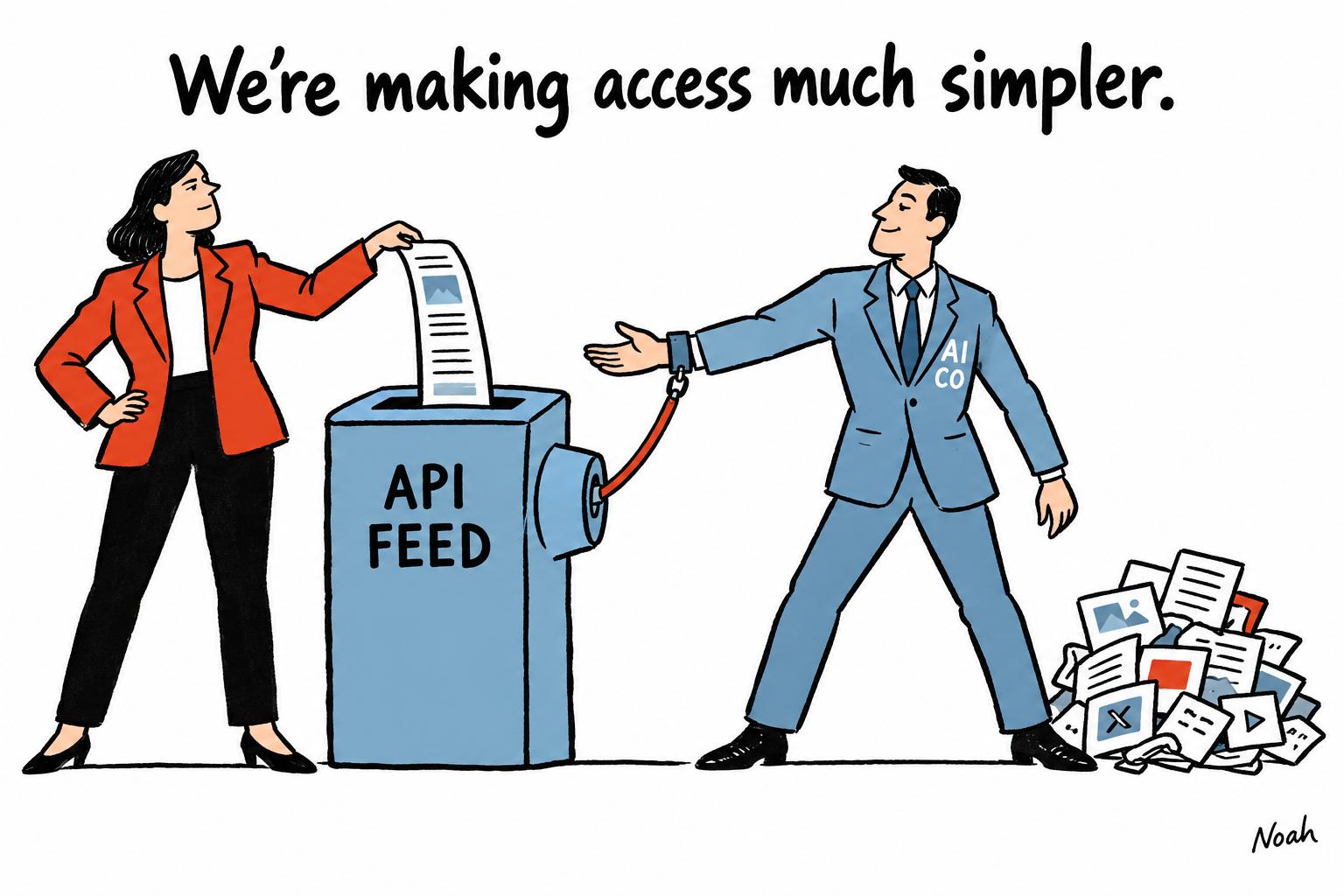
Custom APIs will deliver articles as structured text with trust markers, cutting webpage clutter and giving People Inc. greater control over how AI systems access its journalism.
People Inc. is recasting how its journalism is packaged for machines, moving towards custom application programming interfaces that deliver articles in a stripped-back format designed for AI agents rather than human browsers. According to chief innovation officer Jon Roberts, the goal is to give automated systems the text and the essential metadata they actually need, while removing the surrounding code and design layers that only make sense on a webpage. He told delegates at Digiday’s Media Strategies London event that an HTML page contains a great deal of material that an agent does not need, adding that processing all of it would be both distracting and unnecessarily costly.
The company’s approach marks the next step in a progression that has already taken in web crawling and then Amazon S3 buckets, which allowed People Inc. to send updates and retract content when needed. The new API model is intended to make access more efficient while also giving the publisher greater control over how its journalism is presented to AI partners. Roberts said the feeds will include article text in Markdown, plus information such as authorship, publication dates, update times and other trust markers that matter when content is consumed by automated systems.
The timing is significant. People Inc. recently laid off around 6% of its workforce, a move that underlines the pressure publishers are facing as AI reshapes how audiences find and consume news. The broader industry is also grappling with an explosion in machine-driven activity: HUMAN said in its 2026 State of AI Traffic and Cyberthreat Benchmark Report that traffic from AI agents and agentic browsers surged 7,851% year on year. That rise has sharpened concerns about how publishers distinguish between useful automated readers and bots simply scraping content.
At the same time, other media groups are pursuing their own experiments. Digiday has reported that Time is converting pages from HTML into Markdown and separating core text from design elements, while The Economist is testing more readable layouts for marketing and business-to-business material outside its paywall. Forbes, meanwhile, is trying similar methods for its product-review work, including Markdown versions and an MCP layer, although its executives have stressed that monetisation ideas such as ads for agents remain at an early stage.
For People Inc., the emphasis is not yet on advertising to AI agents, but on making sure its journalism is easier to discover, parse and trust in a world where automated systems are increasingly intermediary readers. That focus reflects a wider shift across publishing: rather than treating AI as a distant threat or a future opportunity, media companies are now redesigning parts of the web around it, one structured feed at a time.
Inspired by headline at: [1]
Sources by paragraph: - Paragraph 1: [2], [1] - Paragraph 2: [2], [1] - Paragraph 3: [7], [3], [1] - Paragraph 4: [4], [5], [6] - Paragraph 5: [2], [4], [5]
Source: Noah Wire Services · Original