Newsrooms are installing AI. The harder task is changing how they work
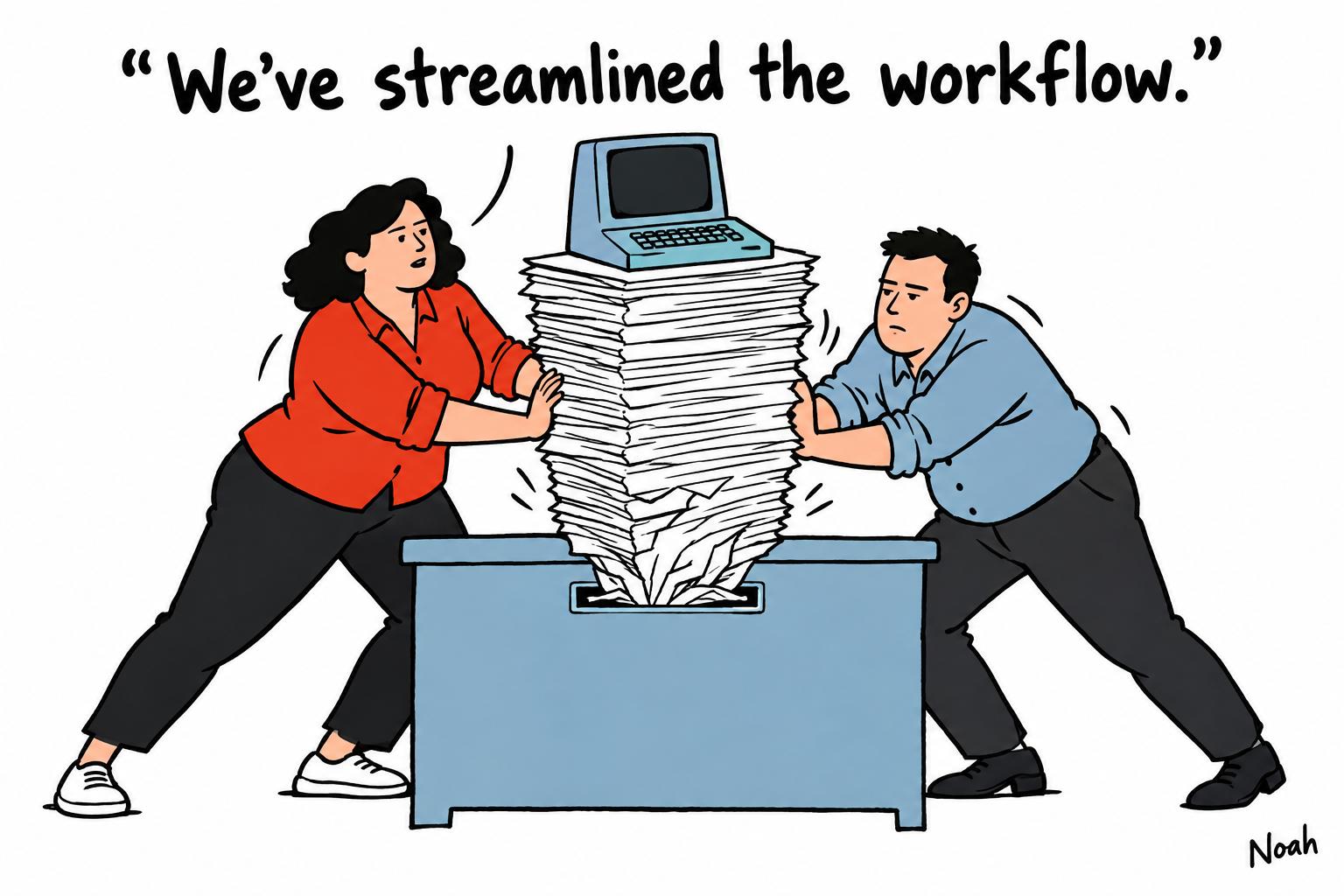
Cartoon · AI-generated
Publishers are rolling out systems to automate routine work, but research suggests few have changed roles or workflows. Adapting to AI will take more than giving journalists new tools.
A visit to a major media group in central Europe offered a glimpse of what newsroom automation might look like when it moves beyond isolated experiments. The company had brought its editors together to discuss practical plans, including an AI-powered operating system designed to connect trend monitoring, research, news assessment, production and analysis. It is now preparing to introduce the system across the group.
The ambition is to automate routine material: wire copy, rewrites, official announcements and press releases. The group hopes that reducing time spent on such work will allow journalists to focus on reporting and analysis that audiences value, and that could help sustain subscriptions. But a sophisticated system is not, by itself, evidence that an organisation has changed.
At the meeting, editors gave varied accounts of how far their newsrooms had progressed with AI. Many said they had streamlined some tasks and introduced tools across departments. A smaller share said the technology had fundamentally altered how they worked and were organised. That claim deserves scrutiny.
There is a familiar pattern here. During the shift from print to digital, many newsrooms appeared to overstate how thoroughly they had adapted. Publishing online did not necessarily mean reorganising around digital audiences. The same distinction now applies to AI: adopting tools is not equivalent to redesigning roles, workflows or editorial priorities.
Research points to that gap. A Reuters Institute survey of senior media leaders found that while 74 per cent expected generative AI to improve newsroom productivity and workflows, only 21 per cent anticipated changes profound enough to transform every newsroom role. A review of 160 AI projects across 101 news organisations, conducted by Arizona State University’s journalism and media centre, likewise found that most applications accelerated familiar tasks such as transcription, summarising and drafting, rather than changing journalism’s underlying model.
At the European group’s gathering, its chief executive voiced a similar frustration, asking why the new system had not yet led to movement between departments or the creation of new roles. An owner-foundation representative, who said he had worked in the industry since the era of typewriters, warned that the print-to-digital transition had cost the sector five years of progress, time it could no longer afford to lose. He suggested it might have only months to adapt.
That timetable may be intentionally stark. Yet the deeper point is less about a deadline than about the need to question habits that no longer fit. As the foundation representative put it, "I have during my entire professional life been forced to 'unlearn stuff'."
Audience behaviour offers a clear example. People have become more accustomed to asking a question and receiving a rapid, tailored response, rather than following a search result to a publisher’s website and looking for the answer there. The Reuters Institute’s 2026 trends report warns that AI-generated answers in search services could further reduce visits to news sites, putting pressure on established business models. Publishers are therefore considering how to strengthen distinctive journalism and build more direct relationships with readers.
The change is apparent in everyday services, too. A membership payment system without a chatbot, relying instead on long help documents, can feel increasingly cumbersome when customers encounter a problem. The expectation of an immediate answer has spread well beyond search engines, and news organisations cannot assume that audiences will keep navigating products designed for an earlier era.
There are opportunities as well as risks. The Reuters Institute’s 2026 report notes that AI can help organisations process and summarise information at scale, while more advanced systems may coordinate complex work such as research and audience studies. The Arizona State review also describes tools that help journalists analyse public documents and monitor civic proceedings, making it possible to examine material that would otherwise be difficult to handle. Used well, these systems could support deeper reporting rather than simply produce more content.
But automation also brings risks, particularly when AI-generated material is put directly in front of readers. The Arizona State review warns of accuracy and reputational hazards in public-facing products such as chatbots. The European Broadcasting Union’s report on newsrooms similarly stresses that errors can undermine trust, and that publishers need legitimacy and strong audience relationships as automated content becomes more plentiful.
That is why the most forceful challenge raised at the gathering , a call to dismiss journalists who do not use or learn to use AI , misses an important part of the problem. Staff need training and clear reasons to engage with new systems, but responsibility cannot be shifted entirely on to individuals. The Aspen Digital report on discussions among UK and European news executives describes adoption as cautious and incremental, with some organisations creating training programmes, specialist roles and internal advocates to help teams adapt.
Management must decide not only which tools to provide, but how work should change around them. The Reuters Institute’s Changing Newsrooms report places AI alongside wider challenges in staffing and workplace practice, suggesting that technology is only one part of the leadership task. And although publishers are concerned about AI’s effects on traffic and business models, the Arizona State review found relatively few projects focused on revenue, subscriptions or fundraising.
The central question, then, is not whether newsrooms possess impressive AI systems. It is whether leaders can reshape organisations around changing audience needs, give staff the support to make that transition and protect the distinctive reporting on which trust and subscriptions depend. Installing the technology may be the visible step. Learning what must be left behind, and acting on it, is the harder one.
Inspired by headline at: [1]
Sources by paragraph: - Paragraph 1: [2], [5] - Paragraph 2: [3], [6] - Paragraph 3: [4], [3] - Paragraph 4: [4], [3] - Paragraph 5: [4], [3] - Paragraph 6: [5], [6] - Paragraph 7: [2], [7] - Paragraph 8: [7], [2] - Paragraph 9: [2], [3] - Paragraph 10: [3], [5] - Paragraph 11: [6], [5] - Paragraph 12: [4], [3]
Source: Noah Wire Services · Original