Newsquest’s subscriber growth puts the renewal test in focus
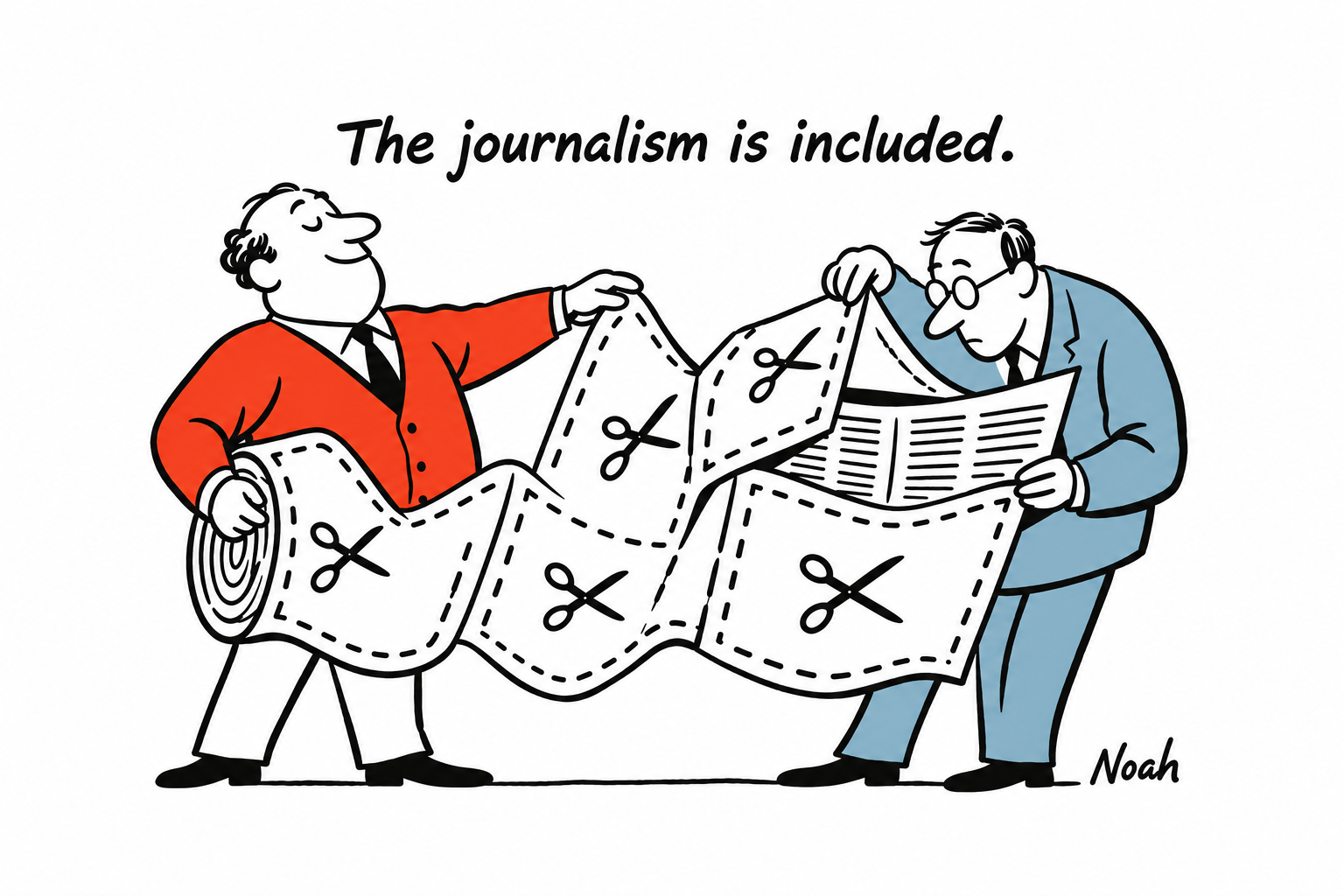
Cartoon · AI-generated
Newsquest ended September with 160,000 paid digital subscriptions, up 15% on a year earlier. Its reported monthly revenue per digital subscriber moved the other way, falling 5% to $5.76. Subscription revenue nevertheless grew. The combination is progress, but it is not a complete account of the business being built. Readers gain another way to support local reporting; publishers gain a direct relationship and the continuing cost of earning a renewal. The next important decision is what keeps a paying reader, rather than which offer produces the most sign-ups.
Those figures, disclosed by parent USA TODAY Co. on 5 November, sharpen a discussion now taking place inside Britain’s popular newspapers. Editors are describing subscriptions less as a wholesale change of news agenda than as a different way to package journalism, understand readers and judge what deserves continued investment.
A useful counterpoint comes from Newsquest’s American sister business. USA TODAY Media had “prioritized subscriber quality over raw volume”, its president Kristin Roberts said on the 5 November earnings call, in the transcript published by Benzinga. That is management’s stated strategy, not an independent verdict on the quality of its customers.
USA TODAY Media’s paid digital base fell 15% to 1.236 million, while its monthly revenue per digital subscriber rose 27% to $11.45. The US and UK businesses are travelling in different directions on these measures. Neither direction, taken alone, establishes the better long-term subscription model.
The editorial version of that argument emerged at the Independent Press Standards Organisation’s conference on 4 November. In Marcela Kunova’s 11 November Journalism.co.uk report, the Mail, Mirror and Sun described changes in presentation, engagement and retention. A story that brings somebody through a paywall and a story that gives an existing subscriber a reason to return are doing different jobs.
An unusually plain product promise comes from Cambrian News, part of Iliffe Media. Explaining its October paywall, Mick O’Reilly acknowledged the old site’s readability problem and promised few if any “very annoying pop-up ads” for paying readers in his 27 September column. The promise is as instructive as a new editorial feature: a subscription can be sold on making the same journalism easier to use. The announcement does not establish how well that promise has been delivered.
What the Newsquest figures do show
The quarterly filing puts Newsquest’s digital-only subscription revenue at $2.716 million, up 13% from $2.410 million. It therefore supports a more positive conclusion than the falling revenue-per-user figure might suggest. More subscriptions are contributing to a growing revenue line. There is no need to turn an incomplete account into a negative one.
But the measures have different denominators. The 160,000 subscriptions are a count at 30 September. Average revenue per user, usually shortened to ARPU, divides average monthly subscription revenue by the average paid subscription base during the quarter. Multiplying the closing count by $5.76 and three months would not reconstruct the reported revenue.
The currency also matters. Newsquest’s British operations are reported in US dollars, and the filing says exchange-rate movements reduced its revenue in the quarter. The dollar ARPU fall is not evidence that every British reader was charged less, nor proof that the publisher cut its sterling prices.
Noah, a research and forecasting service, puts a 57% chance on Newsquest having at least one quarter ending after 12 November 2026 and by 12 November 2027 in which UK digital-only subscription revenue and closing paid subscriptions both grow year on year, with revenue growing faster. Pricing or mix could improve, or recruitment could slow while revenue keeps growing; continued discounted acquisition could preserve the gap. That would be a change in two headline measures, not proof of better renewal rates among comparable readers.
What remains missing from these headline measures is the history of each group of subscribers: how they joined, what they paid after any initial offer and how long they stayed. Lower introductory receipts could be an investment in future full-price customers. They could also buy a succession of short-lived subscriptions. The published totals do not settle that distinction. The industry has not abandoned recruitment: in a Digiday survey of 90 publishers conducted in August and published on 17 September, 60% named acquisition as their main subscription priority and 89% used promotional discounts. The research was sponsored by customer-engagement supplier Braze. It describes those respondents, not a representative census of British news publishers, but it usefully challenges any claim that retention has already displaced acquisition.
Consider an explicitly hypothetical title selling 1,000 annual subscriptions at £12. That produces £12,000 before costs in the first year. If half renew at £60, the survivors produce £30,000 in the next year. If only one in ten renews, they produce £6,000. The acquisition headline is identical. The renewal behaviour changes the business.
The newsroom consequence
Kunova’s conference report describes a hybrid approach at the popular titles: much reporting remains free, with a paid layer of additional material. Amanda Williams, the Mail’s UK editorial director, described packaging the follow-up rather than inventing an entirely new agenda. Mirror editor-in-chief Chloe Hubbard distinguished the open news report from paid analysis or opinion. These are editorial accounts of the approach, not controlled tests of its profitability.
That distinction should change how an editor reads a subscription dashboard. A regularly used money column may convert fewer new customers than an exclusive, yet still matter to the people already paying. Conversely, a story that produces a burst of subscriptions may do little to prevent cancellations once the immediate interest passes.
Rachel Shields, the Sun’s UK editorial director, made the retention case in the same report. The point is not to replace page views with a different single score. It is to ask which part of the reader relationship a piece of journalism serves, and whether the evidence is strong enough to justify the conclusion.
Earlier reporting offers a clue about where to look. John Rahim’s 10 June Audiencers account of Sun Club identifies first-week app activity as its strongest predictor of long-term retention, and describes the most loyal members reading heavily in the app. That is a reported association. It does not prove that persuading an otherwise uninterested reader to open an app will cause a renewal.
The distinction is practical. A new subscriber who cannot log in, does not know what is included or never finds a useful repeat visit may be lost before the newsroom’s strongest work has a chance. Better onboarding can remove those obstacles. Its effect still needs to be measured against comparable subscribers, rather than credited with every renewal that follows.
The benefits question has a cost
Sun Club also combines journalism with money-saving offers and experiences. The Audiencers account presents those benefits as central to the proposition. There is nothing inherently lesser about selling a service that combines useful reporting with something readers can use outside the news cycle. The commercial test is whether the combination earns durable revenue after its costs.
A reader may renew for a discount, for daily journalism or for both. Those motives need not compete. But they have different consequences for the publisher. An expensive perk that attracts people who never use the reporting can inflate the subscriber count without establishing an audience for the next paid editorial product.
The product comparison should therefore include the cost of supplying and administering benefits, the receipts actually retained and the behaviour after an introductory period. A promoted saving is not the publisher’s margin. Nor is a benefit being redeemed proof that it caused the subscriber to stay.
Cambrian News offers a contrasting proposition: its September announcement paired the paywall with a cleaner reading experience, an app and access to e-edition archives. Those promises are closer to the reading product itself. They still need delivery and use. A feature listed on an offer page has not earned a renewal merely by existing.
What deserves protecting
Reader revenue can make a publication more attentive to its users without making every editorial decision a response to an immediate sale. Public-interest reporting, coverage of less commercially attractive subjects and journalism that builds a title’s reputation can matter beyond the subscription attributed to a particular article.
There is a danger in treating only the measurable last step as valuable. If a reader has returned for years before paying after an exclusive, assigning the whole relationship to the exclusive would undervalue the work that made the title worth considering. The same mistake can recur at renewal, when a single recent visit receives credit for a much longer habit.
Newsquest’s growth is a reason to take the opportunity seriously. Its lower reported ARPU is a reason to inspect the mix, not to declare failure. The Mail, Mirror, Sun and Iliffe examples show how varied the paid promise can be: additional journalism, a more usable product, benefits or a combination.
The strongest subscription strategy will make that promise clear and test whether readers continue to value it at the price actually collected. Recruitment establishes that someone was willing to try. Renewal, receipts and the cost of serving that reader establish whether the relationship is becoming a business.
Sources
- USA TODAY Co. Q3 2026 Form 10-Q, reproduced by StockTitan: Newsquest revenue, currency and KPI tables
- USA TODAY Co. 5 November 2026 results release via Business Wire and MarketScreener
- USA TODAY Co. 5 November earnings-call transcript, published by Benzinga
- Marcela Kunova, Journalism.co.uk, The subscriber effect, 11 November 2026 (published conference reporting)
- IPSO: 4 November 2026 conference programme and named panel
- Mick O’Reilly, Cambrian News: paywall announcement, 27 September 2026
- John Rahim, Audiencers: Sun Club at One, 10 June 2026
- USA TODAY Co. leadership: Kristin Roberts role and spelling
- Digiday and Braze, sponsored survey of 90 publishers, 17 September 2026
- Research notes, source checks and forecast scope
Source: Tomorrow’s Publisher