Future’s AI lab needs to count the editing
iMore’s plans for AI-assisted drafting put the focus on the work before publication. A useful result will show what editors still need to check and where the reporting came from.
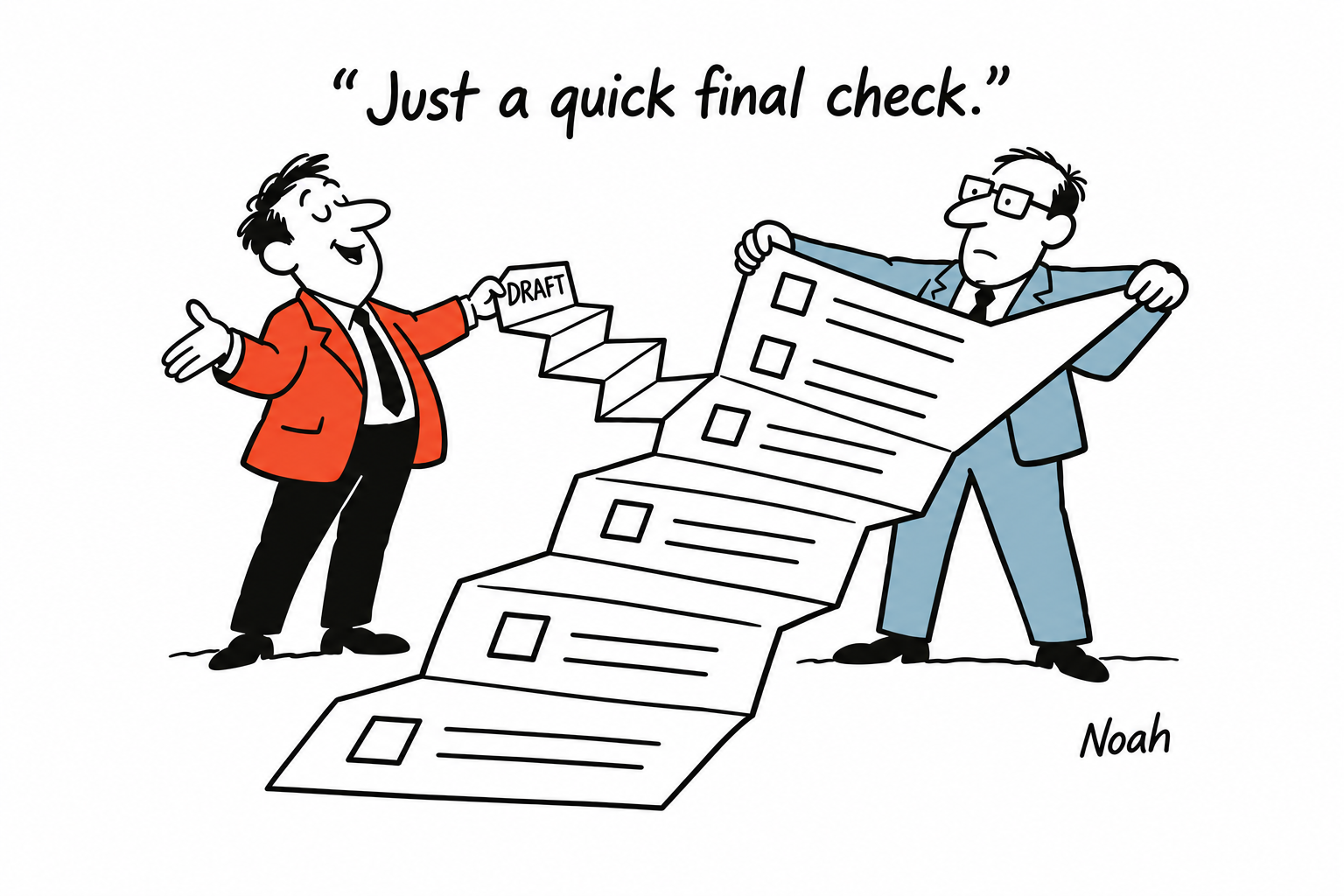
Cartoon · AI-generated
Future has set out plans for AI-assisted article drafting at iMore Labs, alongside tools for research and publishing work. Its latest public statement, dated 16 November, retains human editorial control. The worthwhile business test is whether the tools release time for better reporting after the checking is counted. Readers could gain more useful coverage; editors inherit responsibility for work whose production method is changing. Before expanding a trial, publishing executives need to know what the human work actually involves.
In Introducing iMore Labs, Paul Douglas, Future’s global digital editorial strategy director and iMore Labs’ editorial sponsor, writes: “Our editors have the final word on everything we publish.” That is a clear allocation of authority. It does not yet describe the evidence an editor will see when deciding whether an AI-assisted draft is ready.
The corporate guidance linked from that statement helps define the question. Future’s public policy says editorial teams must not use AI tools to generate new articles for publication on its properties. It also restricts initial drafting “where the core reporting has not been conducted by a human”. Repurposing or summarising completed human-authored text is permitted, subject to human provenance, oversight and verification.
Those distinctions matter more than the broad label of AI-assisted writing. Turning a reporter’s completed account into a shorter version, organising verified notes and producing a story without original reporting are different operations. The lab’s statement does not specify which drafting experiments will reach readers or how a particular trial is authorised within those boundaries. It establishes an ambition, not evidence of a breach or a company-wide relaxation.
An analysis of publishing and newsroom technology coverage by Noah, a research and forecasting service, assigns only a 35% chance that Future puts into effect, after 18 November 2026 and by 18 November 2027, a corporate policy expressly permitting AI drafting of original articles beyond iMore Labs, with human editorial approval before publication. A lab-only exception or permission limited to recommendation tools would not qualify. That tests formal authority, not whether individual staff already experiment with tools. The existing restriction weighs against an easy transition; the lab offers a possible route to clarification.
The chronology also deserves care. iMore’s About page carries an earlier update date, 3 August 2026, and describes the experimental lab and assisted drafting. The November statement gives the project fresh visibility; those page dates do not establish when work began. Neither page supplies a comparative measure of editorial time, factual error or post-publication corrections.
The useful boundary is the reporting
A lab gives Future somewhere to investigate a genuine production question without pretending that every brand, format and subject has the same needs. An Apple product specification can be checked against documentation. A claim about how a device performs still needs the relevant evidence, including testing where the article promises it. The ability to arrange an explanation cannot supply that observation.
Future’s policy makes human-written provenance explicit for repurposed material. Operationally, that requires more than a reassuring note at the end of an article. An editor assessing a transformed passage needs to be able to return to the underlying reporting and see which assertions survived, changed or disappeared. Otherwise a fluent draft can conceal the very distinction the policy is trying to preserve.
This is also where an experiment could earn its place. A tool that helps compare a large body of documentation or locate inconsistencies could leave a journalist more time to investigate an important question. The benefit would be better reporting or a more useful explanation, even if the final word count did not rise. Measuring only the number of drafts would miss that gain.
Checking belongs in the time calculation
A deliberately hypothetical example illustrates the accounting. An article normally takes 50 minutes to draft and 20 to check. A tool cuts drafting to 15 minutes, but checking the assisted version takes 40. Total work falls from 70 minutes to 55. The saving is 15 minutes, although the drafting stage alone appears to save 35. These are illustrative assumptions, not iMore results.
The extra checking in that example is not inevitable. A well-designed workflow with dependable source material could shorten both stages. The point is that a production claim needs the whole route to publishable work. A draft that takes longer to verify than expected is a cost; a source-comparison tool that prevents a costly mistake is a benefit. Both disappear if the only measure is generation speed.
The same calculation should distinguish routine material from work requiring original observation. Comparing a short product update with an investigative feature would obscure whether a tool improved either one. A useful trial would compare sufficiently similar tasks and record work that was rejected as well as work that reached publication. Otherwise the discarded attempts vanish from the apparent saving.
For a public test of the economics, the same analysis gives only a 38.4% chance of a qualifying evaluation appearing between 19 November 2026 and 18 November 2027. A UK- or Europe-headquartered news publisher, or researchers studying one, must publish a comparison of an implemented AI-assisted drafting workflow against comparable non-generative-AI drafting, reporting both total human labour through publication and factual-error outcomes. Favourable results are not required. This forecasts publication of that evidence, not the existence or absence of private productivity gains. Publishers may keep useful trials private, and a full comparison takes more work than a launch announcement.
Future has a commercial incentive to find a repeatable method: a useful tool could serve several specialist brands. The question for an editor is whether the method preserves the evidence and judgement that make those brands useful. An article that merely costs less to assemble is not automatically a better product for a reader deciding what to buy or believe.
When AI arrives inside the publishing system
The lab also sits within a wider change in publishing software. At an April WAN-IFRA webinar, executives from Eidosmedia, Atex and WoodWing described embedding AI into content management systems, the software in which journalists prepare and publish articles. The examples included converting recorded material into drafts for review and reshaping text within the writing interface. These were suppliers’ descriptions of capabilities, not an audit of Future’s systems or measured editorial savings.
That makes permission a practical question inside the production process. A desk could have access to both a permitted summarising function and a tool capable of generating new prose. Technical availability alone would not settle whether a particular use was authorised. The useful record connects the reporting supplied to the tool, its transformation and the editor’s decision. A lab’s boundaries need to remain intelligible when the experiment becomes a button in everyday software.
Future’s own Advisor announcement illustrates another important distinction. In July 2025 it reported its recommendation and content analysis engine across 50 brands, with a threefold increase in on-site clicks. That company-reported engagement result concerns a different task. The release supplies neither an absolute click baseline nor a comparative trial design, and it cannot establish the labour or accuracy result for article drafting.
Other publishers make the decision more specific
The Guardian’s March 2026 editorial code offers one concrete comparison. It requires significant generative AI use in a piece of journalism to be explicitly approved by the relevant senior duty editor and clearly signalled to the user. It also says readers should expect work under a journalist’s byline to have been authored by that journalist. Permission, authorship and disclosure are treated as connected editorial decisions.
The rule names a decision-maker for each significant use and connects permission to authorship and disclosure. For a publisher operating across several titles, a reader should not have to infer the meaning of an AI label from which desk happened to publish it.
A Financial Times case study published in AI & SOCIETY on 3 October adds a different kind of evidence. Liz Lohn and Felix M. Simon analysed 13 interviews with 12 senior managers, conducted in May to July 2025, alongside internal documents. They describe AI use being signposted within tools and reinforced through training and personal accountability, with audience disclosure calibrated to context and automation.
The study is qualitative, not a measured productivity comparison. Lohn worked at the FT during the research and has since left. Its useful finding for another publisher concerns the organisation of a workflow: people need to know when a tool has intervened and what responsibility remains with them. A public promise and an internal interface must describe the same process.
The result worth publishing
iMore’s stated ambition is to experiment openly. The most useful next account would identify a particular task, the human reporting supplied to it, the review required and what changed after a comparable trial. That would give other editors a method they could assess. It could also show where a seemingly modest use, such as preparing material for another format, produces more value than generating a longer draft.
The lab deserves room to find useful tools and to reject disappointing ones. A failed experiment can still prevent an expensive rollout. But a successful one needs a result expressed in the work of journalism: an accurate article delivered with less total effort, or evidence that the same effort produced something readers found more useful. Human editorial control becomes commercially meaningful when the work behind it is visible.
Sources
- Paul Douglas: Introducing iMore Labs, 16 November 2026
- Future and AI: current linked corporate guidance, page dated 12 December 2024
- About iMore Labs, marked updated 3 August 2026
- Future Unveils Advisor AI, 2 July 2025
- Guardian editorial code and guidance, March 2026, page 12
- Liz Lohn and Felix M. Simon: Financial Times AI transparency case study, 3 October 2026
- WAN-IFRA webinar report: CMS platforms and embedded AI, 30 April 2026
- Research notes, forecast definitions and timing limitation, 18 November 2026
Source: Tomorrow’s Publisher