Prediction markets give specialist publishers a business worth building
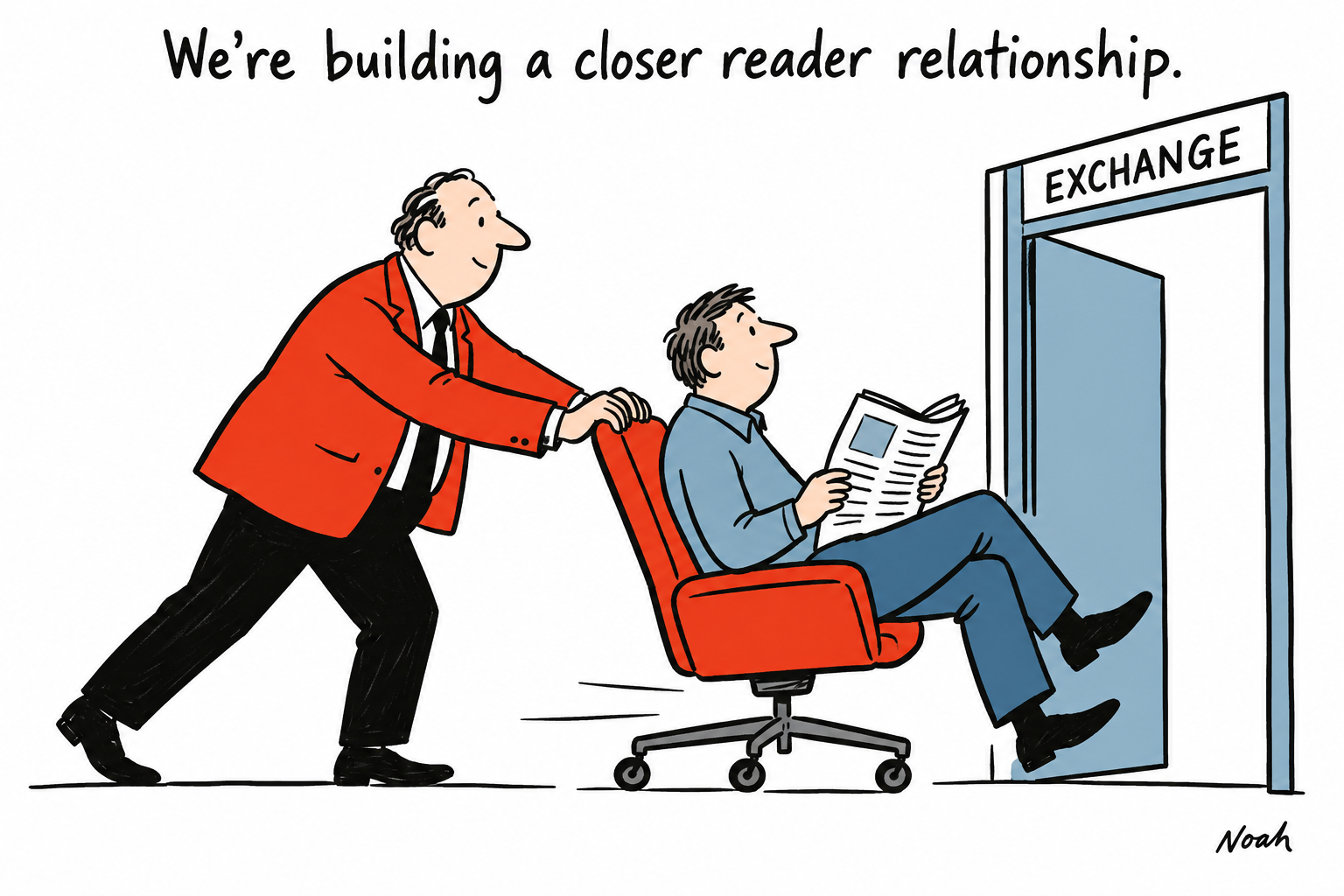
Cartoon · AI-generated
On 19 October, NextBigFuture announced regular Kalshi reviews alongside its science, technology and business coverage. Brian Wang said he would examine two or three markets daily, mainly in science, technology and energy. The article disclosed a paid relationship and possible referral commissions. This is a concrete specialist publishing arrangement beyond sport.
Specialist publishers have an advantage in prediction markets: they already gather people who know a subject, care about its future and return when something important happens. Give those readers a way to record and test their expectations, and the publication can become more useful between the headlines.
Specialist publishers should start testing this business now. The first commercial arrangements are already visible. The larger prize is a community whose expertise, habits and spending remain connected to the publication as successive events unfold.
A prediction market lets eligible users trade contracts tied to a future result. A publisher can build around that idea without turning every reader into a trader. Free forecasts, discussions, watchlists and results can serve a much wider audience. Financial participation, where available through a suitable partner, is one possible part of the business.
The reader who cannot buy the Ferrari
Imagine a reader who knows a particular Ferrari model intimately but cannot afford to own one. A magazine can offer them an auction preview. It can also invite them to predict the price, compare their judgement with other enthusiasts, follow developments and return for the result.
The sale then becomes the beginning of another story. Why did the price exceed expectations? Did the restoration matter? Was the buyer responding to provenance or scarcity? What does the result suggest about the next comparable car?
That creates an editorial cycle with several reasons to register and return. The reader's expertise becomes visible. A history of sensible, well-explained predictions can earn recognition within a community, even for somebody who never risks money or buys the car.
A specialist publication can follow that interest across auction houses and countries. The organiser has an event to sell; the publisher can maintain the relationship between events. The same architecture could work around watches, art, entertainment releases or public milestones in a specialist industry.
This is the opportunity to build for: a publication that helps readers participate in the subject they love, learn from the result and anticipate what comes next.
Partnerships already offer a starting point
The Independent’s prediction-app guide, dated 16 October when checked, also carries a commission disclosure. There is already a way for a publisher to connect relevant journalism with participation income. Neither example discloses the resulting profit, but both move the discussion beyond a hypothetical business model.
Substack supplies evidence of editorial interest at a different scale. In February it introduced native Polymarket tools and said Polymarket had joined its creator sponsorship pilot. It reported that one in five of its 250 highest-revenue publications had already used the embeds. That is adoption within a selected group, rather than proof that an odds display makes a publication successful.
These developments give publishers several starting points: a sponsored forecasting series, a free reader competition, a referral partnership or a paid product built around original research. They do not all require the same investment or technology.
Noah gives a 28% chance that its defined publisher-owned forecasting-community milestone will be reached by 21 October 2027. That concerns at least one established US or UK specialist journalism publisher running its own scored forecasting community, rather than a poll or partner-hosted contest. The full benchmark is linked with the sources. A lighter partnership can let a publisher learn what readers will use before committing to that investment.
Start with participation, then prove the economics
Astral Codex Ten's 2026 contest with Metaculus shows how a publication can organise forecasting through an existing specialist platform. Readers proposed the questions, the contest offered a $10,000 prize pool, and its live page lists 33 questions. This is a working participation model without the publication having to build a market itself.
A publisher's first pilot could follow that practical logic. Choose a subject with recurring interest and clear outcomes. Ask a manageable number of worthwhile questions. Let readers explain their forecasts, update them as evidence changes and see the results recorded consistently. Useful participation should include people who want recognition or knowledge rather than a financial position.
Then measure whether the product earns its place. Do readers register? Do they return after a result? Does discussion improve the reporting? Will a sponsor pay to reach the community, or a reader pay for better intelligence?
Noah puts the same owned-community benchmark at only 44% by 21 October 2029. A pilot can test audience demand without requiring the publication to meet that heavier benchmark. The immediate decision is which reader habit the product can establish and what it costs to maintain.
The revenue calculation can be simple enough to test. Suppose, purely as an illustration, a publication attracts 100,000 relevant monthly visitors. If 5% register and 10% of those become qualifying partner participants, that produces 500 participants. At an assumed one-off payment of £20 each, income is £10,000 before acquisition and product costs. These are hypothetical assumptions, not industry benchmarks or a proposed deal.
That calculation becomes useful when an owner replaces the assumptions with actual results. An existing audience could make acquisition less expensive. Reporting, data, technology and moderation still have to be paid for. Repeat participation or a recurring revenue share needs its own evidence and contract.
Sport shows both the scale and the limits of audience acquisition. ESPN said it brought more than 2.9 million new users into PENN’s ecosystem. Their original agreement involved $150 million a year in cash payments plus warrants, yet the partners announced an early end in November 2025. A powerful audience can attract a valuable deal; sustaining the operating business remains a separate job.
Building trading directly into a publisher’s site is a separate investment decision. Noah gives only a 32% chance that a qualifying US or UK journalism publisher will offer real-money event-contract trading inside its own website or app through a locally lawful, licensed or regulated operator by the end of 2027. That is a heavier undertaking than a free competition or referral partnership; redirects and odds-only displays do not meet the forecast’s test.
Keep the relationship and build a useful record
The important questions for a publisher are who holds the registration, who can send the next alert and whether the reader will return if the commercial partner changes. A referral payment has immediate value. A community can also support sponsorship, events, premium research and datasets built from original work.
Forecasting can improve the editorial product too. Preserve what readers expected before the event, explain the disagreement and investigate the result. Over time, the publication can discover which contributors offer useful expertise and which questions reveal something worth reporting.
That intelligence has to earn its credibility. A few correct calls are not a proven advantage. Keep unsuccessful predictions visible, use consistent scoring and distinguish accurate forecasting from profitable trading.
The exchange may seek the reader relationship itself. Polymarket already publishes The Oracle, including analysis for people who may never trade. Publishers therefore need a contribution readers value independently: original reporting, subject knowledge, thoughtful questions and a community worth returning to.
Start with a small, useful product and judge it by repeat use and contribution after direct costs. Keep editorial decisions independent of rewards for transactions. Expand when the audience and the economics justify it.
A collector does not have to own the Ferrari to have valuable knowledge about it. A publication that gives that knowledge somewhere useful to go has a promising product to build. The opportunity is already emerging; publishers can help decide what it becomes.
Sources
- Kalshi and CNBC partnership, 4 December 2025
- Substack: native Polymarket tools and creator sponsorship, 18 February 2026
- American Gaming Association: Kalshi sports-volume claim, 4 September 2026
- PENN and ESPN: early termination, payments and user acquisition, 6 November 2025
- ESPN and DraftKings agreement, 6 November 2025
- Pew: US Google browsing and AI summaries, 22 July 2025
- Metaculus: medals and community contribution
- Metaculus: scoring rules
- Astral Codex Ten: 2026 reader forecasting contest
- Metaculus: ACX 2026 contest and question count
- Polymarket: The Oracle and Substack expansion
- The Oracle: about
- NextBigFuture: paid Kalshi reviews and referral disclosure, 19 October 2026
- The Independent: prediction-app guide and commission disclosure, 16 October 2026
- Noah forecasts: full definitions, probabilities, uncertainty ranges and run references
Source: Tomorrow’s Publisher