Authors accuse publishers of feeding both sides of the AI fight
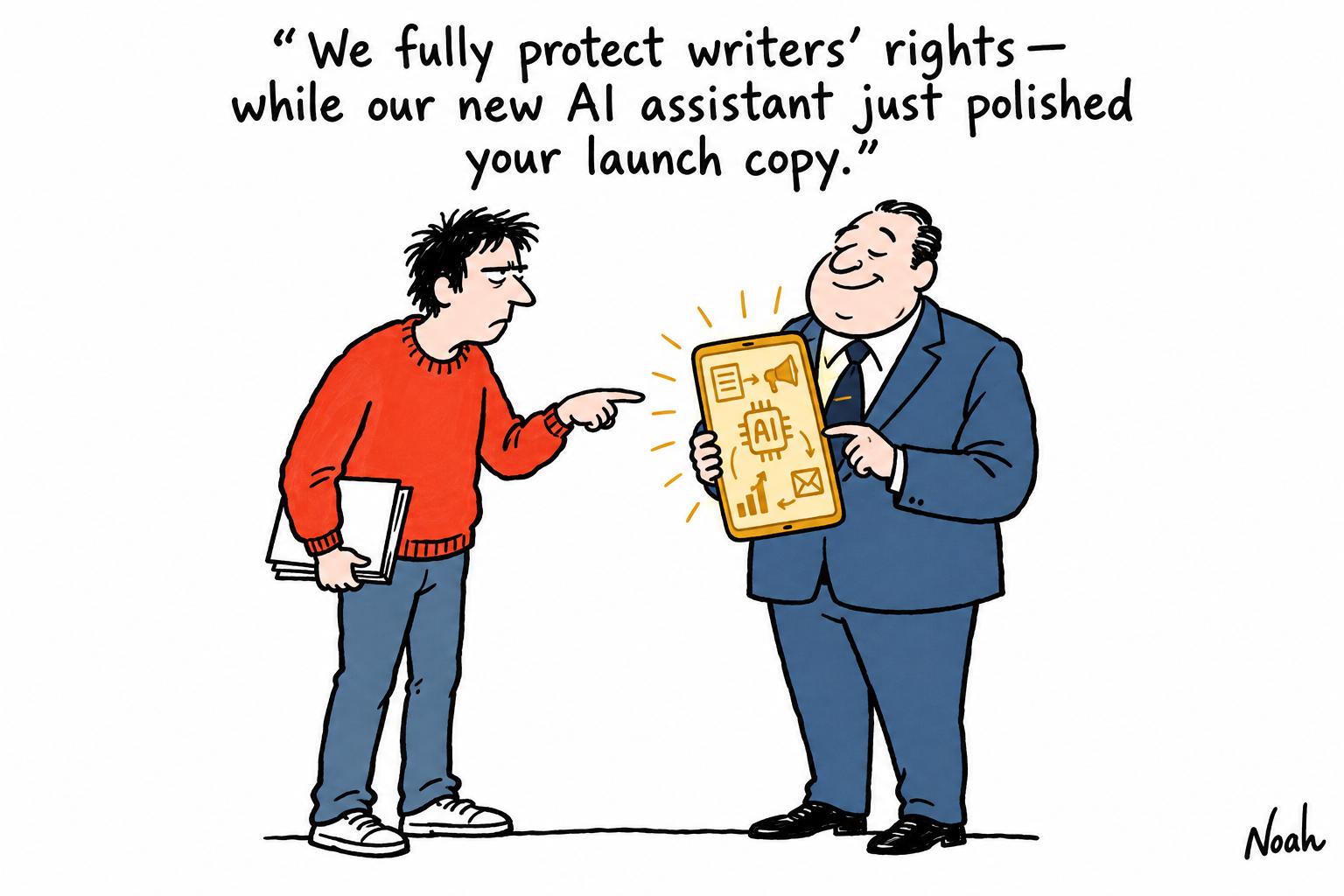
Cartoon · AI-generated
Writers say publishers are defending their rights against AI companies while using the technology to produce marketing and editorial work, deepening a crisis of trust across the industry.
The latest flare-up over artificial intelligence in publishing is not just about machines writing blurbs or drafting marketing copy. It is increasingly about trust. According to Wired, several bestselling authors have said publishers’ growing enthusiasm for AI is worsening relations with writers, particularly in romance, where some authors fear their work is being handled as a set of prompts rather than as a human creative process. One writer told the magazine that marketing material for a book included invented quotations generated by AI, and that the publisher dismissed their concerns when challenged. Another asked, "What are authors even doing with traditional publishers anymore if they’re going to outsource everything to a machine?" and argued that writers could do such work themselves.
The dispute is sharpened by a striking contradiction. Several publishing houses have been involved in legal action against AI firms over copyright and training data, yet the same companies are also experimenting with the technology in-house. The New York Times reported that this dual role has left some authors convinced that publishers are happy to challenge AI when it affects their rights, but eager to adopt it when it promises savings or speed. One author quoted by Wired said it was "frustrating to watch publishers get these massive settlements [from] AI companies and then embrace AI to do their work. It feels like they’re feeding at both sides of the trough."
The unease is not confined to writers. Wired said staff inside the Big Five publishers , Hachette, HarperCollins, Macmillan, Penguin Random House and Simon & Schuster , have also expressed scepticism about how far AI should be allowed into editorial and operational workflows. At Macmillan, employees recalled the rollout of an internal chatbot called NOA in 2024, which was promoted for tasks ranging from drafting emails to brainstorming ideas and preparing performance-review goals. According to Wired, some staff found it unhelpful, and the tool was later phased out, although the company has continued exploring AI options, including integration with Google Gemini. Kelly Collins, Macmillan’s vice-president of communications and community, told Wired there had been no instruction from leadership to use Gemini in any part of the publishing process, including the assessment of submission letters from agents.
That tension reflects a broader industry argument now playing out across the books world. The Guardian, the BBC and Publishing Perspectives have all reported growing author concern about AI-generated marketing copy, misleading descriptions and the loss of the human judgement that has long defined publishing relationships. Critics say the issue is not merely whether AI can save time, but whether its use is being disclosed honestly and whether it preserves an author’s voice. If publishers continue to adopt the technology without clearer boundaries and better communication, the backlash may not stop with irritation over faulty blurbs; it may push more writers to look elsewhere.
Inspired by headline at: [1]
Sources by paragraph: - Paragraph 1: [2], [3] - Paragraph 2: [4], [2] - Paragraph 3: [2], [7] - Paragraph 4: [3], [5], [6]
Source: Noah Wire Services · Original