Broadcasters move from AI experiments to hard choices over control and return
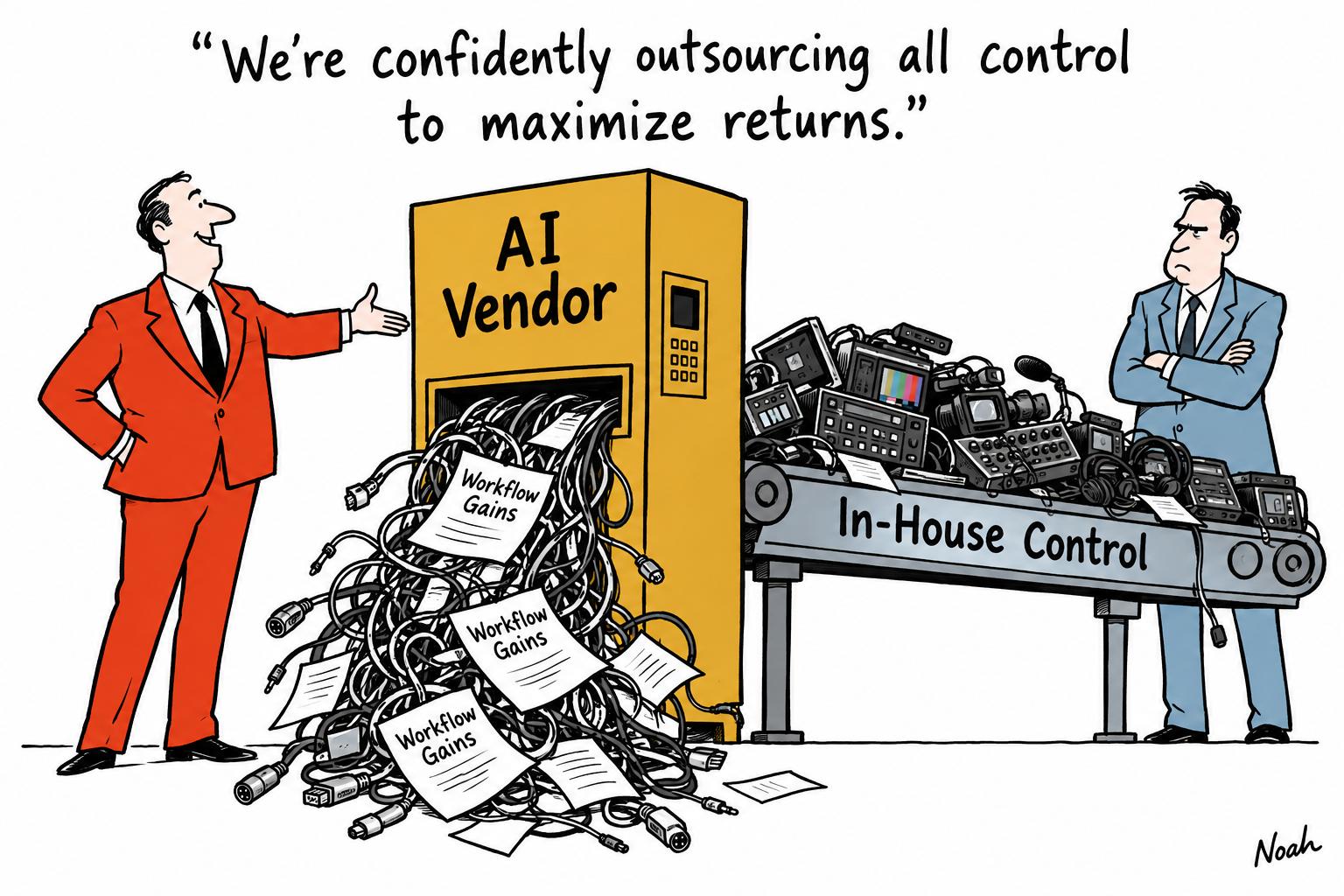
Cartoon · AI-generated
TV station groups are shifting the AI debate from adoption to execution, weighing in-house control against vendor expertise while targeting measurable gains in workflows, content and advertising.
At TVNewsCheck’s Local TV Strategies conference in New York on 21 October, six executives from station groups and media technology companies described a broadcast sector that has moved well beyond debating whether artificial intelligence belongs in the business. The question now is where it can produce measurable gains, where outside vendors make more sense and where broadcasters should keep ownership of core tools. The discussion reflected a wider industry mood seen throughout the 2025 NAB Show, where AI shifted from a speculative theme to a practical one, with broadcasters increasingly focused on workflow automation, content integrity and revenue applications.
For Circle City Broadcasting, the priority is preserving editorial trust while using AI to remove repetitive work. Nelson Spade, general manager of Circulus Digital Media, said the company has no appetite for ceding control of systems that touch its audience or advertisers. Instead, the group looks for routine tasks that can be standardised and sped up, particularly those that consume staff time several times a day. He said AI training begins when employees join the organisation, underlining the idea that adoption is becoming part of the operational culture rather than an occasional experiment.
Hearst Television’s Michael Rosellini argued that the old build-versus-buy calculation has not changed simply because AI is now available in more forms. In his view, broadcasters may feel tempted to create everything in-house, especially when modern coding tools make development look faster and easier, but that instinct still needs to be tested against the realities of maintenance, support and scale. Hearst has also shown in other workflow projects that standardisation matters as much as innovation: the company has rolled out Florical ingest and media asset management tools across its 35-station group to make content handling more consistent and reduce errors before material reaches the air chain.
That same emphasis on practical return ran through the rest of the panel. Fox Television Stations’ Erik Smith said the company favours building where it can control the environment and tailor solutions to its own stations, but he stressed that long-term support is the harder part. Christina Hartman of E.W. Scripps said her company tends to buy commodity tools when the market has already solved the problem, arguing that the true cost of building becomes clear only after launch, when systems need to be maintained and improved for users. Lindsay Stewart, founder and chief executive of Genna, said the strongest case for buying comes when a broadcaster wants access to the accumulated experience of multiple customers rather than a one-off bespoke product.
The discussion also pointed to the parts of the broadcast stack where AI is already generating commercial benefit. Hearst has used AI with Mobian to re-examine brand-safety classification and recover inventory that keyword-based filters had unnecessarily pushed into lower monetisation buckets. Circle City said its team is using AI to draft web articles from iNews material, with 70 per cent of staff using an AI tool at least three times a week and web output up 14 per cent in one recent month. The Weather Company said its new Weather Story Assist product halves research time for meteorologists, while Genna said clients are producing thousands of videos a month with a single resource. Those use cases fit a broader advertising trend too: DirecTV Advertising has recently launched an AI-powered connected TV platform for political campaigns, a sign that broadcasters and distributors are also applying machine learning to audience targeting and ad sales.
Even with that momentum, the panel was adamant that AI remains tightly governed in newsroom and audience-facing use. Hartman said Scripps discloses AI when it is used in material that directly interfaces with viewers, but not when it is confined to internal process work such as metadata or headlines. Stewart said broadcasters working with Genna typically have an AI governance board, while the Weather Company said meteorologists review story ideas before publication. The common thread was clear: broadcasters are no longer asking whether to use AI, but how to control it, where to trust it and how to make sure it saves more than it costs.
Inspired by headline at: [1]
Sources by paragraph: - Paragraph 1: [2], [3] - Paragraph 2: [1] - Paragraph 3: [1], [4] - Paragraph 4: [1], [4], [5] - Paragraph 5: [1]
Source: Noah Wire Services · Original