APEC press centre AI gives journalists access to a newsroom, not just a chatbot
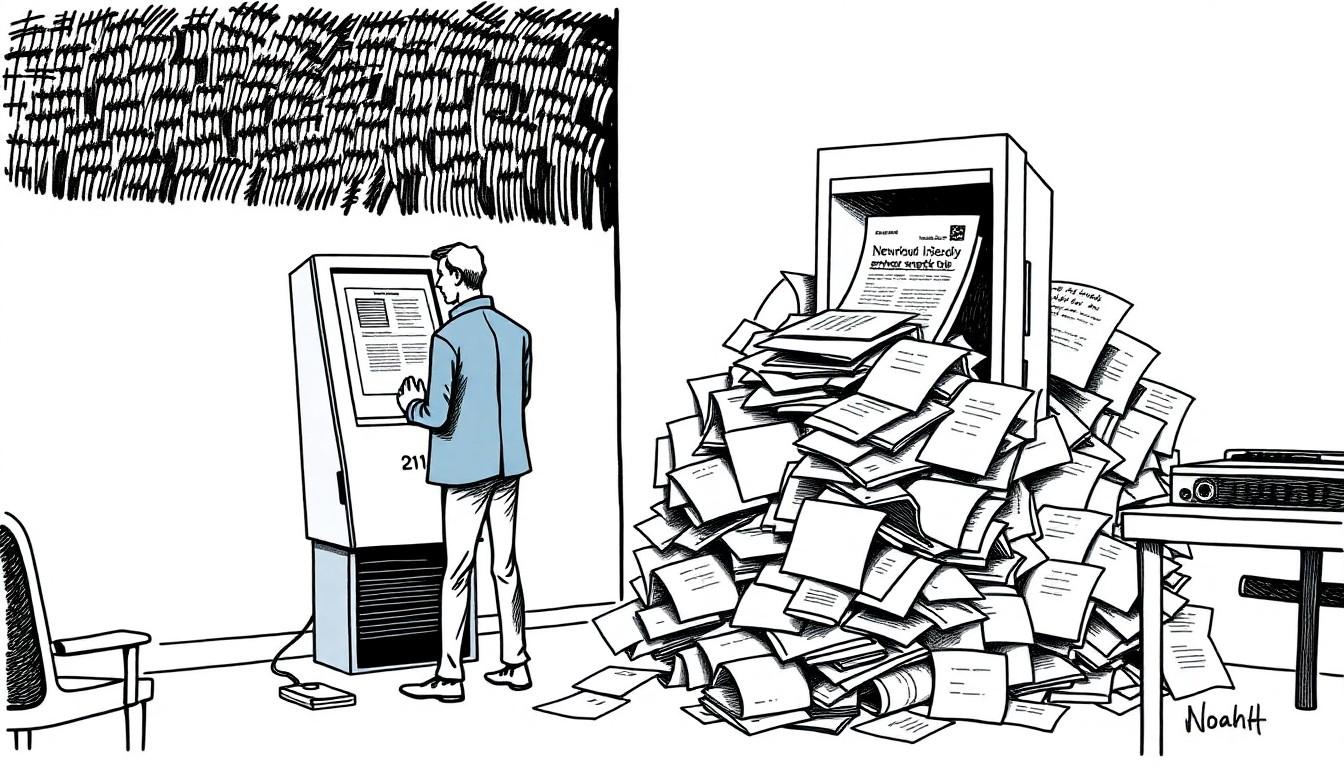
Cartoon · AI-generated
At the 2026 APEC Leaders’ Meeting, MediaBuddy links AI tools to authorised media archives and production workflows , capabilities that general-purpose services do not necessarily provide.
At the 2026 APEC Leaders’ Meeting Week press centre in Shenzhen, artificial intelligence is being used to help journalists retrieve material, produce reports and prepare content for audiences speaking different languages. The technology is not necessarily beyond the reach of the public. The sharper divide is between general-purpose tools that can generate content and a newsroom service connected to authorised media resources and built around professional reporting tasks.
The press centre opened on 11 November in Hall 2 of the Shenzhen Convention and Exhibition Centre in Futian. Xinhua reported that the 15,000-square-metre facility was expected to support nearly 5,000 Chinese and international journalists, with work areas, technical services, press briefings and broadcast signals among the facilities on offer. The leaders’ meeting is scheduled for 18 and 19 November in Shenzhen.
An AI reporting agent called MediaBuddy is among the services available to registered media organisations. People’s Daily Online reported that the press-centre website, which began operating on 8 November, incorporated the system, developed by Tencent and Shenzhen Radio, Film and Television Group. Journalists can use natural-language prompts to search for official APEC material and move through content production and multilingual delivery within a single interface.
MediaBuddy is built on Tencent’s WorkBuddy Enterprise platform, according to a People’s Daily Online report on the companies’ collaboration. That same report describes a workflow spanning planning, writing, editing and multilingual delivery, alongside access to official material for registered media. The distinction matters: a shared technological foundation does not mean public users receive the same permissions, resources or publishing processes as journalists working through the press-centre service.
Some of the production capabilities are also being demonstrated in a broader media setting. China News Service reported that MediaBuddy can search media resources, transcribe and translate content, and assist with preliminary video editing. A Tencent Cloud representative said the system draws on Shenzhen Radio and Television Group’s archive, enabling journalists to search audio-visual material by keyword and assemble a draft editing timeline from footage. The report also described a smart studio integrating cameras, lighting and switching equipment, with AI agents helping to manage production.
A separate APEC-focused agent illustrates the value of carefully selected source material. Guangdong University of Foreign Studies says AI Paike was developed with Guangdong Radio and Television using structured content from the “Understanding APEC” book series. The collection covers the organisation’s development and co-operation, as well as its member and observer economies. Rather than relying solely on open-web results, the project makes a curated body of reference material searchable and reusable.
For everyday users, Tencent presents WorkBuddy as an AI workbench for office, software and creative tasks. Its product information lists text, image, table, code and video capabilities, along with tools for handling documents and carrying out multi-step tasks. These are the kinds of general functions that can support drafting and content creation, but Tencent’s product page does not establish that public users can access APEC’s official media archive, rights-cleared material or the newsroom’s integrated production arrangements.
Professional use also involves more than generating a draft. The journalist training initiative described by People’s Daily Online includes organising background information, structuring interviews, comparing sources and basic fact-checking. Those tasks underline the continuing need for editorial judgement: an AI system may help prepare material, but journalists still need to assess its accuracy, permissions and suitability for publication.
The press-centre model therefore points to a practical distinction rather than a simple contest between sophisticated and ordinary AI. General tools can help users write, translate and create; specialist newsroom systems add controlled access to institutional material and connect generation to established production processes. Whether such capabilities become more widely available will depend not only on the tools themselves, but also on access to trustworthy sources, rights and the workflows needed to turn generated content into publishable journalism.
Inspired by headline at: [1]
Sources by paragraph: - Paragraph 1: [3], [7] - Paragraph 2: [2] - Paragraph 3: [3] - Paragraph 4: [4] - Paragraph 5: [5] - Paragraph 6: [6] - Paragraph 7: [7] - Paragraph 8: [4] - Paragraph 9: [3], [4], [7]
Source: Noah Wire Services · Original